Showing posts with label economics. Show all posts

Wednesday, November 18, 2009

JCPenney to stop publishing 'big book' catalogs

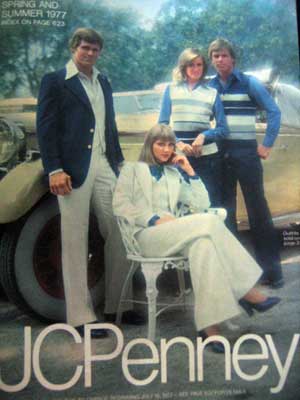
PLANO, Texas (AP) — J.C. Penney will stop publishing its twice-yearly "big book" catalogs, now that customers increasingly shop online.

Instead, J.C. Penney Co. says it will publish specialty catalogs and focus its efforts online, on the Web site jcp.com and on social networks. In part, the company says it is responding to consumer habits to view catalogs more as "look books."

The Plano, Texas, company will continue to publish its Christmas catalog and others, such as the "Little Red Book" for women's apparel and "Matters of Style" for men.

Eliminating the hefty twice-a-year catalogs will cut the company's paper use by 25 percent to 30 percent in 2010.

Sunday, November 08, 2009

on the closing of Waldenbooks and B. Dalton Bookseller

One of the joys of my childhood was going to Tanglewood Mall on a Saturday afternoon and checking out what was new at Waldenbooks and B. Dalton Bookseller. It’s hard to remember in a post-superstore and internet world how good these stores were, but they actually were decent stores with good selections in their heyday. They were at least as good as a typical Barnes & Noble and Borders, just smaller and lacking the chairs and coffee.

IMO what killed them was the shifting of corporate focus by their parent companies. After Barnes & Noble and Borders took of in the ’90s, both B. Dalton and Waldenbooks became de-facto outlets for their corporate families and started filling the fronts of their stores with worthless bargain book sections: poorly conceived clearance aisles filled with low quality books that should never have been published in the first place. The over-abundance of loss leaders shrunk the traditional book selections to a shadow of their former selves and ruined the two chains’ reputations as sources for quality books.

Even though Barnes & Noble corporate eventually saw the light and integrated the Barnes & Noble search and order capabilities into their B.Dalton mall stores, Borders corporate steadfastly refused to bring Waldenbooks in line with Borders search and order capabilities until Waldenbooks got so small they couldn’t support their own system.

It doesn’t take a retail genius to figure out that the companies were de-emphasizing the mall stores in favor of a larger, more profitable format and that the reduced selection of a modern Waldenbooks and B.Dalton would eventually make they easy to dispose of if the mall business never recovered (and it hasn’t so far).

It’s sad to think of how many small and medium sized cities will now have no new general-interest bookstore thanks to B. Dalton and Waldenbooks’ closures. Danville, Va. and Bluefield, W.Va. immediately come to mind: somewhat isolated cities that don’t have enough college-educated customers to be considered for a book superstore but yet have enough population to support one. Cities like these will be solely at the mercy of Walmart and the like, which only stock books they figure will sell to a mainstream audience and little else.

This is an embarrassing and depressing situation. Why should people in typically sized American cites have to travel 60 miles or more just to buy a non-New York Times bestseller book in person? I just hope that a company like Books-A-Million will step up and bring some essential choice and selection back to these towns.

Monday, June 02, 2008

Newbury Street icon Louis seeks someplace trendier

Louis Boston, a fixture on Newbury Street (in Boston) that helped usher luxury retail into the city, will move out of its historic building when its lease expires in 2010, opening up the marquee 40,000 square foot space for the first time in 20 years. (more)

Wednesday, January 16, 2008

Nike set to release 23rd Air Jordan

BEAVERTON, Ore. (AP) -- It's gotta be the shoes, right?

No other basketball shoe has changed the face of business, athletics and marketing like the Air Jordan. This month, Nike releases the 23rd edition, and it is expected to be just as venerated as its predecessors.

The sleek design and link to Michael Jordan's jersey number make it a touchstone in the line. It's also Nike's first basketball shoe designed under its "Considered" ethos, which aims to reduce waste and use environmentally friendly materials wherever possible.

The Air Jordan XX3 will be released in three hyped-up rounds from January to February, starting with a limited edition to be sent to only 23 retailers to be sold for $230 and concluding with the national launch at $185.

There had been talk at Nike about retiring the shoe at No. 23, because of his iconic jersey number. But company officials won't say whether this will be the last of the line. Neither will Jordan.

"You'll just have to wait and see," Jordan said in an e-mail to The Associated Press, responding to questions about the upcoming release.

Before launching the first shoe in 1985, Nike had just signed Jordan for $2.5 million over five years. Nike won't say what Jordan's current contract with the company is worth.

Jordan's deal with Nike opened the door for sneaker manufacturers to chase after athletes, signing them up --sometimes just out of high school-- for multimillion-dollar contracts in hopes of being able to cash in on the next superstar. It sent sneaker prices to new heights, which has since generated a backlash against selling pricey shoes to basketball-loving kids.

"The Air Jordan franchise created the most coveted basketball footwear in the world and changed the basketball landscape forever," said Nike Brand President Charlie Denson.

Unlike most basketball shoes to date, which were often white and utilitarian, the Air Jordan was a shock of black and red. It was initially banned by the NBA for not conforming with other players' shoes.

Jordan continued to wear them and was fined $5,000 a game, which Nike paid.

"Nobody expected the mass hysteria created by its release," Jordan, who has been a part-owner of the Charlotte Bobcats since 2006, said in his e-mail to The AP.

A new edition was launched each year, and release dates had to be moved to the weekends to keep kids from skipping school to get a pair.

The frenzy got dangerous. People were mugged and even killed for the shoes.

The Air Jordans helped spawn a subculture of collectors, who line up at stores to buy the shoe's latest edition.

Jordan said he never expected that the shoe would become an icon.

"Like every kid growing up, I dreamed of making winning shots at the buzzer and I was fortunate to live out that dream, but never in my wildest dreams did I ever entertain the idea of the success of the Air Jordan franchise," he said.

The Air Jordans moved basketball shoes from true high-tops or low-tops to a middle range and used unheard of styles, such as patent leather toes and elephant print.

As Jordan's success grew on the courts, so did Nike's in the shoe industry.

People from the streets to the suburbs were wearing $100-plus basketball shoes, which was unheard of at the time.

That price is the norm today, but it has launched a backlash, such as the partnership between New York Knicks player Stephon Marbury and the Steve & Barry's store chain to sell basketball shoes for $14.98 -- a direct stab at pricey sneakers like Air Jordans.

At that time, the Air Jordan captured a mix of design, marketing, athleticism and player charisma that hadn't been seen before in the industry -- everyone wanted to "Be Like Mike."

"Athletes had been endorsing products for years prior to this," said Tinker Hatfield, Nike's Vice President of Innovation Design and Special Projects.

"But they were just signing their name to the shoe. I think there was a very understandable difference...Michael's personality and even the changes in the game and inspiration from other walks of life were all sort of being designed into this product and that made it more interesting."

Jordan and Hatfield work together on the design and function on many of the Air Jordan shoes. Jordan has final say on design matters.

Air Jordan was the lightning in the bottle that every company hopes for.

Advertising images of Jordan soaring across the sky were ubiquitous. Spike Lee could be heard hollering "It's gotta be the shoes" on television. And Jordan's outstretched arms with the swoosh nearby adorned walls across the country.

Nike quickly moved from a running company and newcomer to the basketball category to the market leader. Some industry estimates put Nike's current share of the basketball shoe market at about 85 percent. Far behind are Adidas and Reebok.

The idea of adding such unusual style to a product or so closely aligning with a personality was novel at the time, but it paid off.

Other companies tried to follow suit but it was like trying to come up with the next Harry Potter or iPhone for basketball.

The relationship completely changed the idea of sports marketing. Companies now make athlete sponsorships the centerpiece of their business, spending millions signing them and designing product lines and marketing platforms around them.

Jordan's original deal seems like a pittance compared to multimillion-dollar contracts inked these days, such as Nike's $90 million agreement with LeBron James.

"The beginning of the Jordan era marked a new and more sophisticated approach to leveraging an athlete," said Paul Swangard, managing director of the Warsaw Sports Marketing Center at the University of Oregon.

Like any bet, athletic companies take their risks -- some pay off, like Tiger Woods or LeBron James. But some don't, a la Michael Vick. Nike terminated its contract with Vick last August after his plea agreement on dogfighting charges.

Jordan was spun off into its own division in 1997, a move that some high up in Nike questioned when Jordan retired.

But the business is a key component, with new players signing on under the brand. Nike has spun that Jordan swagger into performance and luxury apparel for men and woman.

The Air Jordan remains the pinnacle piece for shoe collectors. The original Air Jordan 1 can sell for thousands of dollars, depending on various factors.

Jordan said: "It blows my mind that even after five years removed from the game the shoe would be stronger than ever and I would still be greeted by fans as if I had just won a championship all over again."
Tuesday, June 12, 2007

way to shop?

Macy's regional buying strategy is criticized

By SUZANNE KAPNERF
The New York Post

Even as Macy's spends millions of dollars to create a national brand through advertising and store renovations, behind the scenes the company still operates through seven regional buying offices, a system that analysts have panned as outdated and costly.

Macy's argues that its regional divisions allow it to better tailor merchandise for different stores, ensuring that marquee locations such as Macy's Herald Square carry more upscale items than do stores in less affluent neighborhoods.

But analysts point out that Macy's is one of the few large retailers to still rely on regional buying offices. J.C. Penney, Kohl's and Nordstrom are among those that have switched to central systems, yet manage to pepper stores with local flavor, these people said.

As Macy's sales continue to lag expectations, the company's cost structure is increasingly becoming a topic of conversation. This is especially true as savings from its merger with the May Department Stores Co. start to run their course.

"Macy's cost structure is too high, and, as a result, their prices are too high," said Robert Buchanan of A. G. Edwards. "That is a key reason why they are likely to lose market share."

Buchanan estimates that Macy's could save $100 million a year by eliminating all but two of its buying offices. He favors the retention of regional merchandise managers to ensure that products are tailored to individual stores.

Such a move would help bring Macy's expenses in line with competitors. According to Buchanan, Macy's expense-to- sales ratio is 32 percent compared with 27 percent for Nordstrom and 25 percent for both J.C. Penney and Kohl's.

Macy's has tried centralized buying in its home department with disastrous results, making it less likely the company would move quickly to streamline other divisions, observers said.

The move to central buying for bedding, furniture and other items for the home pre-dated Macy's, then known as Federated Department Stores, 2005 merger with the May Co.

Logistical problems with warehouse and distribution centers overwhelmed the Macy's team. Then the housing slump kicked in, further hurting sales of home goods, which have been among the company's weakest performers.

The pressure to cut costs by centralizing operations comes as Macy's finds it increasingly difficult to integrate the roughly 400 stores it acquired from the May Co.

Macy's is adding more promotions and adjusting merchandise through a seven-box grid. Prices range from good, better, best. Styles are lumped into four groups with traditional being the most conservative and fashion the most trendy.

Tinkering with the merchandise only works if consumers perceive products sold at Macy's to be of comparable or better value to what competitors are offering, analysts said.

For instance, towels sold at Macy's under its private label Charter Club brand for $16 stack up poorly against Target's Fieldcrest towels, which regularly go for $11.99, said Robert Passikoff of Brand Keys.

Monday, October 23, 2006

Newest chef's surprise is the $40 entree

NEW YORK, Oct. 21 (UPI) -- The $40 entree becoming more common at U.S. restaurants and is being applied not just to surf-and-turf extravaganzas.

The New York Times noted Saturday that even fish and pasta dishes are topping the $40 barrier in places like Denver and Fort Lauderdale, not just in upscale eateries in Manhattan or Las Vegas.

Diners told The Times that seeing a $40 price on the menu makes them think the dish must be out-of-this-world tasty, or it is simply overpriced.

Nevertheless, restaurant owners say the higher prices reflect the cost of prime ingredients and the developing trend of customers spending more time on their meals, meaning they can turn their tables fewer times in an evening.