Showing posts with label history. Show all posts

Monday, December 28, 2009

Acres of memories

Sam Witcher can look back on eight decades of growing tobacco in Franklin County.

By Ruth L. Tisdale | ruth.tisdale@roanoke.com | 981-3149
Sunday, October 07, 2007


SNOW CREEK, Va. -- Rip. Snap.

The sounds of tobacco leaves being ripped from a stalk have defined 88-year-old Sam Witcher.

He heard it growing up in the Snow Creek area of southeast Franklin County in the 1930s while his mother washed clothes for others.

He made the sounds when as a 15-year-old boy he pulled the leaves from the plants as a sharecropper to put food on the table for his family.

The sounds grew louder as he bought more and more farmland in Franklin County and Henry County until he owned nearly 1,000 acres.

But although others have sold farms to developers to pay for a better life, Witcher has kept all of the land for himself and his family.

"I didn't want to sell the land," said Witcher, standing outside his home on a 90-degree August afternoon. "I figured my children or their children would make use of it one day."

Humble beginnings

Higher education was not an option for Witcher growing up in the 1930s.

With state-sanctioned racial segregation at an all-time high in rural Virginia, Witcher said his only option was the tobacco fields.

"The buses weren't coming around back then to pick up blacks," Witcher said. "You had to walk five or 10 miles just to get on the bus. We couldn't go to school like the whites."

But segregation wasn't the only motivation for Witcher to pull tobacco.

Torn apart from his brothers and sisters after his mother lost her job, Witcher was forced to be the man of the house at age 14 and dropped out of school in the seventh grade.

"We stayed with relatives for a while," Witcher said. "Times were hard back then. We just did what everyone else did. We pulled tobacco."

Pulling tobacco as a black sharecropper didn't bring in as much income as it did for Witcher's white counterparts, however.

Witcher said he made just 10 cents a day pulling tobacco, making it nearly impossible to buy land of his own.

"They made the quota higher for us than they did the whites," he said. "You had to plant other things just to survive."

Buying land

But Witcher's fortunes began to change in the 1960s. He was able to buy his own land when more and more farmers gave it up for more lucrative jobs in manufacturing plants in Danville and Martinsville.

"There was a time when everyone grew a little bit of tobacco on their land to keep ahead," he said. "But when the manufacturing jobs started coming in, they started moving off their farms and they were selling the land at cheap prices, so I bought it."

Witcher's other endeavors also increased his land holdings.

In addition to growing tobacco, Witcher had a dairy farm, and raised beef cattle. He also grew hay.

Witcher said his late wife, Elsie Warren Witcher, who was a minister at two churches in the area, kept track of all of the expenses of the household as well as the expenses of the business.

"She knew where everything was," he said. "She kept everything going."

Family affair

As his farms grew, Witcher began using his 11 children to help pull tobacco.

"We just had 10 acres at first," he said. "That was good back then. But we would get the girls out there to pull the tobacco, and when the boys got old enough, they would pull it."

Darlene Swain, one of Witcher's daughters, said she remembers pulling tobacco in the morning before going to school and again after coming home.

"There were six girls before there were any boys," Swain said. "Daddy used to always joke that he wouldn't have any boys to help him. We girls were happy when he finally got his boys."

Out of Witcher's four sons, three have continued on in the family tradition, with all three owning more than 400 acres of land each in Franklin County. None of his seven daughters has gone into farming.

Elvis Witcher, one of Sam Witcher's youngest sons, has taken over much of the land that his father used to farm in addition to the nearly 400 acres he owns.

With work boots covered with red Virginia soil and sweat pouring from his brow from bending low to rip tobacco leaves from their stalk, Elvis Witcher said his father's land still produces more than 450,000 pounds of flue-cured tobacco a year.

Witcher said the amount of work to be done to his father's land is so much that they have to hire 20 men to help with the planting and the harvest, which ends in early November.

"We have had only one year where we didn't have a crop, and that was in 2003, when there was a flood," Witcher said.

Witcher said the family hasn't had to take out any loans for machinery and didn't take a buyout from the government. In 2004 the federal government offered such buyouts as part of the end of the federal tobacco-quota program, which regulated where tobacco could be grown and the prices for which it could be sold.

"We've been lucky," Witcher said.

A dying breed

The Witcher family success is a rarity among black farmers nationwide, said John Boyd, president of the National Black Farmers Association.

"Black tobacco farmers are becoming extinct at an alarming rate," Boyd said. "They just don't have the capital to compete in today's industry. They are losing land and are being wiped out."

At the beginning of the 1900s, black farmers owned more than 15 million acres of land; today they own fewer than 3 million, Boyd said.

The number of black farmers also has decreased by 50 percent in the past 25 years, and there is only one other black family in Franklin County that raises tobacco, Boyd said.

Blacks own just 1 percent of all farms, with the number of black-owned farms dropping from 54,367 in 1982 to 29,090 in 2002, according to documents obtained by the Environmental Working Group, a watchdog organization that documents discrimination against black farmers.

Boyd said that while 60 percent of the 11,000 tobacco members in his organization took the 2004 tobacco buyout, the rest did not know about it, and many have since sold their farms.

"Many of these people do not have telephones; some don't even have inside toilets," Boyd said. "It's hard to expect them to go on the Internet and find out this type of information."

Blake Brown, a tobacco economist, said that even those who took money from the 2004 federal buyout have had problems financially.

"It is a free market now with buying tobacco," Brown said. "Many of these small farms don't have the land or the capital to keep up with these bigger manufacturers. All of the African-American farms fall into this category."

Boyd said the disappearance of black farms has a lot to do with discrimination against black farmers.

Boyd's claims are supported by a February 1997 U.S. Department of Agriculture report that found when minority farmers applied for loans, they were mistreated and that some complaints filed about the mistreatment went missing.

"Many times black farmers get loans late if they get them at all," Boyd said. "To a farmer, not being able to start planting on time puts you behind other farmers. Black farmers won't report it, because many of the people they report it to are the ones doing the discriminating."

Boyd said for a family such as Witcher's to have long-lasting success in the farming business is an accomplishment.

"With everything that's going on, it shows a tremendous amount of dedication and strength to survive and last this long," he said.

The next generation

But Sam Witcher doesn't feel that way.

On his porch in September, Witcher stood and looked over his 200-acre homeplace.

He saw the idle tobacco barns that he used to cure tobacco and make it ready for the market.

He observed the fields that once touted rows upon rows of tobacco but are now just used to produce hay.

He remembered the day when his wife, Elsie, suddenly died of a heart attack in 2000 and the years that followed when gradually he tilled fewer and fewer of the tobacco fields on his homeplace.

With a tearful eye, Witcher said he doesn't feel like the same farmer he once was.

"I don't know why you all want to do a story on me," Witcher said. "Everything around me is dead."

But a smile and then a laugh arose from his lips when discussion came to his children and the way they care for him.

"They come by and see about me all the time," Witcher said. "I didn't want so many girls at first, but I'm glad I have them now."

Witcher said he had thought about selling his land, which has become prime real estate with the burst of growth at Smith Mountain Lake, but decided to keep it, and the sounds of tobacco harvests past and future, for his family.

"Daddy always said that he was going to keep the land so his family would always have a place to live," Swain said. "No matter how far we go, we would always have some place to call home."

Spend some time on Sam Witcher Sr.'s tobacco farm.

Sunday, December 13, 2009

Holidays on Display

The main aisle of Marshall Field & Co., Chicago, circa 1955. (National Museum of American History, Smithsonian Institution)

Holidays on Display examines the art, industry, and history of holiday display across the United States. Focusing on parading culture and department store retail display, primarily between the 1920s and 1960s, when holiday displays were considered commercial endeavors equally rewarding for the American public, the exhibition showcases numerous photographs, postcards and rendering illustration of parade floats and window displays—including the Macy’s Thanksgiving Day parade and Marshall Field & Company Christmas windows—as well as objects relating to the early creation of these displays.

“Holidays on Display” will be on view at the National Museum of American History through November 2010

Link to Smithsonian Institution
Online Exhibition
Press Realease
Asked and Answered | Holidays on Display

Sunday, November 08, 2009

on the closing of Waldenbooks and B. Dalton Bookseller

One of the joys of my childhood was going to Tanglewood Mall on a Saturday afternoon and checking out what was new at Waldenbooks and B. Dalton Bookseller. It’s hard to remember in a post-superstore and internet world how good these stores were, but they actually were decent stores with good selections in their heyday. They were at least as good as a typical Barnes & Noble and Borders, just smaller and lacking the chairs and coffee.

IMO what killed them was the shifting of corporate focus by their parent companies. After Barnes & Noble and Borders took of in the ’90s, both B. Dalton and Waldenbooks became de-facto outlets for their corporate families and started filling the fronts of their stores with worthless bargain book sections: poorly conceived clearance aisles filled with low quality books that should never have been published in the first place. The over-abundance of loss leaders shrunk the traditional book selections to a shadow of their former selves and ruined the two chains’ reputations as sources for quality books.

Even though Barnes & Noble corporate eventually saw the light and integrated the Barnes & Noble search and order capabilities into their B.Dalton mall stores, Borders corporate steadfastly refused to bring Waldenbooks in line with Borders search and order capabilities until Waldenbooks got so small they couldn’t support their own system.

It doesn’t take a retail genius to figure out that the companies were de-emphasizing the mall stores in favor of a larger, more profitable format and that the reduced selection of a modern Waldenbooks and B.Dalton would eventually make they easy to dispose of if the mall business never recovered (and it hasn’t so far).

It’s sad to think of how many small and medium sized cities will now have no new general-interest bookstore thanks to B. Dalton and Waldenbooks’ closures. Danville, Va. and Bluefield, W.Va. immediately come to mind: somewhat isolated cities that don’t have enough college-educated customers to be considered for a book superstore but yet have enough population to support one. Cities like these will be solely at the mercy of Walmart and the like, which only stock books they figure will sell to a mainstream audience and little else.

This is an embarrassing and depressing situation. Why should people in typically sized American cites have to travel 60 miles or more just to buy a non-New York Times bestseller book in person? I just hope that a company like Books-A-Million will step up and bring some essential choice and selection back to these towns.

Saturday, August 22, 2009

top 15 modernist gas stations

Some of America’s best Mid Century Modern architecture is in the form of gas stations, with their simple space requirements and focus on innovative roofs.

Check out this link to pictures of the top 15 modernist gas stations. You can even vote on your favorite one.

Shared via AddThis

Sunday, June 21, 2009

A Prefab House That Dazzles Still

By ALICE RAWSTHORN
Published: June 15, 2009

The Eames House in southwestern California, which turns 60 this month, remains a model of economy and creativity. (more)

Wednesday, May 20, 2009

Malls of America: R.I.P.

As of today, the much appreciated Malls of America blog has been removed from Blogger. Keith Milford's work over the past several years chronicling the history of retail was legendary and remarkably thorough. The commentary was always informative and fun, and the photo quality was consistently good.

Malls of America was around for a couple of years before new posts came to an abrupt, unexplained end about a year and a half ago, but it served as the inspiration for at least a half-dozen blogs and websites. I was a supporter to the end, and I kept going back to the site for a while hoping to see new posts. Alas, it was not to be.

If you've never seen the site, check out the archived version before it's too late.

Saturday, January 10, 2009

Reviving the memory of his beloved Carolina Circle Mall

Frequent LiveMalls contributor Billy Coore collects memorabilia from the former Carolina Circle Mall. (Greensboro News & Record photo by Neslon Kepley)

The love affair began at a young age, with the cheery music and constant spin of the merry-go-round.

The emotion only grew stronger over time, with trips to the food court, strolls through store aisles and afternoons at the movies.

Even when others fell out of love with Carolina Circle Mall, taking their business and money elsewhere, Billy Coore's devotion remained...

Read more of Lanita Wither's story on Billy Coore at the News & Record website.

Monday, June 23, 2008

Appreciation: Carlin, from straight comic to icon

By JOHN ROGERS

LOS ANGELES (AP) — When he shucked the coat and tie for black T-shirts and jeans, grew his hair long and began to riff about those "Seven Words You Can Never Say on TV," George Carlin became more than just the countercultural comedian.

Carlin, who died Sunday of heart failure at 71, took comedy itself in a whole new direction.

No longer were nightclubs the territory of guys in suits telling harmless mother-in-law jokes.

"He was more than just a comic. His routines became part of the American lexicon," fellow comedian Paul Rodriguez told The Associated Press on Monday. "They came to say a lot about America and its times."

Indeed, when Muhammad Ali was stripped of his world heavyweight boxing championship for refusing induction into the U.S. military, Carlin noted that Ali, who made his living beating people up, had refused service because he opposed the Vietnam War.

"He said, 'No, that's where I draw the line. I'll beat 'em up. But I don't want to kill 'em.' And the government said, 'Well, if you won't kill people, we won't let you beat 'em up.'"

Arguably his most famous routine, though, was simply called "Seven Words."

More than just an outpouring of obscenities, it was — as almost all Carlin routines were — a clever play on the sound and meaning of almost every word Carlin used.

One word in the routine, for example (not one of the offending seven) was what he called "a two-way word," explaining: "You can prick your finger. But don't ... "

"Some people think the routines were all about saying dirty words, but it wasn't about that at all," says Jamie Masada, who as owner of the Laugh Factory comedy clubs knew Carlin for more than 20 years.

"He had a different motivation," Masada continued, "and the motivation was free speech. George believed when he was on stage that was like being in his church and he could say anything he wanted there."

It's only appropriate, then, that Carlin's name is attached to a key U.S. Supreme Court free-speech ruling, albeit one limiting the right.

The 1978 decision, the result of a radio station playing "Seven Words," upheld the government's authority to issue sanctions for broadcasting offensive language during hours when children might be listening.

"So my name is a footnote in American legal history, which I'm perversely kind of proud of," Carlin told the AP earlier this year.

Other than that, he said at the time, he had very little interest in public affairs. He claimed to have not voted in a presidential election in decades.

"I was always out of step," he said. "I left school in ninth grade, I got kicked out of the Air Force, I got kicked out of the choir and the altar boys and summer camp and three schools and I was a pot smoker when I was 13 in the early '50s. I was always a lawbreaker and a kind of outlaw rebel."

One thing he was good at, though, was doing funny voices and making funny faces like his boyhood idol, Danny Kaye.

"When I was 10, 11, I was watching MGM movies with Danny Kaye," he said. "I kind of looked at that and thought, `Gee, I can do that.'"

After a brief pairing with comedian Jack Burns, with whom he would remain friends the rest of his life, Carlin went out on his own in 1962, inspired, Burns said Monday, by a Lenny Bruce show the two saw in Chicago in 1961.

By the end of the 1960s, Carlin had grown his hair long, added a beard that he joked covered his acne and began to embrace the countercultural ethos of the time.

"I finally did the right thing, which was to get in touch with my own real voice, and that made me happy for the first time," he once said.

From there, he would go on to record 23 comedy albums, win four Grammys, do 14 TV specials for HBO, write three best-selling books and appear in several movies. Just last week it was announced that Carlin was being awarded the 11th annual Mark Twain Prize for American Humor.

"None of that would have happened if I had remained imprisoned in a suit," Carlin said.

As his humor became more observational, nothing was off-limits, from politics to sports to religion, with war and other atrocities frequent targets.

"The very existence of flame-throwers," he once joked, "proves that some time, somewhere, someone said to themselves, `You know, I want to set those people over there on fire, I'm just not close enough to get the job done.'"

At the same time, his humor could be gentle when the moment called for it.

He appeared as Mr. Conductor on the children's show "Shining Time Station" in the 1990s and was the voice of Fillmore, the hippie van, in the popular 2006 children's movie "Cars."

From a nightclub stage, however, his humor could always be expected to be scatological. And although his penchant for funny voices and faces might soften it some, it could still be in your face as he ridiculed God, joked about televising suicides and did things like simply ending a routine with a recitation of every synonym for penis.

"He made us look at things, look at ourselves. You won't find too many comics with the kind of chops to do that," said fellow comedian Tommy Chong. "You're only allowed to do that when you've paid your dues."

And indeed Carlin had. Early in their careers, Burns recalled, the two were so broke they shared a one-room apartment with a pullout bed.

"Two guys lying next to each other for three months. You can bet we made jokes about that," he laughed.

Carlin went on to develop a serious cocaine addiction, and as recently as 2004 he entered rehab to break what he called a dependency on vicodan and wine.

Despite those struggles, Carlin, who suffered the first of several heart attacks when he was only 41, said the coronary artery disease that finally killed him was the result not of drugs but of genetics.

"My father gave me this disease," he told the AP in 2007. "But he also gave me my gift of gab, my sense of humor. So what the ... . It was a good trade-off."

Monday, June 02, 2008

Newbury Street icon Louis seeks someplace trendier

Louis Boston, a fixture on Newbury Street (in Boston) that helped usher luxury retail into the city, will move out of its historic building when its lease expires in 2010, opening up the marquee 40,000 square foot space for the first time in 20 years. (more)

Sunday, June 01, 2008

Legendary designer Yves Saint Laurent dies at 71

By ELAINE GANLEY

PARIS (AP) — Legendary designer Yves Saint Laurent, who reworked the rules of fashion by putting women into elegant pantsuits that came to define how modern women dressed, died Sunday evening, a longtime friend and associate said. He was 71.

Pierre Berge said Saint Laurent died at his Paris home following a long illness.

A towering figure of 20th century fashion, Saint Laurent was widely considered the last of a generation that included Christian Dior and Coco Chanel and made Paris the fashion capital of the world, with the Rive Gauche, or Left Bank, as its elegant headquarters.

In the fast-changing world of haute couture, Saint Laurent was hailed as the most influential and enduring designer of his time. From the first YSL tuxedo and his trim pantsuits to see-through blouses, safari jackets and glamorous gowns, Saint Laurent created instant classics that remain stylish decades later.

When the designer announced his retirement in 2002 at age 65 and the closure of the Paris-based haute couture house he had founded 40 years earlier, it was mourned in the fashion world as the end of an era. His ready-to-wear label, Rive Gauche, which was sold to Gucci in 1999, still has boutiques around the world.

In October 2006, Saint Laurent slipped and fell outside a Paris restaurant during Fashion Week, suffering slight scratches but reminding fans of the perennially fragile designer's advancing age.

Saint Laurent was born Aug. 1, 1936, in Oran, Algeria, where his father worked as a shipping executive. He first emerged as a promising designer at the age of 17, winning first prize in a contest sponsored by the International Wool Secretariat for a cocktail dress design.

A year later in 1954, he enrolled at the Chambre Syndicale school of haute couture, but student life lasted only three months. He was introduced to Christian Dior, then regarded as the greatest creator of his day, and Dior was so impressed with Saint Laurent's talent that he hired him on the spot.

When Dior died suddenly in 1957, Saint Laurent was named head of the House of Dior at the age of 21. The next year, his first solo collection for Dior — the "trapeze" line — launched Saint Laurent's stardom. The trapeze dress — with its narrow shoulders and wide, swinging skirt — was a hit, and a breath of fresh air after years of constructed clothing, tight waists and girdles.

In 1960, Saint Laurent was drafted into military service — an experience that shattered the delicate designer, who by the end of the year was given a medical discharge for nervous depression.

Bouts of depression marked his career. Berge, the designer's longtime business partner and former romantic partner, was quoted as saying that Saint Laurent was born with a nervous breakdown.

Saint Laurent returned to the spotlight in 1962, opening his own haute couture fashion house with Berge. The pair later started a chain of Rive Gauche ready-to-wear boutiques.

Life Magazine hailed his first line under his own label as "the best collection of suits since Chanel."

Berge has said that Saint Laurent's gift to fashion was that he empowered women after Chanel had freed them.

Nowhere was Saint Laurent's gift more evident than the valedictory fashion show that marked his retirement in January 2002.

Forty years of fashion were paraded in a 300-piece retrospective that blurred the boundaries of time, mixing his creations of yesterday and today in one stunning tribute to the endurance of Saint Laurent's style. He also designed costumes for theater and film.

There was the simple navy blue pea coat over white pants, which the designer first showed in 1962 when he opened his couture house and kept as one of his hallmarks.

His "smoking," or tuxedo jacket, of 1966 remade the tux as a high fashion statement for both sexes. It remained the designer's trademark item and was updated yearly until he retired.

Also from the 60s came Beatnik chic — a black leather jacket and knit turtleneck with high boots — and sleek pantsuits that underlined Saint Laurent's statement on equality of the sexes. He showed that women could wear "men's clothes," which when tailored to the female form became an emblem of elegant femininity.

"More than any other designer since Chanel, YSL represented Paris as the style leader," The Independent of London wrote in an editorial after Saint Laurent's retirement. "By putting a woman in a man's tuxedo, he changed fashion forever, in a style that never dated."

In his own words, Saint Laurent said he felt "fashion was not only supposed to make women beautiful, but to reassure them, to give them confidence, to allow them to come to terms with themselves."

Some of his revolutionary style was met with resistance. There are famous stories of women wearing Saint Laurent pantsuits who were turned away from hotels and restaurants in London and New York.

One scandal centered on the designer himself, when he posed nude and floppy-haired for a photographer in 1971, wearing only his trademark thick black glasses, to promote his perfume.

Saint Laurent's rising star was eternalized in 1983, when the Metropolitan Museum of Art devoted a show to his work, the first ever to a living designer.

Subsequent shows at the Hermitage in St. Petersburg and in Beijing made him a French national treasure, and he was awarded the Legion d'Honneur in 1985.

When France basked in the glory of its 1998 World Cup soccer final, it was Saint Laurent who took center field pre-kick off with an on-field retrospective at the Stade de France.

In 1999, Saint Laurent sold the rights of his label to Gucci Group NV, ceding control of his Rive Gauche collection, fragrances, cosmetics and accessories for US$70 million cash and royalties.

Industry insiders cited friction between Saint Laurent and Gucci's creative director, Tom Ford, as a likely factor in the fashion guru's decision to retire three years later. Ford stepped down in 2003.

When he bowed out of fashion in 2002, Saint Laurent spoke of his battles with depression, drugs and loneliness, though he gave no indication that those problems were directly tied to his decision to stop working.

"I've known fear and terrible solitude," he said. "Tranquilizers and drugs, those phony friends. The prison of depression and hospitals. I've emerged from all this, dazzled but sober."

Associated Press writers Rachid Aouli and Joelle Diderich contributed to this report.

Monday, January 21, 2008

36(6), day 21 - the dream is still alive

Dedicated to the memory of the Rev. Dr. Martin Luther King, Jr. (1929-1968)

Wednesday, January 16, 2008

Nike set to release 23rd Air Jordan

BEAVERTON, Ore. (AP) -- It's gotta be the shoes, right?

No other basketball shoe has changed the face of business, athletics and marketing like the Air Jordan. This month, Nike releases the 23rd edition, and it is expected to be just as venerated as its predecessors.

The sleek design and link to Michael Jordan's jersey number make it a touchstone in the line. It's also Nike's first basketball shoe designed under its "Considered" ethos, which aims to reduce waste and use environmentally friendly materials wherever possible.

The Air Jordan XX3 will be released in three hyped-up rounds from January to February, starting with a limited edition to be sent to only 23 retailers to be sold for $230 and concluding with the national launch at $185.

There had been talk at Nike about retiring the shoe at No. 23, because of his iconic jersey number. But company officials won't say whether this will be the last of the line. Neither will Jordan.

"You'll just have to wait and see," Jordan said in an e-mail to The Associated Press, responding to questions about the upcoming release.

Before launching the first shoe in 1985, Nike had just signed Jordan for $2.5 million over five years. Nike won't say what Jordan's current contract with the company is worth.

Jordan's deal with Nike opened the door for sneaker manufacturers to chase after athletes, signing them up --sometimes just out of high school-- for multimillion-dollar contracts in hopes of being able to cash in on the next superstar. It sent sneaker prices to new heights, which has since generated a backlash against selling pricey shoes to basketball-loving kids.

"The Air Jordan franchise created the most coveted basketball footwear in the world and changed the basketball landscape forever," said Nike Brand President Charlie Denson.

Unlike most basketball shoes to date, which were often white and utilitarian, the Air Jordan was a shock of black and red. It was initially banned by the NBA for not conforming with other players' shoes.

Jordan continued to wear them and was fined $5,000 a game, which Nike paid.

"Nobody expected the mass hysteria created by its release," Jordan, who has been a part-owner of the Charlotte Bobcats since 2006, said in his e-mail to The AP.

A new edition was launched each year, and release dates had to be moved to the weekends to keep kids from skipping school to get a pair.

The frenzy got dangerous. People were mugged and even killed for the shoes.

The Air Jordans helped spawn a subculture of collectors, who line up at stores to buy the shoe's latest edition.

Jordan said he never expected that the shoe would become an icon.

"Like every kid growing up, I dreamed of making winning shots at the buzzer and I was fortunate to live out that dream, but never in my wildest dreams did I ever entertain the idea of the success of the Air Jordan franchise," he said.

The Air Jordans moved basketball shoes from true high-tops or low-tops to a middle range and used unheard of styles, such as patent leather toes and elephant print.

As Jordan's success grew on the courts, so did Nike's in the shoe industry.

People from the streets to the suburbs were wearing $100-plus basketball shoes, which was unheard of at the time.

That price is the norm today, but it has launched a backlash, such as the partnership between New York Knicks player Stephon Marbury and the Steve & Barry's store chain to sell basketball shoes for $14.98 -- a direct stab at pricey sneakers like Air Jordans.

At that time, the Air Jordan captured a mix of design, marketing, athleticism and player charisma that hadn't been seen before in the industry -- everyone wanted to "Be Like Mike."

"Athletes had been endorsing products for years prior to this," said Tinker Hatfield, Nike's Vice President of Innovation Design and Special Projects.

"But they were just signing their name to the shoe. I think there was a very understandable difference...Michael's personality and even the changes in the game and inspiration from other walks of life were all sort of being designed into this product and that made it more interesting."

Jordan and Hatfield work together on the design and function on many of the Air Jordan shoes. Jordan has final say on design matters.

Air Jordan was the lightning in the bottle that every company hopes for.

Advertising images of Jordan soaring across the sky were ubiquitous. Spike Lee could be heard hollering "It's gotta be the shoes" on television. And Jordan's outstretched arms with the swoosh nearby adorned walls across the country.

Nike quickly moved from a running company and newcomer to the basketball category to the market leader. Some industry estimates put Nike's current share of the basketball shoe market at about 85 percent. Far behind are Adidas and Reebok.

The idea of adding such unusual style to a product or so closely aligning with a personality was novel at the time, but it paid off.

Other companies tried to follow suit but it was like trying to come up with the next Harry Potter or iPhone for basketball.

The relationship completely changed the idea of sports marketing. Companies now make athlete sponsorships the centerpiece of their business, spending millions signing them and designing product lines and marketing platforms around them.

Jordan's original deal seems like a pittance compared to multimillion-dollar contracts inked these days, such as Nike's $90 million agreement with LeBron James.

"The beginning of the Jordan era marked a new and more sophisticated approach to leveraging an athlete," said Paul Swangard, managing director of the Warsaw Sports Marketing Center at the University of Oregon.

Like any bet, athletic companies take their risks -- some pay off, like Tiger Woods or LeBron James. But some don't, a la Michael Vick. Nike terminated its contract with Vick last August after his plea agreement on dogfighting charges.

Jordan was spun off into its own division in 1997, a move that some high up in Nike questioned when Jordan retired.

But the business is a key component, with new players signing on under the brand. Nike has spun that Jordan swagger into performance and luxury apparel for men and woman.

The Air Jordan remains the pinnacle piece for shoe collectors. The original Air Jordan 1 can sell for thousands of dollars, depending on various factors.

Jordan said: "It blows my mind that even after five years removed from the game the shoe would be stronger than ever and I would still be greeted by fans as if I had just won a championship all over again."

Tuesday, August 21, 2007

Tuesday, May 22, 2007

A Pall on The Mall

Note from Steve: this article focuses on my collegues over at labelscar.com, a great mall history site if there ever was one. It also mentions frequent steve's blog contributor Mitch Glaser's excellent All the Malls of Southern California

Are dead malls worth saving?

Lissa Harris
The Weekly Dig, Boston

As a kid in suburban Rhode Island in the ’80s, [Jason] Damas (left) was, naturally, a mall rat, spending his spare time at the Rhode Island Mall food court and his spare quarters in the Aladdin’s Castle arcade. What’s odd is that he never grew out of it. One rainy day when he was 18, he drove to the Lincoln Mall a few towns over for no reason at all, and spent the day just watching people come and go. It was a bit of an epiphany for Damas...

...Now living in suburban Boston, the 26-year-old Damas is an avid historian—albeit a historian who writes under the pen name “Caldor,” taken from a now-defunct Northeastern retail chain that went belly-up in 1999...

Last year, Damas and [Ross] Schendel launched Labelscar (labelscar.com)—a blog, an ambitious retail history project and a state of mind, with a name that manages to be at the same time both poetic and technical....

Read More at The Weekly Dig.

Monday, February 26, 2007

A Shopping Center is Born

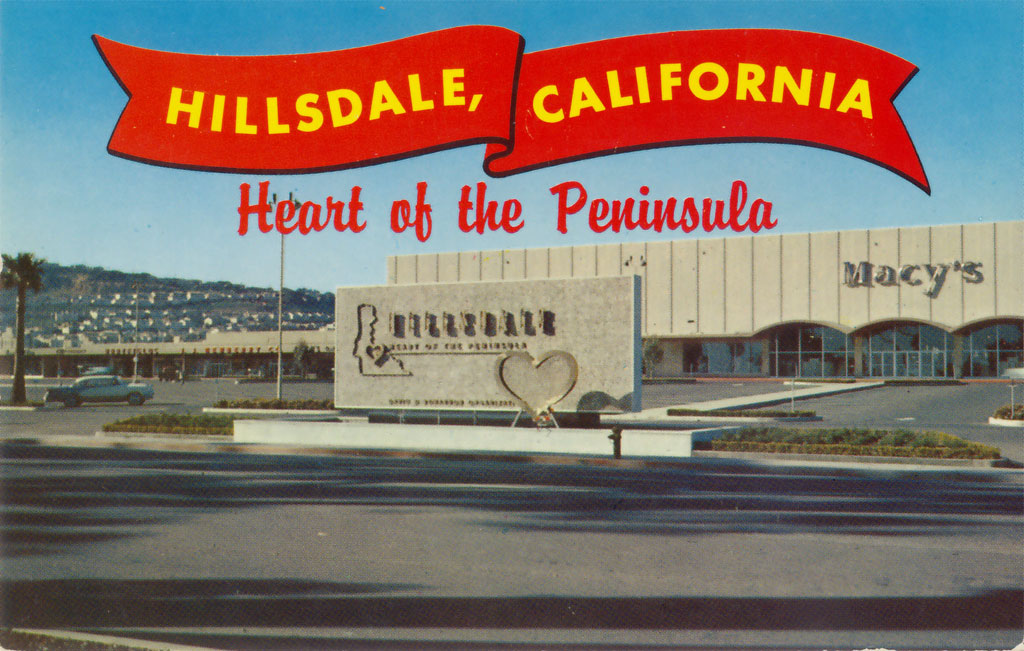
David at Retail Memories From Coast to Coast uploaded 2 videos (split) about Hillsdale Shopping Center in San Mateo, California, as it was in 1957 when it opened.

The videos show the center before it was enclosed, activities related to it, and vintage fashions, stores and signage. They serve as almost a class as to "how to shop" in what was then a new style of commerce.

Check them out. I think you'll enjoy them.

A Shopping Center is Born

(photo courtesy of Scott at BIGMallrat's Malls in Northern California and Reno Blog)

Friday, January 26, 2007

Thanks to Baltimore, Air Force 1 still flying

Nike sneaker boasts 25 years of loyal fans

By Tanika White
Baltimore Sun reporter

BALTIMORE - In the 2002 hit "Air Force Ones," the rapper Nelly extolled his love for the sneaker in the song's title: "I need two pair," he drawled. "Give me two pair."

Clearly Nelly is not from Baltimore. If he were, he'd have far more than just two pairs.

Nike is launching a major promotion for the 25th anniversary of its Air Force 1 - a sneaker that Baltimore had a major role in saving and helping to become an urban fashion sensation of the past generation.

In contrast to the product hype often manufactured on Madison Avenue, the sneaker's following grew initially by word of mouth, before the Internet and with little TV advertising. The shoe originated in 1982, when Nike sales were one-15th what they are now and its future endorsement king, Michael Jordan, was still a freshman at the University of North Carolina.

Curiously, the buzz for the Air Force 1 centered in Baltimore, far from the major fashion centers and the only place where the model was sold for a time after it was all but discontinued.

"No city is as important to the Air Force 1 as Baltimore," Nike acknowledged in a booklet it sent to retailers recently for the 25th anniversary promotion. "The city rebirthed the shoe and set in motion a series of events that would change the way sneakers were perceived in the marketplace."

Nelly's two pairs wouldn't suffice for Melvin Bartee, for example. He has amassed at least 100 pairs of the $80 sneakers over the years, their orange boxes stacked to the ceiling in the basement of his East Baltimore home. "I don't even go down there to look for a pair anymore. I just buy new ones," said Bartee, 41, a youth basketball coach at the Cecil-Kirk Recreational Center.

Keith Holly of West Baltimore said he has at least 50 pairs of Air Force 1's. He buys them two at a time, wears them twice, maybe three times, then gives them away.

And even a trans-Atlantic distance couldn't stem Michael Boateng's passion for Air Force 1's. When he attended high school in West Africa, Boateng, now 29, said, "My parents mailed me the new ones when they came out."

While Nike helped shape the modern athletic wear industry with its line named for Jordan, the lesser-known Air Force 1 model has been the Oregon company's biggest seller, footwear expert John Shanley said. The shoe generated roughly $1 billion a year for the company at its peak, about $600 million in more recent years.

"I remember going to the malls at 7 a.m. and kids would be in line for those shoes," said Shanley, a New York-based analyst who covers the athletic wear industry for Susquehanna Financial Group. "There's no other shoe that ever created that kind of thing. Maybe some of the Jordans."

In 1982, Nike introduced the Air Force 1 as a high-performance basketball shoe. Moses Malone, who became the first basketball player to go directly to the pros from high school after declining an offer to play at the University of Maryland, was one of the first to wear the sneakers, starting a fad in urban areas.

"Back then, shoes had a limited run," Nike spokesman KeJuan Wilkins said. "They'd come out and then they'd go away forever."

By 1983, Nike was ready to discontinue the model for newer styles. But three Baltimore-area retailers at the time - Charley Rudo Sports, Cinderella Shoes and Downtown Locker Room - banded together to implore Nike executives to reconsider.

"The shoes were blowing out of my store," recalled Harold Rudo, then the footwear buyer for his father's store, Charley Rudo Sports. "I flew out to [Nike's headquarters in] Portland, Oregon, and met with the second-in-command."

Rudo and cohorts from the other two sporting goods stores persuaded Nike initially to continue selling two styles of Air Force 1's - white with royal blue, and white with chocolate brown - but only in their stores in Baltimore.

The first weekend the sneakers were re-introduced in Baltimore, Rudo said, he sold more than 100 pairs.

"Then, we started popping out new styles, color by color by color by color. We brought out one to two colors a month," said Rudo, who is known even today as "Mr. Shoe." "We were exclusive, the Three Amigos."

In pre-Internet days, word of mouth propelled sneaker-heads along the East Coast to Baltimore for Air Force 1's.

"We had people coming from New York, Washington, D.C.," Rudo said. "They were coming from all over Pennsylvania. They knew we had 'em, and they'd all come running to Baltimore to buy them from us."

Eventually, Nike concluded that Baltimore was on to something. About 10 years after the shoes' exclusive run in Baltimore, the company re-released the Air Force 1 nationally in the mid-1990s.

"This is something that is now on a global level," said Wilkins, the company spokesman. "People in Japan love the Air Force 1. People in Brazil love the Air Force 1. To think that it really started in Baltimore is kind of amazing. ... It has moved from being a performance shoe to a cultural icon."

Until Nike announced a 25th anniversary promotional campaign for the Air Force 1, only a select few were aware of Baltimore's role in popularizing the model early on.

"So often you think of L.A., New York, Chicago for this kind of thing," said Mike May, spokesman for the Sporting Goods Manufacturers Association.

While Nike poured millions into promoting its Jordan line, it barely advertised the Air Force 1, lending the sneaker an underground appeal. Like Converse's canvas Chuck Taylors and Adidas' Superstar model, Nike's Air Force 1 became a phenomenon with a clean, simple look. As more colors were added, buyers continued to clamor for the shoe because no matter the outfit, there was an Air Force 1 to go with it.

"You can basically get any color to match your clothes, whatever you feel like wearing," said Boateng of East Baltimore. "I've worn 'em to church. I'll be wearing a blazer and then I'll have on my Air Forces."

Today, there are more than 1,700 different styles of Air Force 1's, although the shoe is essentially the same as in 1982 - unusual for Nike sneakers, even Air Jordans. There are versions in patent leather, multi-colored styles and some designed by graffiti artists. Wealthy rap artists and celebrities often take a pair of Air Force 1's and upgrade the "swoosh" with designer monograms, such as Louis Vuitton's signature LVs.

After-purchase customization of the Air Force 1 has become a cottage industry for some city artists and retailers.

Dwayne Gillard, 27, of West Baltimore, had one of his five pairs of white-on-white Air Force 1's professionally decorated at Mondawmin Mall with "Hundred Grand Federation," the logo for his side business as a rapper.

"You gotta have a pair of Air Force 1's. You put 'em on at night, and I swear you look like your feet are glowing," Gillard said. "Then you gotta have a second pair. The second pair you gotta get somebody to customize 'em for you. The third pair is the backup for that first pair. And the fourth and fifth is for when nobody's selling them no more. I got five right now because I know come May, I'm not gonna be able to find 'em."

Baltimore retailers sometimes struggle to meet demand, said Jeffrey Bowden, a spokesman for DTLR, formerly the Downtown Locker Room, which now operates from Atlanta to Chicago.

"It's absolutely a phenomenon," Bowden said. "It's clearly the Baltimore shoe. There were times there where it was hard for us to keep them in stock, through all sizes, from kids' all the way up to men's.

"That real hard-core demographic, they're like, 'Hey, I need a new pair of Airs,' just because they got a scuff on them. And they've got to have every color when they come out," he said. "I'm even guilty of that. I've had hundreds over the years."

Nike officials can't explain why the shoe has had such a foothold in Baltimore, but they are grateful for the love.

To promote the 25th anniversary version of the Air Force 1 - and the just-released Air Force 25 sneaker - the company built a pricey in-store display at DTLR in Mondawmin Mall, one of the first stores to originally sell the Air Force 1, Nike said.

The display shows players of the past in flight jumpsuits, such as Malone, beside a "second coming" of current stars such as LeBron James and Kobe Bryant, who are promoting the new Air Force 25s.

Local sellers don't expect the relationship to wane anytime soon.

"Twenty years from now ... it's going to be the same thing," said Greg Vaughan, manager of Mondawmin Mall's DTLR and a former salesman at Charley Rudo Sports, one of the three stores that saved the shoe. "I'm watching generations of kids growing right into it."

Wednesday, October 04, 2006

The Bergen Mall on myspace

LiveMalls fan Jordan Berson sent me a link to his myspace tribute to New Jersey's iconic Bergen Mall. There are lots of great pictures and commentary about the Paramus mall, one of the first large suburban shopping centers in America.

I think if you like this site and LiveMalls, you will love his page.

myspace.com/bergen_mall

Thursday, September 07, 2006

Culture at the counter

By Jan Whitaker
originally published in the Boston Globe

JUST AS THEY pioneered modern escalators to carry crowds of shoppers upward, department stores encouraged their customers' social mobility. The big stores grew up with a burgeoning American middle class that they provided with its tastes, habits -- and consumer goods.

As full-service department stores continue to disappear, it becomes clear just what influential organizations they were in shaping the lives of millions.

With concerts, lectures, style forums, art shows, science exhibits, and book festivals, the big stores showed Americans how their lives could be richer and more gratifying. Sometimes employing deadly earnestness and at other times circus-like antics, they caught the public's imagination and sold them an American way of life, complete with gold-rimmed dinner plates, pianos, prom dresses, and engraved invitations.

Along with the goods came lessons on child psychology, galleries hung with oil paintings, symphonies, author teas, and countless other edifying sights and sounds. Salvador Dali designed show windows at Bonwit-Teller; Leopold Stokowski conducted an orchestra at Wanamaker's in Philadelphia; and William James discussed philosophy at Filene's. The Federal Children's Bureau worked with department stores to instruct parents on the health and well-being of infants.

For decades the largest booksellers in many cities were department stores. In 1904, The Wall Street Journal reported that Wanamaker's in Philadelphia ran the largest book shop in the world. Although many early department store books were cheap reprints of first-run editions, their lower prices put books in the hands of a wider spectrum of readers than ever before. Jordan Marsh boasted of a ``colossal book display" in 1897, featuring ``Quo Vadis" selling briskly at half the regular price. The store also claimed to have an ``enormous stock of juvenile books," a true department store merchandise stronghold. Department stores' professional book buyers dominated the American Booksellers Association through much of the 20th century, as well as hosting some of the first author tours and book festivals.

Museums in the 1920s looked to department stores as models. At a style forum at Kaufmann's Department Store in Pittsburgh, Stewart Culin of the Brooklyn Museum declared, ``The department store stands for the greatest influences for culture and taste that exist today in America." The director of the Newark Museum, John Cotton Dana, acknowledged that a first-class department store was more like a good museum than any of the actual museums of 1928. The stores were judged far more skillful at display, less intimidating to the public, and better overall at drawing crowds to view art works and exhibits of modern industrial design. They attracted thousands to symposiums on style, such as Macy's 1927 Art in Trade show that presented a weeklong program of talks by designers, scholars, and museum curators.

Art galleries in the big stores dated back to the late 19th century. Jordan Marsh proclaimed its new 1894 exhibit space had good lighting, perfect for displaying work ``from the studios of Boston's best artists." Local artists were always popular, as were sentimental subjects, but department stores also showed paintings by Picasso, Rosa Bonheur (at Watt & Shand in Lancaster, Pa., in 1908), the ``ashcan school," European cubists, and social realists.

The wonders of science and technology were demonstrated in stores' lighting systems, pneumatic tubes, elevators, and escalators, all of which fascinated the public at a time when most people lacked modern conveniences at home. But the stores also presented natural history exhibits, expositions on how electricity worked, and attractions such as Lindbergh's Spirit of St. Louis and, later, space suits worn by the first astronauts.

The stores' attractions were free and open to all. Of course department stores are businesses that must focus intently on the bottom line, but they built their fortunes on the notion that as their customers prospered and developed more artistically discriminating tastes, they would buy better merchandise and profits would rise accordingly.

By the 1960s, a large US middle class took it for granted that local department stores were reliable links to the mores, manners, and material accoutrements of mainstream American life. But, despite success as social arbiters, the big stores' high cost of distribution -- due in part to special events and lavish services -- undermined profits. In city after city they closed or were consolidated in buyouts.

The department store represented a historic confluence of merchandising creativity and social aspirations that may be impossible to replace.

Jan Whitaker is author of ``Service & Style: How the American Department Store Fashioned the Middle Class."

Tuesday, August 29, 2006

After Smooth Sales Talk, Stores Take Macy’s Name

By MICHAEL BARBARO

PORTLAND, Ore. — It was to be the most ambitious transition in the history of American retailing: To complete the merger of Federated and May, the nation’s largest department store companies, executives would abandon the names of 11 storied local chains, like Marshall Field’s in Chicago and Filene’s in Boston, and replace them with Macy’s, the very symbol of New York City.

And focus groups signaled that it could be a public relations disaster. “I left New York for a reason,” one consumer told Macy’s executives here.

But protests now seem remote as company officials prepare, in their words, to “Macyize” 400 stores on Sept. 9. And the reason has much to do with the diplomacy of one man who has crisscrossed the country, a chief executive cum politician, handing out money and promises, and calming local nerves as part of a campaign to neutralize opposition before it gathered strength.

Terry J. Lundgren, the chief executive of Macy’s parent company, Federated Department Stores, flew to Los Angeles, where he agreed, at the mayor’s request, to build a Macy’s at a mall in North Hollywood. In Chicago, he promised to resume local manufacturing of the famed Frango mints at Marshall Field’s. In St. Louis, he vowed to keep the downtown Famous-Barr store open, despite years of poor sales.

“When you are a company of our size, trying to make the changes we are making, you need a close relationship with local officials,” Mr. Lundgren said in an office at Macy’s Herald Square store in Manhattan. “You have to get off on the right foot.”

Any misstep would be costly. The merger Mr. Lundgren engineered in early 2005 was always a high-stakes bet that in a retail landscape dominated by big-box chains like Wal-Mart and specialty stores like J. Crew, consumers still needed department stores, and that they would warm to a retailer that wiped out century-old local brands.

The delicacy of the task may explain why Mr. Lundgren traveled here to painstakingly court Gerry Frank, whose family started Meier & Frank, a 149-year-old Oregon department store that Federated inherited when it bought May. Last year, Mr. Frank, the great-grandson of Meier & Frank’s founder, wrote a letter asking Mr. Lundgren, in no uncertain terms, not to tamper with the identity of the family’s department store. “I think I can speak for many, many Oregonians,” he wrote, “in asking that Federated maintain the Meier & Frank name.”

So, in the midst of the $11 billion takeover of May, Mr. Lundgren flew 2,500 miles to dine with Mr. Frank in Portland. Back at his office in New York, Mr. Lundgren exchanged flattering e-mail messages with him (“You are a Great Man and True Friend,” concluded one note from Mr. Lundgren. “Don’t be afraid to ask me or tell me anything,” read another.)

In a final flourish, Mr. Lundgren agreed to emblazon Mr. Frank’s family name on plaques outside the downtown Portland store after it became Macy’s.

“Today I would jump off a building for him,” Mr. Frank said of Mr. Lundgren.

It is a performance that Mr. Lundgren has repeated over and over, from Boston, where Macy’s will become an official department store sponsor of the Boston Red Sox, to St. Louis. “He called me on the phone several times, met me in person twice, then he had us up to New York,” said Francis G. Slay, the mayor of St. Louis, where the Famous-Barr chain is soon to become Macy’s. “Honestly, I was surprised that he gave so much personal attention to us.”

At the heart of Mr. Lundgren’s campaign is a simple insight into the politics of retailing: people care more about store symbols and traditions than the names behind them.

So instead of fretting over the loss of Hecht’s in Washington or Famous-Barr in St. Louis, Mr. Lundgren focused on the handful of rituals that matter to shoppers — the Christmas tree lighting ceremonies, the Santaland displays and the July 4 fireworks shows.

Even in Chicago, where 60,000 people signed an online petition to preserve the Marshall Field’s name, Mr. Lundgren has managed to win over detractors by emphasizing tradition, big and small. He has ensured, for example, that the downtown State Street store’s elaborate Christmas windows will remain untouched. He signed off on a plan to refurbish an abandoned express elevator that once carried shoppers directly to the store’s designer boutique, 28 Shop.

And he has seized on Frango mints, a cherished symbol of the State Street store and the source of a public relations fumble for Marshall Field’s earlier owner, Dayton Hudson, in the late 1990’s. Shortly after buying the chain, Dayton Hudson outsourced the mint’s production, laying off about 150 local workers and earning a very public rebuke from Mayor Richard M. Daley.

No wonder, perhaps, that at a luncheon in July that was expected to reveal long-simmering tensions over the Marshall Field’s name change, Mr. Lundgren announced that Macy’s would begin manufacturing Frango-mint-flavored cheesecakes in Chicago, a headline that dominated local newspapers the next day.

At the end of the lunch, members of the audience swarmed around the 54-year-old Mr. Lundgren, a silver-haired, meticulously groomed former Neiman Marcus executive. Several asked for his autograph.

“Very smooth,” was the verdict of one attendee, John S. Maxson, president of the Greater North Michigan Avenue Association, which represents 700 businesses in downtown Chicago. “Were this not handled as expertly as it has been, it could have been a big disaster. It has not been.”

Although Mr. Lundgren is credited with improving Federated’s financial performance, the company is by no means a runaway success. Before it bought May, it reported sluggish sales growth for several years. Bolstered in part by the merger, its earnings have improved; in the 12 months ended in January, revenue was $22.3 billion and profit was $6.5 billion.

All the more reason that Mr. Lundgren insists on sticking to the most disputed part of his plan, the name changes. The May department store chains, Federated executives maintain, have buried consumers under a blizzard of coupons and flustered them with crowded aisles of middle-brow fashions. As a result, the chains lost their relevance as purveyors of style and, with it, their ties to the community.

To prove the point, Mr. Lundgren tells a story. Soon after Federated disclosed that Marshall Field’s, an upscale Midwest department store, would lose its name, scores of shoppers wrote blistering letters to the company, with several threatening to cut up their Field’s charge cards.

Worried that the reaction might be widespread and hurt the chain’s sales, Mr. Lundgren asked the accounting department to pull the purchase records of the first 100 letter writers. “There was no activity,” he said. “Or incredibly little activity.”

“This is where the tension was coming from,” he continued. “There was a group of people who did not want a change. But do they like the merchandise in the store? Not according to their spending. In their letters, they talked about when they were a child. But nobody was talking in the present tense.”

The lesson was clear: changing the name was unlikely to hurt sales. In fact, it might improve them. Then there is the pure financial logic. The conversion to Macy’s will save Federated millions on advertising — one name is cheaper to market than 11 — and create one national brand with stronger negotiating power with clothing suppliers.

Mr. Lundgren said that power had already translated into exclusive product lines for Macy’s, which is trying to shake its reputation as a stodgy, midprice department store by carrying higher-priced, more fashionable brands. After the merger, Martha Stewart said she would develop an upscale furniture line for the chain — much to the chagrin of Kmart, which carries her Martha Stewart Everyday products — while the designer Elie Tahari agreed to create a collection of women’s clothing.

Mr. Lundgren’s commitment to stock more upscale merchandise has become a major selling point in his campaign to sell local political leaders on the Macy’s takeover. For years, officials in St. Louis, Washington and Portland have complained that May dumped cheap goods into their downtown stores.

“It was heartbreaking to watch,” said Mr. Frank, the Meier & Frank scion, who waged a bitter — and unsuccessful — battle to stop his family from selling the chain to May in the 1960’s. “Row after row of sales merchandise just turned people off.”

In their early conversations, Mr. Lundgren told Mr. Frank he would try to restore the luster to the Meier & Frank legacy, investing in elegant new store fixtures and more prestigious clothing brands. But Mr. Frank, at one time the chief of staff to the former Oregon Senator Mark O. Hatfield, a confidant of the Oregon governor and a columnist for the state’s largest newspaper, still opposed the name change.

Upsetting Mr. Frank could mean upsetting much of the Oregon political establishment, so Mr. Lundgren took his charm offensive on the road. He and his wife, Tina, attended a charity dinner in Mr. Frank’s honor in Portland, writing a donation check on the spot. He later invited Mr. Frank to lunch in New York City.

Mr. Lundgren also began exchanging frequent letters and e-mail messages with Mr. Frank, often venturing beyond business matters and speaking in strikingly personal terms. “Tina and I will be there for you if and when you ever need us,” concludes one e-mail message, which Mr. Frank shared with a reporter. “We both absolutely adore you.”

After Mr. Lundgren learned that a block in downtown Portland would be renamed “Meier & Frank Square,” he wrote: “Frankly (no pun intended), I would rather it be named Gerry Frank Square but we are all happy with the alternative. You are the very best.”

Mr. Lundgren has certainly let local leaders down, too. Shortly after Federated announced its plans to convert May stores into Macy’s, a team of political and business leaders from St Louis, where May is based, flew to New York to meet with Mr. Lundgren. In a conference room at Macy’s Herald Square store, they asked him to consider relocating Federated’s headquarters from Cincinnati to St. Louis, which would spare the city steep job losses. “I really appreciate this,” Mr. Lundgren recalled telling the group. “But we are not going to do this.”

In the end, the city lost several hundred jobs. But like their counterparts in Portland, Los Angeles and Philadelphia, St. Louis city leaders did not walk away empty-handed. Mr. Lundgren agreed to designate St. Louis the headquarters of Macy’s Midwest division, overseeing stores from Kansas City to New York, and to renovate the first floor of the city’s struggling downtown store. Mr. Lundgren delivered each piece of news himself, either in person or by phone.

To Mr. Slay, the mayor of St. Louis, the experience must have seemed strangely familiar. “That is,” he said, “a political approach.”

Sunday, August 27, 2006

Blue Streak

America's love affair with indigo-dyed denim started with hard-working men soon after the first pair of Levi's hit the streets of San Francisco in 1873. In his new book, Jeans, Amesbury, Mass. author James Sullivan traces the history of everybody's favorite garment, from those early rugged jeans to the designer styles we wear today, and goes inside one of Boston's hottest jeans boutiques.

By James Sullivan
for The Boston Globe Magazine

'Did they flatten your butt out?" The moment the customer pulls back the dressing room curtain, the quick-talking shopkeeper peppers her with questions: "How do the jeans fit? Are they tight in the thighs? How do they feel on the hips?"

She's not just trying to make another sale, although at an average of $180 a pair for the high-end denims Leah Eckelberger retails at Jean Therapy, her Kenmore Square boutique, every sale is a considerable victory. Eckelberger, 31 and compact as a gymnast, is no master of the hard sell. She'll cheerfully send first-timers who blanch at her prices down to Newbury Street, to the Lucky Brand store, to buy less-expensive fashion jeans. She just wants her customers to go home feeling flattered, feeling cared for, as if they'd been to a spa. To Eckelberger, jeans are, in fact, a kind of therapy. They are comforting and familiar, yet they can make you feel sexy and adventurous. Her enthusiasm for her merchandise - enthusiasm, hell; it borders on pathology - is contagious.

Eckelberger likes to say that shopping for jeans brings out the best and worst in us. Customers don't hesitate to announce what they perceive to be their physical deficiencies. "They'll say 'I'm short,' or 'I have big legs,' " she says. "They're overaware of their bodies, actually. It's crazy." For many women, she says, the act of buying a new pair of jeans has become as intimate, and as anxiety-riddled, as picking out a bathing suit or an evening gown.

That's one reason the store owner believes the boom in couture denim is no passing fad. People will continue to pay higher prices, says Eckelberger, as long as the industry does not neglect the needs of ordinary buyers.

For years, the basement space that Jean Therapy now shares with a bookstore was home to the Rathskeller, the dank punk-rock hovel affectionately known as the Rat. Now stark-white and brightly lit, the space has a concrete floor patterned with Jean Therapy's graffiti-style logo, spray painted with a cardboard stencil. The transformation is telling, a microcosm of urban renewal in America. The yowling nihilism of the dive bar has given way to the hip Zen of boutique shopping. At Jean Therapy, Leah Eckelberger sells blue jeans with names that imply devotion, names such as Earnest Sewn and Sacred Blue.

In the crook of the store's L-shaped layout sits an old Singer sewing machine on a child-size table. It's a little shrine to Eckelberger's youthful infatuation with clothing. The mall jeans and Salvation Army castoff s she has altered over the years - Diesel, Gap, Liz Claiborne, "things that I've ripped apart, hemmed, studied" - are folded into stacks on the small shelves above.

Eckelberger used her parents' retirement fund as collateral for a loan to open the store. She went through three banks before finding a match, she says, fielding the same question at every one: "Who's going to spend that much on jeans?"

But this young entrepreneur knows what the loan officers may not have understood. Jeans, whatever their momentary position on the fashion ladder, are not like other clothes. We are as loyal to a good pair as we are to an old friend.

INDIGO-DYED DENIM, ORIGINALLY worn by men who dug mines, cut timber, herded cattle, drove railroad ties - working men, in other words, who built a civilization from a wilderness and had no use whatsoever for the cycles of fashion - has been part of the foundation of the fickle clothing industry for more than half a century now. Side-zip jeans for women were popular in the 1950s, when $5 was considered a preposterous price to pay for denim pants. Twenty years later, skeptics were dumbfounded when people flocked to department stores to pay $30 or $45 for dressy jeans with designer labels stitched to the rear pockets. In the early 1990s, "lifestyle" brands such as Diesel and Lucky tugged the industry to the brink of the $100 barrier. Today, for many compulsive shoppers, there is no apparent ceiling. "I don't balk at $500 for a pair of shoes," one woman told The New York Times at the height of the latest denim craze. "Why should I balk at that price for jeans that are special?"

For decades, genteel designers have been effusive in their praise of the lowly blue jean, which has its origins in European sailors' trousers and peasant overalls. "I wish I had invented blue jeans," said Yves Saint Laurent, sometimes credited as the first designer to bring denim to the runway. "They have expression, modesty, sex appeal, simplicity - all I hope for in my clothes." Bill Blass declared Levi's "the best single item of apparel ever designed." Even Charles James, the brilliant couturier whose intricate silk and satin creations epitomized the wholly impractical fine art of fashion, recognized his country's hardy contribution to cross-cultural modes of dress. "Blue denim is America's gift to the world," he said.

Levi Strauss & Co. patented the modern mass-produced prototype in 1873, reinforcing the pockets - two in front, one in back - with copper rivets. In 1890, the year the patent expired, the company added a fourth pocket, the little watch pocket, to the original design. By 1905, there were two back pockets on the 501XX, the archetypal Levi's button-fl y trouser, and this basic, riveted five-pocket jean has been the industry standard ever since. Thousands of manufacturers around the world have copied it.

It's a perfect pattern. Blue jeans are for men and women alike, for all body types. They stand up to hard work and rough play. They can imply either democratic parity or the aristocratic hierarchies of status. Around the world, blue jeans have obliterated every demographic distinction - age, ethnicity, income, education - in becoming the common casual uniform. And in our own headlong, irreverent culture, jeans have a deep and venerable past that is loaded with meaning. For vintage collectors and fashion-forward designers alike, jeans are steeped not just in the multiple dips of indigo dye but in a rich sense of history. Whether we called them overall pants or "blue drillin's" or dungarees, blue jeans have been an indispensable part of our culture for almost as long as we've had an American culture. First they built the country's infrastructure, then they populated it with a collective identity.

BOBBY GARNETT HAS HAD A STOREFRONT in Boston's South End since a homeless shelter was the most conspicuous landmark on the block. Now there are new condominiums, artists' galleries, and loft-style office spaces.

In this mixed-use enclave a stone's throw from the Southeast Expressway, the shabby chic of Bobby's shop gives it the feel of an old gentlemen's club. Piled high with vintage American and English clothing - from classic denim work wear to reindeer sweaters and straw hats - it's the kind of place where Ralph Lauren might find some inspiration.

In fact, Lauren is one of many fashion designers, collectors, and dealers who consider Bobby Garnett - better known as Bobby from Boston - to be a founding father of the contemporary resale business and an invaluable resource in the perennial recycling of classic styles. Garnett has been in the business for more than three decades, first selling his "experienced" clothing, as he likes to call it, to hippie students with a fl air for creative dress. In the 1980s, when denim collectibles became big business in Japan, certain savvy dealers beat a well-worn path from Tokyo to Bobby's lair. These days, Bobby from Boston does a lot of his business with Hollywood costume designers. He recently sold thousands of dollars of period clothing to the costumer for the Sean Penn remake of All the King's Men.

Set on a refurbished but largely untrafficked courtyard, the Bobby from Boston shop is usually as calm and contemplative as its heavy wood furnishings and comfortable chairs suggest. A magnificent old pool table in the center of the room is piled high with incoming merchandise. The only concession to the present day is the sound system, tuned to a high-energy R & B station. In the back, several big brown boxes are being packed for shipping. They are stuff ed with Levi's cutoff s, which Lauren's company buys in bulk to stock in its summer-resort stores on Long Island and Martha's Vineyard.

At 55, Garnett still dresses like a college student, wearing faded Levi's, white sneakers, and a gray hooded sweat shirt with a Ralph Lauren Rugby cap pulled down over his brow. He was one of the first of his generation, coming of age in the 1960s, to realize the revenue potential in recycled denim. From the beginning, he had a collector's nose for it. Acting on a tip from a friend in the south of France, he once bought a hundred pairs of red-line Levi's - the highly collectible "selvage" denim, made on old, narrow looms - for a dollar a pair. On another occasion, he dug through 70 100-pound bales of jeans jackets in a rag yard in Worcester, uncovering many prewar gems. When a regional discount chain accepted a huge shipment of "dead-stock" work clothes, unsold goods from old stores going out of business, he drove 900 miles in two days, snatching up almost all of it. "I was freakin'!" he says in his heavy local accent, laughing.

Though the vintage market has waned considerably since its heyday in the late 1980s and early '90s, Garnett still buys "big E" Levi's, those dating before 1971, when the company changed the lettering on its red tab from upper to lower case. He still travels extensively in search of old overalls, barn- and cowboy jackets and other pieces made by the Big Three of blue jeans - Levi's, Lee, and Wrangler - as well as onetime staple brands such as Big Smith and Sears' Hercules label. His pride and joy, however, is his collection of DubbleWare, denim work clothes made in Boston between World War I and World War II. The DubbleWare brand was produced by M. Hoffman, the longtime Massachusetts apparel maker.

"The best part is buying the stuff," says Garnett, carefully laying out a pair of hickory-stripe railroad overalls and patting it down. "You can't keep it all, so you have to sell some of it."

Excerpted from Jeans: A Cultural History of an American Icon, by James Sullivan. Published by arrangement with Gotham Books, a division of Penguin Group (USA) Inc. Copyright © 2006 by James Sullivan.