I posted this to Amazon.com, but I'm showing it to you here because I wrote it and I think it's pretty good.
Popular music can be a fickle thing. Take for example, the genre known as “Smooth Jazz.” Some supposed jazz “purists” insist that it’s a stagnant genre, filled with clichés and rudimentary musicianship and absent of innovation. Others champion the style, saying that the opposite is true. Smooth jazz fosters creativity and brings the music to a whole new audience.
Both sides would find plenty of things to justify their position listening to “Trust” by Boney James (Warner Brothers, 1992). This album was released in 1992, and Boney James was on the forefront of the R&B-laced saxophone jazz that would typify the decade. Assisted by the relatively unknown (at the time) producer Paul Brown and studio legends Paul Jackson, Jr, and Lenny Castro, among others, James crafted a fine album of crossover jazz, replete with high-tech synthesizers, soft percussion, R&B backbeats and enough jazzy chord changes to fill two albums. It stuck quite a pose at the time with most of its contemporaries falling into the “elevator music’ category.
Some highlights of “Trust” include the prototype Boney James song “Metropolis,” vaguely Asian-feeling “Kyoto,” and fine smooth jams “Lilly” and “Roadrunner.” Each provides a beautiful stage for James’ alto, tenor and soprano saxophone stylings and paints lush, memorable pictures in the minds of listeners.
Naysayers will be glad to know that the other half of “Trust” is filled with an undefined blandness; even at album release (at the start of James’ search for a signature sound) it was “could be anybody” music. Even the cover of Stevie Wonder’s classic “Creepin’” is boring. These dull tracks sound even more anonymous now, after a decade or so, when nearly every saxophonist with a backbeat and a recording contract copped the style laid out by first-wave artists like James and Art Porter.
If you’re a naysayer like I’ve described, you’ll have ammunition with “Trust.” If you’re a Boney James fan, add to your collection with this release. If you’re on the fence, start with James’ “Sweet Thing” or more contemporary releases. They more accurately show what Boney James is capable of creating.
Saturday, August 28, 2004


Thursday, August 26, 2004
the joy of blucher mocs (part two)
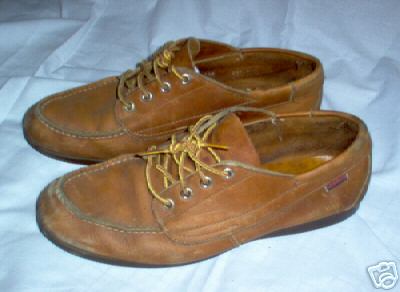
Blucher mocs, broken in, though not mine. These are from an eBay listing.
Read part one by clicking on this link.
When we last left this story, I had just purchased my new L.L. Bean Blucher Mocs and had put them on for the first time..
L.L. Bean provides a good description of their products in the catalog and website, but they don’t tell you in the catalog description about the break-in period or how they look when you first buy them. Not much anyway. I read about the break-in period on the little cards that came in the shoe box. They read ‘allow two to three wearings to evaluate fit of shoes.’ More like ten.
They should also have a card that says ‘shoe will be really stiff and weird-looking for the first several wears.’ Because it was. They looked like brown cardboard at first and they were a little hard to tie, because of the stiffness. I wore them to work sockless (gotta be cool, y’know) and had to walk to lunch, which was about a mile or so round trip on concrete and asphalt. I got calluses on my toes and some serious heel pain. Now, I thought, I know a little about what women put themselves through to wear cute shoes, but I’d like to think that a smart woman would have kept a pair of sneakers for the walk to lunch. Not me, of course. I have to be the dumbass that suffers through the pain. I wondered if Eddy had to go through this with his, too. But then again he wouldn’t have walked in them to lunch downtown.
The strange thing about my dogged determination to wear these shoes regardless of good sense may have paid off in the long run. I can’t say when it happened, but somewhere between then and now, the shoes finally broke in. Now when I wear them, they are soft, and easy to tie. They no longer look like boats, but rather an extension of my body. It’s still missing the well-loved patina of Eddy’s but that will come in time. Since they’re now comfortable, non-callus forming “cool shoes” I feel confident wearing them. They look great with all the new clothes I bought. And because they’re so out the local consciousness, but so appropriate fashion-wise, I get all sorts of compliments and inquiries about where I bought them. That feels good.
I finally got the shoe that I wanted for years and they’re cool and comfortable. Maybe this new-found comfort is what the goobers get when they wear their common boat shoes. That’s no explanation for the various other sartorial disasters they commit, but it’s a start at understanding that I didn’t have before. In any event, I’m looking forward to a long life with my Blucher Mocs, courtesy of 7th grade material lust, Eddy Hicklin, and a mid-year shopping binge. Isn’t life great?
Wednesday, August 25, 2004
a sneaker timeline (courtesy of sneakerhead.com)
I found this on sneakerhead.com and thought it was interesting. If anyone from sneakerhead reads this, please know that I'm a big fan of your site and so are many of my friends. Read below.
1800’s- The first rubber-soled shoes, called plimsolls, were manufactured.
1892-1916 - Goodyear, then a rubber shoe company and division of the U.S. Rubber Company, manufactures rubber and canvas shoes under different names, finally settling on Keds as the best name.
1908- Marquis M. Converse establishes Converse shoe company, revolutionizing the game of basketball for more than half a century and becoming an American icon.
1917- Keds are the first mass marketed athletic shoes, later termed sneakers Henry Nelson McKinney, an advertising agent for N. W. Ayer & Son because they don’t make any noise when you walk.
1917- Converse releases the world’s first performance basketball shoe, the Converse All Star.
1920- Adi Dassler begins producing handmade training shoes in his mother’s washroom without electricity
1923- The All Star gives way to the Chuck Taylor All Star, a staple of basketball players, kids, and rebels for more than 50 years. Also known as “Chucks,” “Cons,” “Connies” these shoes, to date, have sold more than 744 million in 144 countries.
1924- Adi and Rudolph Dassler, with the help of some 50 family members, register their business as Gebrüder Dassler Schuhfabrik”, Herzogenaurach, Germany.
1931- Adidas produces its first tennis shoe.
1935- Converse releases the Jack Purcell with its telltale “Smile” on the front. Jack Purcell shoes have gained fame well beyond that of the 1930s badminton/tennis champion himself – they became a staple of early Hollywood and the bad boy crowd.
1948- “Puma Schuhfabrik Rudolf Dassler” is founded and the world is introduced to the PUMA Atom, PUMA’s first football shoe worn by members of the West German football team.
1950s- Sneakers are the preferred footwear of teenagers and the symbol of rebellion. Cheap, they are worn by students around the world. In the U.S., cheerleaders wear sweaters, short skirts, and ankle socks with canvas topped shoes (or keds). The fashion is officially sanctioned when James Dean is photographed wearing his Levis jeans and white sneakers.
1962-1964- Phil Knight, a business major at the University of Oregon, and his coach, Bill Bowerman, partner to provide a low cost, high tech athletic shoe under the name Blue Ribbon Sports (BRS)
1968- BRS begins marketing new designs and technology and changes their name to Nike. Nike is named after the Greek Goddess of Victory.
1968- PUMA is the first sports shoe manufacture to offer Velcro fasteners.
1969- Quarterback Joe Namath, wearing PUMA shoes, leads the New York Jets to victory in SuperBowl III.
1971- The Nike Swoosh trademark is purchased from a graphic design student for $35.
1972- Bill Bowerman pours rubber into his wife's waffle iron, creating the basis for the popular Nike Waffle Racer; a shoe with the optimal traction of waffle soles, wedged heel, the cushioned mid-sole, and nylon uppers. Nike marketed its waffle soled shoe by saying that four of the top seven runners at the 1972 Olympic Trials wore Nike shoes.
1973- Steve Prefontaine, runner and an American record-holder, becomes the first major athlete to wear Nike running shoes.
1974- Nike releases the Waffle Trainer, with Bill Bowerman’s famous Waffle outsole.
1974- Converse releases the Converse One Star line of shoes, representing an entire lifestyles of “Indie” athlete; individuals whose lifestyle, sports and style are fused together by creativity, imagination and self-expression. Always popular with an eclectic crowd these shoes are now popular in the surf and skate community.
1979- Nike creates the first Nike Air sole units, resulting in the revolutionary Nike Air cushioning. Nike also releases the first running shoe, the Nike Tailwind, with the patented Nike Air technology.
1981- Blue Ribbon Sports and Nike merge to form Nike, Inc.
1982- Nike releases the first of a long line of shoes, the Air Force 1. This durable shoe has been released in a low, mid, and high-top versions. The Air Force 1 has survived over two decades with little change to its basic design and continues to remain a legacy and a fashion statement with its numerous colorways.
1985- Chicago Bulls basketball rookie, Michael Jordan, endorses a line of Nike shoes and apparel. Nike releases the first Air Jordan.
1987- The first Nike Air Max shoes is released, giving athletes their first real introduction to the Nike Air cushioning. Nike also releases the first Air Cross Trainer, a shoe cushioned enough for aerobics and court sports.
1989- Puma releases its “Trinomic” sport shoe system
1991- Puma introduces its high-tech “PUMA disc system” sport shoe.
1996- PUMA introduces the first foam-free midsole with PUMA CELL technology.
1998- Bauer Nike Hockey is formed, dedicated to producing quality footwear for hockey players.
1999- PUMA basketball star, Vince Carter, is name NBA “Rookie of the Year”
1999- Nike co- founder, Bill Bowerman, dies in December.
2000- Sales of Nike Golf soar after Tiger Woods switches to Nike golf balls wins three majors during the season.
2001- Nike introduces the Nike Shox, the most advanced support technology. The Shox system is based on columns of specially engineered foam that provide superior impact cushioning thus creating a new revolution in shoe design.
2003- Nike acquires long-time shoe manufacturer, Converse, Inc.
2003- Converse re-issues authentic presentations of classic athletic performance shoes such as the Chuck Taylor All Star and the Jack Purcell. These editions are now popular with fans of nostalgic fashion and those wanting to return to the purity of past sports eras.
1800’s- The first rubber-soled shoes, called plimsolls, were manufactured.
1892-1916 - Goodyear, then a rubber shoe company and division of the U.S. Rubber Company, manufactures rubber and canvas shoes under different names, finally settling on Keds as the best name.
1908- Marquis M. Converse establishes Converse shoe company, revolutionizing the game of basketball for more than half a century and becoming an American icon.
1917- Keds are the first mass marketed athletic shoes, later termed sneakers Henry Nelson McKinney, an advertising agent for N. W. Ayer & Son because they don’t make any noise when you walk.
1917- Converse releases the world’s first performance basketball shoe, the Converse All Star.
1920- Adi Dassler begins producing handmade training shoes in his mother’s washroom without electricity
1923- The All Star gives way to the Chuck Taylor All Star, a staple of basketball players, kids, and rebels for more than 50 years. Also known as “Chucks,” “Cons,” “Connies” these shoes, to date, have sold more than 744 million in 144 countries.
1924- Adi and Rudolph Dassler, with the help of some 50 family members, register their business as Gebrüder Dassler Schuhfabrik”, Herzogenaurach, Germany.
1931- Adidas produces its first tennis shoe.
1935- Converse releases the Jack Purcell with its telltale “Smile” on the front. Jack Purcell shoes have gained fame well beyond that of the 1930s badminton/tennis champion himself – they became a staple of early Hollywood and the bad boy crowd.
1948- “Puma Schuhfabrik Rudolf Dassler” is founded and the world is introduced to the PUMA Atom, PUMA’s first football shoe worn by members of the West German football team.
1950s- Sneakers are the preferred footwear of teenagers and the symbol of rebellion. Cheap, they are worn by students around the world. In the U.S., cheerleaders wear sweaters, short skirts, and ankle socks with canvas topped shoes (or keds). The fashion is officially sanctioned when James Dean is photographed wearing his Levis jeans and white sneakers.
1962-1964- Phil Knight, a business major at the University of Oregon, and his coach, Bill Bowerman, partner to provide a low cost, high tech athletic shoe under the name Blue Ribbon Sports (BRS)
1968- BRS begins marketing new designs and technology and changes their name to Nike. Nike is named after the Greek Goddess of Victory.
1968- PUMA is the first sports shoe manufacture to offer Velcro fasteners.
1969- Quarterback Joe Namath, wearing PUMA shoes, leads the New York Jets to victory in SuperBowl III.
1971- The Nike Swoosh trademark is purchased from a graphic design student for $35.
1972- Bill Bowerman pours rubber into his wife's waffle iron, creating the basis for the popular Nike Waffle Racer; a shoe with the optimal traction of waffle soles, wedged heel, the cushioned mid-sole, and nylon uppers. Nike marketed its waffle soled shoe by saying that four of the top seven runners at the 1972 Olympic Trials wore Nike shoes.
1973- Steve Prefontaine, runner and an American record-holder, becomes the first major athlete to wear Nike running shoes.
1974- Nike releases the Waffle Trainer, with Bill Bowerman’s famous Waffle outsole.
1974- Converse releases the Converse One Star line of shoes, representing an entire lifestyles of “Indie” athlete; individuals whose lifestyle, sports and style are fused together by creativity, imagination and self-expression. Always popular with an eclectic crowd these shoes are now popular in the surf and skate community.
1979- Nike creates the first Nike Air sole units, resulting in the revolutionary Nike Air cushioning. Nike also releases the first running shoe, the Nike Tailwind, with the patented Nike Air technology.
1981- Blue Ribbon Sports and Nike merge to form Nike, Inc.
1982- Nike releases the first of a long line of shoes, the Air Force 1. This durable shoe has been released in a low, mid, and high-top versions. The Air Force 1 has survived over two decades with little change to its basic design and continues to remain a legacy and a fashion statement with its numerous colorways.
1985- Chicago Bulls basketball rookie, Michael Jordan, endorses a line of Nike shoes and apparel. Nike releases the first Air Jordan.
1987- The first Nike Air Max shoes is released, giving athletes their first real introduction to the Nike Air cushioning. Nike also releases the first Air Cross Trainer, a shoe cushioned enough for aerobics and court sports.
1989- Puma releases its “Trinomic” sport shoe system
1991- Puma introduces its high-tech “PUMA disc system” sport shoe.
1996- PUMA introduces the first foam-free midsole with PUMA CELL technology.
1998- Bauer Nike Hockey is formed, dedicated to producing quality footwear for hockey players.
1999- PUMA basketball star, Vince Carter, is name NBA “Rookie of the Year”
1999- Nike co- founder, Bill Bowerman, dies in December.
2000- Sales of Nike Golf soar after Tiger Woods switches to Nike golf balls wins three majors during the season.
2001- Nike introduces the Nike Shox, the most advanced support technology. The Shox system is based on columns of specially engineered foam that provide superior impact cushioning thus creating a new revolution in shoe design.
2003- Nike acquires long-time shoe manufacturer, Converse, Inc.
2003- Converse re-issues authentic presentations of classic athletic performance shoes such as the Chuck Taylor All Star and the Jack Purcell. These editions are now popular with fans of nostalgic fashion and those wanting to return to the purity of past sports eras.
Saturday, August 21, 2004
chipped ham productions (my friend evan's blog)
My friend Evan Cantrell has a really cool blog called Chipped Ham Productions.
He's been maintaining this blog for a short while and it tells a little about him, his family and his interests. A couple of his main interests are comics and sciernce fiction, with occasional segways into fantasy. Some of his favorite TV shows are "The X-Files," "Buffy the Vampire Slayer" and "24." I'm not as into these things as he is, but I think it's really cool that he's found things he loves as much as I love malls and shopping.
A couple of interests that we share are architecture (he's an architect, too), music, and beautiful women (check out the pictures of Jessica Alba on his blog). I think you'll really love his blog, so why not stop on by.
He's been maintaining this blog for a short while and it tells a little about him, his family and his interests. A couple of his main interests are comics and sciernce fiction, with occasional segways into fantasy. Some of his favorite TV shows are "The X-Files," "Buffy the Vampire Slayer" and "24." I'm not as into these things as he is, but I think it's really cool that he's found things he loves as much as I love malls and shopping.
A couple of interests that we share are architecture (he's an architect, too), music, and beautiful women (check out the pictures of Jessica Alba on his blog). I think you'll really love his blog, so why not stop on by.
Thursday, August 19, 2004
nyc: super heroes and sneakers
My friend Evan offered this unique perspective on my recent trip:
Then I found this and told him about it:
Relating comics and your trip to New York...I watched a special on the Travel channel last night that I had recorded a few days ago.
New York Marvel Super Hero Inspirations
It was a really cool look at some of the landmarks that had inspired Marvel comics. I'll have to try to visit them someday.
Then I found this and told him about it:
Bringing it all full circle with a very Steve perspective, I found a unique pair of shoes inspired by Spider-Man on the internet that’s sold in New York and on the internet. It’s only in kids’ sizes, but it’s very cool. Click on the link below:
PickYourshoes.com: Nike Spiderman Dunks
They also have Hulk shoes on this site. Both would be excellent collectors’ items. Thought you might get a kick out of them.
Sunday, August 15, 2004
mr. swain goes to town
a first-hand observation or two on my day in the city (August 14, 2004)
I almost missed my trip to New York this weekend. I guess some of you are wondering “He went to New York? I didn’t know that.” Well it’s hard to keep everybody informed about things these days. All of you (even the ones I don't know) are great friends of mine and I’m a man of few words (really), plus it doesn’t seem like I had the free time I once did. Or I’m getting old. Either way, I’m telling you now. How’s that. I thought so.
The first road block was my dad coming to get me from work. He got there about 6 (I get off at 5, but he refuses to remember), and then when we went home I had to help my mom with some heavy lifting and rearranging (at the country club) that always seems to pop up when I need to get out and have some fun. I was scared that I was going to be late, but we worked it out…barely. You know my life. Pretty typical.
I rode all night on the bus from Roanoke to the city. And I saw where the new Cabela’s in Hamburg, Pennsylvania is located. If you’re on I-78 between Harrisburg and Allentown, you can’t miss it. Didn’t get to go, but I want to go up there real soon.
I was on a shopping trip run by a bus tour company (Abbott Trailways). We spent 8 hours in Manhattan Saturday site-seeing and shopping (mostly shopping) and spent the night in Secaucus (AmeriSuites, Harmon Meadow) before coming back Sunday afternoon. We ate at Pizzeria Uno in New Jersey (Doug L. and Todd R. are salivating reading this I’m sure) and I got to try the All-American Dessert that Todd R. raves about. BTW, it’s good Todd. Real good. I liked the whole thing, from the vanilla ice cream to the hot apples and cinnamon. Excellent.
Where’d I shop at: Macy’s (of course), H&M, The NBA Store, Lord & Taylor, Bloomingdales, Bergdorf Goodman, Saks Fifth Avenue, Barneys, Salvatore Ferragamo, Louis Vuitton, Burberry, Niketown, Rochester Big & Tall and your standard assortment of mall-type stores in their most decked out versions. You’d likely say I was lying if I told you Old Navy is actually better in the city than in the suburbs, but I shit you not. It is. It has a lot of the same stuff they have at the ones around here, but they have a lot of exclusive product too.
I almost ate at The Plaza hotel, but Kevin balked at the price. Of course at NikeTown he paid over $140.00 for a pair of Muppet-green Air Force Ones and a matching T-shirt he’ll likely never wear (but I’m the one that’s being excessive.). We ended up eating at the 59th and Lex restaurant in Bloomingdales, which I can recommend.
Okay, it’s time to disappoint everyone: I didn’t get any souvenirs for you guys; I missed the subway, Grand Central, the Statue of Liberty, Tiffany’s, many of the ethnic neighborhoods (not enough time), the strip club (sorry Rich) and countless other things. But I’m going back. And I’ll miss them again (ha ha). Just kidding.
Yep, the trip was killer, y’all. All of you who haven’t been need to go. Without question. Kevin and I covered a good portion of the city from 34th to 59th on foot. It was a haul, but I saw so much. Bought a couple of things, but didn’t overdo it. Got a few pictures that came out good with the disposable camera.
I’m a little sore leg-wise from the walking, but I got some generic Ben-Gay type stuff from Wal-Mart when I got back.
I was off work on Monday. Sorry I missed Judy’s birthday of course, but glad to be off. I went to get the mail and I saw a little too much yard clutter. I have looked at the excess crap that was in the yard at home and at the club long enough and had to do something about it. So I cleaned the yard in both places. Sometimes I impress myself I try hard enough: for example, I moved a thirty foot tall tree, piece by piece today. It was exhausting, and I’m not done in the least, but in both places it looks a little more like people care about their surroundings. My dad got embarrassed that I cleaned up that he started mowing. That in itself was great, if nothing else.
I almost missed my trip to New York this weekend. I guess some of you are wondering “He went to New York? I didn’t know that.” Well it’s hard to keep everybody informed about things these days. All of you (even the ones I don't know) are great friends of mine and I’m a man of few words (really), plus it doesn’t seem like I had the free time I once did. Or I’m getting old. Either way, I’m telling you now. How’s that. I thought so.
The first road block was my dad coming to get me from work. He got there about 6 (I get off at 5, but he refuses to remember), and then when we went home I had to help my mom with some heavy lifting and rearranging (at the country club) that always seems to pop up when I need to get out and have some fun. I was scared that I was going to be late, but we worked it out…barely. You know my life. Pretty typical.
I rode all night on the bus from Roanoke to the city. And I saw where the new Cabela’s in Hamburg, Pennsylvania is located. If you’re on I-78 between Harrisburg and Allentown, you can’t miss it. Didn’t get to go, but I want to go up there real soon.
I was on a shopping trip run by a bus tour company (Abbott Trailways). We spent 8 hours in Manhattan Saturday site-seeing and shopping (mostly shopping) and spent the night in Secaucus (AmeriSuites, Harmon Meadow) before coming back Sunday afternoon. We ate at Pizzeria Uno in New Jersey (Doug L. and Todd R. are salivating reading this I’m sure) and I got to try the All-American Dessert that Todd R. raves about. BTW, it’s good Todd. Real good. I liked the whole thing, from the vanilla ice cream to the hot apples and cinnamon. Excellent.
Where’d I shop at: Macy’s (of course), H&M, The NBA Store, Lord & Taylor, Bloomingdales, Bergdorf Goodman, Saks Fifth Avenue, Barneys, Salvatore Ferragamo, Louis Vuitton, Burberry, Niketown, Rochester Big & Tall and your standard assortment of mall-type stores in their most decked out versions. You’d likely say I was lying if I told you Old Navy is actually better in the city than in the suburbs, but I shit you not. It is. It has a lot of the same stuff they have at the ones around here, but they have a lot of exclusive product too.
I almost ate at The Plaza hotel, but Kevin balked at the price. Of course at NikeTown he paid over $140.00 for a pair of Muppet-green Air Force Ones and a matching T-shirt he’ll likely never wear (but I’m the one that’s being excessive.). We ended up eating at the 59th and Lex restaurant in Bloomingdales, which I can recommend.
Okay, it’s time to disappoint everyone: I didn’t get any souvenirs for you guys; I missed the subway, Grand Central, the Statue of Liberty, Tiffany’s, many of the ethnic neighborhoods (not enough time), the strip club (sorry Rich) and countless other things. But I’m going back. And I’ll miss them again (ha ha). Just kidding.
Yep, the trip was killer, y’all. All of you who haven’t been need to go. Without question. Kevin and I covered a good portion of the city from 34th to 59th on foot. It was a haul, but I saw so much. Bought a couple of things, but didn’t overdo it. Got a few pictures that came out good with the disposable camera.
I’m a little sore leg-wise from the walking, but I got some generic Ben-Gay type stuff from Wal-Mart when I got back.
I was off work on Monday. Sorry I missed Judy’s birthday of course, but glad to be off. I went to get the mail and I saw a little too much yard clutter. I have looked at the excess crap that was in the yard at home and at the club long enough and had to do something about it. So I cleaned the yard in both places. Sometimes I impress myself I try hard enough: for example, I moved a thirty foot tall tree, piece by piece today. It was exhausting, and I’m not done in the least, but in both places it looks a little more like people care about their surroundings. My dad got embarrassed that I cleaned up that he started mowing. That in itself was great, if nothing else.
Thursday, August 12, 2004
sneaker reviews, part three (New Balance)
Part three of my sneaker reviews follows:
New Balance MX609 (white/blue)
Like I’ve said before, Dick’s in Greensboro is THE place to buy shoes. I got these shoes in my narrow width there in November 2002 and wore the hell out of them for over a year. It’s not much to look at, but it’s easily the best looking shoe in the NB 600 cross-training series and it’s comfortable with a capital C. I had a pair of 606’s and 608’s before, and they don’t compare.
New Balance M991 (gray/white)
The old-guy shoe! These shoes are as corny as Orrville Redenbacher, but if you ever wear them, you’ll love them. They are sooo comfortable, and they coordinate with a lot of things. Premium shoe all the way.
New Balance M806AT (gray/black/yellow)
Ordered this one from Cabela’s. I’m more in love with the look of this shoe than the shoe itself. It’s a cool looking shoe; very contemporary. I replaced a pair of 805’s with these, and I have to say, the 805’s win by a landslide. When the 805’s finally broke down a few months ago after years of hard use, I still thought about throwing out the 806’s instead of the 805’s. It’s not that they’re not cool in their way, but they aren’t comfortable (the upper is too stiff) and they don’t coordinate with causal wear as well as I had hoped.
New Balance M475 (black/white)
This was all about the color. Usually, I try to avoid buy shoes solely based on fashion decisions. But I wanted a black shoe, and this fit the bill. It’s a little wide for me but it’s cool for the rare occasions I wear it. I bought it at The Shoe Department at Four Seasons Town Centre in Greensboro.
New Balance M1221 (white/blue/red)
I bought these from Nordstrom to replace a pair of Nike Air Structure Triax that I adored for many years. This is a fitting replacement; in fact it may be a little more sophisticated. It’s got advanced cushioning and anti-roll technology that makes them stable, good for anything shoes like my Structures were. If I ran, this would be the one shoe out of all of the ones I have that I would use.
Well thats's all the sneaker talk I can stand today. Hope you had as much fun reading it as I had writing it.
New Balance MX609 (white/blue)
Like I’ve said before, Dick’s in Greensboro is THE place to buy shoes. I got these shoes in my narrow width there in November 2002 and wore the hell out of them for over a year. It’s not much to look at, but it’s easily the best looking shoe in the NB 600 cross-training series and it’s comfortable with a capital C. I had a pair of 606’s and 608’s before, and they don’t compare.
New Balance M991 (gray/white)
The old-guy shoe! These shoes are as corny as Orrville Redenbacher, but if you ever wear them, you’ll love them. They are sooo comfortable, and they coordinate with a lot of things. Premium shoe all the way.
New Balance M806AT (gray/black/yellow)
Ordered this one from Cabela’s. I’m more in love with the look of this shoe than the shoe itself. It’s a cool looking shoe; very contemporary. I replaced a pair of 805’s with these, and I have to say, the 805’s win by a landslide. When the 805’s finally broke down a few months ago after years of hard use, I still thought about throwing out the 806’s instead of the 805’s. It’s not that they’re not cool in their way, but they aren’t comfortable (the upper is too stiff) and they don’t coordinate with causal wear as well as I had hoped.
New Balance M475 (black/white)
This was all about the color. Usually, I try to avoid buy shoes solely based on fashion decisions. But I wanted a black shoe, and this fit the bill. It’s a little wide for me but it’s cool for the rare occasions I wear it. I bought it at The Shoe Department at Four Seasons Town Centre in Greensboro.
New Balance M1221 (white/blue/red)
I bought these from Nordstrom to replace a pair of Nike Air Structure Triax that I adored for many years. This is a fitting replacement; in fact it may be a little more sophisticated. It’s got advanced cushioning and anti-roll technology that makes them stable, good for anything shoes like my Structures were. If I ran, this would be the one shoe out of all of the ones I have that I would use.
Well thats's all the sneaker talk I can stand today. Hope you had as much fun reading it as I had writing it.
Tuesday, August 10, 2004
sneaker reviews, part two (Nike Shox)
Here's part two of my sneaker reviews:
Nike Shox NZ (silver/white/black/red)
Seems like I’m always in denial about wanting these shoes I buy, but I resisted this one for many months before I broke down at Finish Line at Carolina Place in Pineville (Charlotte). This shoe is one of the most comfortable I’ve ever had, and it’s so “new school” it’s crazy. It seems like the shoe was made personally for me. This one gets a lot of compliments to boot.
Nike Shox Turbo (white/black/silver)
I shouldn’t have been able to find this shoe. By the time I decided I wanted it, they were gone from most of the shoe stores near me. But fate intervened and I found them at the Finish Line at SouthPark during their grand opening in my size. I’ve only worn them once, but they are both comfortable and cool-looking.
Coming soon: Part Three (New Balance)
Nike Shox NZ (silver/white/black/red)
Seems like I’m always in denial about wanting these shoes I buy, but I resisted this one for many months before I broke down at Finish Line at Carolina Place in Pineville (Charlotte). This shoe is one of the most comfortable I’ve ever had, and it’s so “new school” it’s crazy. It seems like the shoe was made personally for me. This one gets a lot of compliments to boot.
Nike Shox Turbo (white/black/silver)
I shouldn’t have been able to find this shoe. By the time I decided I wanted it, they were gone from most of the shoe stores near me. But fate intervened and I found them at the Finish Line at SouthPark during their grand opening in my size. I’ve only worn them once, but they are both comfortable and cool-looking.
Coming soon: Part Three (New Balance)
Thursday, August 05, 2004
sneaker reviews, part one (Nike Retros and adidas)
I decided to break the shoe reveiws up into three categories: retros, Nike Shox and New Balance. It makes the posts shorter and easier to read. Here goes:
Nike Air Force 1 Mid (white/white)
This should have been a no-brainer. I’ve liked these shoes for a long time, but couldn’t bring myself to buy them. I thought the assault of that much white on my size 13’s would be too much, plus cleaning them would be a challenge. It’s not a shoe that looks great dirty. But one day at Dick’s Sporting Goods in Greensboro, which sells exceptional shoes for a big-box store, I might add, I got the urge. Haven’t looked back since. To date I’ve only worn them a couple times, but they are sooo phat. I wonder how they played basketball in these things, though. I mean it’s a nice looking shoe, but God is it heavy. I don’t buckle the ankle strap and I keep them loose. They look real good.
Nike Air Force 1 High (white/black)
I bought these on a fluke. They were just there in Hibbett Sports in Martinsville, a place I very rarely go, because the mall it’s in kinda sucks. Anyway, they had been sold out everywhere else for months and seeing them there I had to have them. They’re not terribly comfortable despite the cushioning, but they have the coolest ankle strap (worn backwards hanging off the shoe as I’ve seen others do) and people ask me about them favorably wherever I go. That’s heaven for a shoe guy like me, not that I need validation, but still, it feels good.
Nike Delta Force ¾ (white/red)
I wanted the high top version of this shoe so bad when it was out in the ‘80s. Seemed like everybody that was cool (to me) had them at the time. I almost had it. My dad was going to get me the white/natural colorway at Cox’s Fashions in Rocky Mount, but I wanted some color (plus my elementary school “rival,” Travis Thorp had that color). So we went to Leggett department store up the street which had the white/blue colorway (which nobody I knew had) but charged more for it. My dad refused to spend the extra 10 dollars to get me what I wanted and I think I ended up getting a pair of Nike aerobic shoes, or some cheap shit like that. Not a great story.
Fast forward to 2004. Nike retroes the ¾ high, which wasn’t that popular back in the day, and didn’t sell this time, but Dick’s in Greensboro had it on sale (told you they were fly) so it gave me an opportunity to get something like what I wanted at a lower price than Nike charged in 1987. It’s a “pretty shoe” as my mom says and the “sure-grip” lining (my words) hold the feet in place very well. I love these shoes.
Nike Dunk Premium (khaki/brown/white)
These are the rarest shoes in my cache, but I almost didn’t buy them. I thought they were cool, but the color combination of the brown and khaki didn’t seem very fun. Belk SouthPark (can you believe a department store got some rare shit like that? But that’s BSP for you) finally put them on sale for next to nothing, and I bit the bullet. The materials are first rate, and the Dunk is one of Nike’s coolest basketball shoes ever. They’re hard to coordinate with my clothes, but it’s still so cool. Definitely a winter shoe. Looks silly with shorts because of the color.
adidas Superstar 1 (white/black)
This replaced an old pair of Superstars I had for a few years. It’s an aesthetic masterpiece. Something about this shoe is so right, it’s scary. There are more comfortable shoes; there are more technologically advanced shoes, but the Superstar stands on its own as the ultimate sneaker. The best adidas has made, by far.
Coming soon: Part Two (Nike Shox)
Nike Air Force 1 Mid (white/white)
This should have been a no-brainer. I’ve liked these shoes for a long time, but couldn’t bring myself to buy them. I thought the assault of that much white on my size 13’s would be too much, plus cleaning them would be a challenge. It’s not a shoe that looks great dirty. But one day at Dick’s Sporting Goods in Greensboro, which sells exceptional shoes for a big-box store, I might add, I got the urge. Haven’t looked back since. To date I’ve only worn them a couple times, but they are sooo phat. I wonder how they played basketball in these things, though. I mean it’s a nice looking shoe, but God is it heavy. I don’t buckle the ankle strap and I keep them loose. They look real good.
Nike Air Force 1 High (white/black)
I bought these on a fluke. They were just there in Hibbett Sports in Martinsville, a place I very rarely go, because the mall it’s in kinda sucks. Anyway, they had been sold out everywhere else for months and seeing them there I had to have them. They’re not terribly comfortable despite the cushioning, but they have the coolest ankle strap (worn backwards hanging off the shoe as I’ve seen others do) and people ask me about them favorably wherever I go. That’s heaven for a shoe guy like me, not that I need validation, but still, it feels good.
Nike Delta Force ¾ (white/red)
I wanted the high top version of this shoe so bad when it was out in the ‘80s. Seemed like everybody that was cool (to me) had them at the time. I almost had it. My dad was going to get me the white/natural colorway at Cox’s Fashions in Rocky Mount, but I wanted some color (plus my elementary school “rival,” Travis Thorp had that color). So we went to Leggett department store up the street which had the white/blue colorway (which nobody I knew had) but charged more for it. My dad refused to spend the extra 10 dollars to get me what I wanted and I think I ended up getting a pair of Nike aerobic shoes, or some cheap shit like that. Not a great story.
Fast forward to 2004. Nike retroes the ¾ high, which wasn’t that popular back in the day, and didn’t sell this time, but Dick’s in Greensboro had it on sale (told you they were fly) so it gave me an opportunity to get something like what I wanted at a lower price than Nike charged in 1987. It’s a “pretty shoe” as my mom says and the “sure-grip” lining (my words) hold the feet in place very well. I love these shoes.
Nike Dunk Premium (khaki/brown/white)
These are the rarest shoes in my cache, but I almost didn’t buy them. I thought they were cool, but the color combination of the brown and khaki didn’t seem very fun. Belk SouthPark (can you believe a department store got some rare shit like that? But that’s BSP for you) finally put them on sale for next to nothing, and I bit the bullet. The materials are first rate, and the Dunk is one of Nike’s coolest basketball shoes ever. They’re hard to coordinate with my clothes, but it’s still so cool. Definitely a winter shoe. Looks silly with shorts because of the color.
adidas Superstar 1 (white/black)
This replaced an old pair of Superstars I had for a few years. It’s an aesthetic masterpiece. Something about this shoe is so right, it’s scary. There are more comfortable shoes; there are more technologically advanced shoes, but the Superstar stands on its own as the ultimate sneaker. The best adidas has made, by far.
Coming soon: Part Two (Nike Shox)
Monday, August 02, 2004
the joy of blucher mocs (part one)
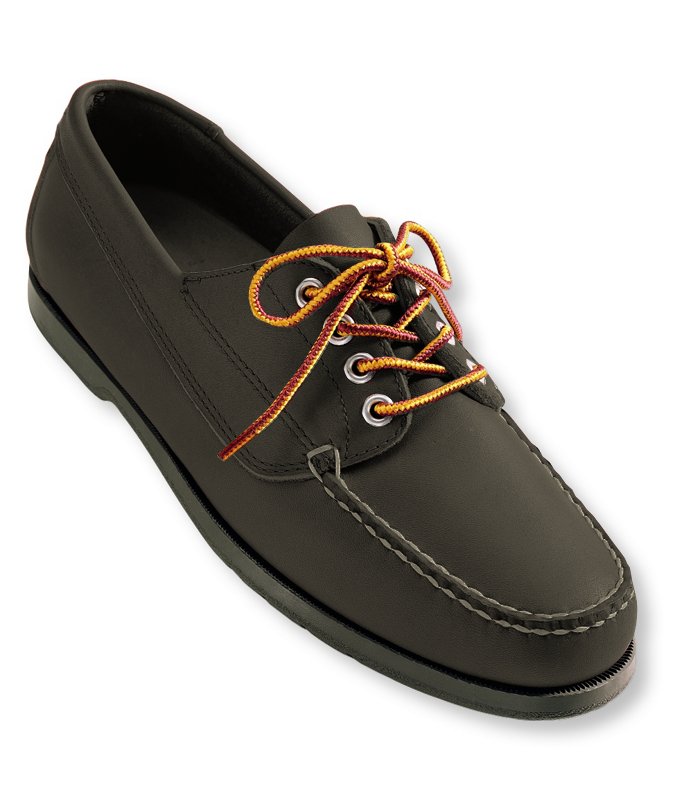
L.L. Bean Handsewn Moccasins, Blucher Moc
I went on a little shopping binge this summer. It’s shameful, because even though I’m always rallying against excessive materialism and conspicuous consumption, I’m also a mall nut and a packrat (and, I might add one hell of a bargain hunter) and on top of that was probably a little depressed, too. So I was at malls a lot, looking for a lift (I guess) and also discovered I was finally had a nice enough body to wear t-shirts and shorts without looking like a war-torn starving villager in one of those old “Care” commercials.
It was the perfect storm.
I bought a lot of shorts and t-shirts (and baseball caps) during my binge, along with a few extra pairs of sneakers to go along with them, because you can’t rock the new gear with old kicks, y’know what I’m sayin’? Sorry, got a little ‘hood there. Anyway, I was set...unless I wanted to look a little classier (I was wearing this stuff to work, too). Where should I turn to kick it up a notch?
The old-school.
Preppy was hot this year, so boat shoes seemed like a logical choice…but not really. You see I’ve always liked the general style of boat shoes, but the way that people wear them kind of dampens my enthusiasm for them. For one thing they’re not “dress shoes,” but yet people around here persist in trying to wear them to dressy occasions, usually in a color that doesn’t match anything else they’re wearing. My God, if I see another goober in a blue denim shirt, black pants, white socks and brown boat shoes calling themselves “dressed up,” I’ll hurl. Strike one. Then there’s finding the right type. The market is flooded with cheap Topsider knockoffs and the good stuff is hard to find, especially in my size (13 B). When the appropriate classy pair of luggage-brown Sebago boat shoes was found at Nordstrom, they cost over a hundred dollars. Strike two.
My inspiration for the right pair of causal shoes came from a person that no one who knows him would ever associate with “style”: Eddy Hicklin. Eddy’s a land surveyor, and not a particularly flashy one at that. But he’s a tall, slim guy who’s in decent shape, and he could make whatever he was wearing look nice. The dude could rock overalls and a bright yellow Green Bay Packers sweatshirt with a Packers bucket hat and still look great! We used to work together and on some of the days he didn’t go out into the field, he would wear an old pair of L.L. Bean Blucher Mocs in the “cactus” color. They had a few years on them, but they were great on him, worn to the old-shoe perfection that we all enjoy when we find a shoe that’s “just right” and wear it ‘till it falls apart. This could be the shoe I need to buy, I thought.
I’m on the horns of a dilemma, though. No one outside of a few people who haven’t let the ‘80s go and/or hard core Bean fans are wearing these shoes these days. Eddy’s looked at least 5 or 10 years old. They peaked fashion-wise around here circa 1987. At that time, preppy was in, and almost anyone who was cool in my age group had a pair, either the real ones or a Sebago, Bass, or whatever knockoff. Even Kmart had them. I didn’t have any. I was too shy to ask for anything because my family was kind of broke at the time, and it never struck my parents’ consciousness that I wanted any, anyway. So I grew out of it and moved on, but a certain part of me wanted to have a pair, even when they were woefully out of style in the grunge-covered world that was ‘90s fashion. To tell you the truth, other than when my friend Todd Martin bought a pair for work back when we were in college I wasn’t sure if they still made them. Or if my flat narrow feet would look good in them. I was miserable when I really shouldn’t have been. God, they’re just shoes, I thought, what’s the big deal either way?
The answer to my question came in the mail. I went to the mailbox one day in the spring and out popped the latest L.L. Bean catalog. On page 56, they had them: the old Blucher Mocs I remember, in my size for less than $70.00. This was it. I was going to get my perfect summer shoes and if they didn’t work, I would utilize L.L. Bean’s liberal return policy. When I got up the nerve to call, they were backordered. I began to question my decision. Was it a sign? Naw, man stop being stupid, I told myself. After a month of backorder and a daily check of the package tracking once they were shipped (the internet: we love obsessive people!) I got them in the mail on a Saturday morning. I was excited, to say the least. I put them on right away.
coming soon, part two
find out what happend after I tried them on...
Sunday, August 01, 2004
steve’s sneaker collection (in no particular order)
I love shoes. I don't know why, but I do. I've got at least a couple dozen pairs, but the closet right now is dominated by my sneakers, so I thought I'd let y'all in on my stash. They are:
Nike Air Force 1 Mid (white/white)
Nike Air Force 1 High (white/black)
Nike Delta Force ¾ (white/red)
Nike Dunk Premium (khaki/brown/white)
Nike Shox NZ (silver/white/black/red)
Nike Shox Turbo (white/black/silver)
New Balance MX609 (white/blue)
New Balance M991 (gray/white)
New Balance M806AT (gray/black/yellow)
New Balance M475 (black/white)
New Balance M1221 (white/blue/red)
adidas Superstar 1 (white/black)
In a few days, I'll follow with some reviews of these sneaks.
Nike Air Force 1 Mid (white/white)
Nike Air Force 1 High (white/black)
Nike Delta Force ¾ (white/red)
Nike Dunk Premium (khaki/brown/white)
Nike Shox NZ (silver/white/black/red)
Nike Shox Turbo (white/black/silver)
New Balance MX609 (white/blue)
New Balance M991 (gray/white)
New Balance M806AT (gray/black/yellow)
New Balance M475 (black/white)
New Balance M1221 (white/blue/red)
adidas Superstar 1 (white/black)
In a few days, I'll follow with some reviews of these sneaks.
Tuesday, July 27, 2004
The crowning jewel of SouthPark
It's a great day to be a SouthPark fan. Yesterday, Neiman Marcus officially announced it will open a new department store in Charlotte at my favorite mall as part of its expansion.
If you've been reading here for any length of time, you'll know that I love all forms of shopping, especially really nice shopping like SouthPark offers. Having a NM closer allows me to check out what's fashionable within a day's drive. It joins an impressive list of tenants at SouthPark, including Burberry, St. John, Sur La Table, Nordstrom, and Louis Vuitton. On top of all the exclusive stores, SouthPark has the flagship Belk department store, and the largest Dillard's and Hecht's stores in the region. It's a fashionista's wet dream. And it's in North Carolina, smack in the middle of NASCAR country!
This announcement has a dark side, hard as that may be to believe. There's a good chance that Saks Fifth Avenue, another fine specialty department store with plans for Charlotte (namely, at one point, the exact spot where NM is locating) won't be coming. Saks is scheduled to be a part of the Village at Seven Eagles, an upscale development not too far from SouthPark that has had all sorts of financial problems during its construction. Rumor is that it may not be built at all, leaving saks homeless with almost no suitable sites left in the Queen City.
Anyway, the article gives the facts and figures, read below...
Neiman Marcus coming to SouthPark
AMY BALDWIN, charlotte.com, July 27, 2004
Hold on to your Prada handbag. Neiman Marcus is coming to Charlotte.
The Dallas-based department store chain, known to fans as the creme de la creme of retail, will open a store at SouthPark in fall 2006.
The store will be Neiman Marcus' 39th property and the mall's sixth anchor. The announcement, from mall manager and owner Simon Property Group, confirmed year-old speculation that Neiman Marcus was headed to the Queen City.
Longtime Charlotte developer Henry Faison, whose company helped spearhead SouthPark's expansion, said, "This is another large step in creating the finest shopping experience in the Carolinas. Charlotte is a world-class city and deserves world-class shopping."
Charlotte real estate analyst Frank Warren, president of Warren & Associates, said the arrival of Neiman Marcus speaks to the region's shifting demographics. With Charlotte's two big banks pulling in affluent employees from the Northeast, he said, retailers are responding with upscale stores.
Shoppers familiar with Neiman Marcus might envision a store much larger than the one planned for Charlotte. At 80,000 square feet, this Neiman Marcus will be the chain's second smallest, ahead of Palm Beach's 53,000-square- foot store, according to the company's corporate Web site.
By comparison, Atlanta's Neiman Marcus, the closest to Charlotte, is nearly twice as large at 154,000 square feet.
Neiman Marcus did not return a phone call seeking comment.
City officials and retail analysts said the addition confirms Charlotte as an undisputed shopping hub. Retailers and shoppers expressed delight.
"It's very much needed," said Laura Snyder, who was shopping Monday at Phillips Place. "We'll have access to more designers, a greater variety of styles."
The excitement over a store that sells $1,000 suits and $150 neckties underscores a point noted by economists: Despite some soft spots in the U.S. economy, high-end retailers are thriving.
Upscale department stores such as Neiman Marcus and Nordstrom have been enjoying double-digit sales growth this year, said Malachy Kavanaugh, spokesman for the International Council of Shopping Centers.
Neiman Marcus' June sales grew 13 percent over the previous June, according to the company's Web site.
"A lot has to do with the economy, the tax rebates ... the (strong) housing market in which people can cash out equity on their homes," Kavanaugh said.
Discount retailers have seen more modest results because the economic recovery hasn't trickled down to middle- and lower-income customers, he said.
Neiman Marcus oozes style and exclusivity. Its cache of labels are the finest the fashion world offers -- $3,000 leather jackets by Valentino and $485 satin pumps by Manolo Blahnik, to name a few.
Most labels sold by Neiman Marcus, known to some critics by the moniker "Needless Markup" already are available in Charlotte at specialty shops such as Paul Simon, or at department stores such as Nordstrom, which opened in March, and Belk.
Other brands found under a Neiman Marcus roof have their own shopping outlets. Burberry, known for its iconic plaid check rain hats and coats, and Louis Vuitton, known for its designer Marc Jacobs, are two such examples. Both have stores in the new SouthPark wing that Neiman Marcus will enter.
But high-end shopping isn't just about access to luxury goods, shoppers say. Neiman Marcus is as much about the experience.
"Neiman Marcus to me is the ultimate. It kind of says elegance to me," said Judy Hovis, president of the Charlotte chapter of the National Association of Women Business Owners and an avid shopper.
Hovis, a telecommunications executive, said she'll do lots of shopping when Charlotte's Neiman Marcus opens.
Rumors of Neiman Marcus' arrival had circulated since last July, when Charlotte developer Dee-Dee Harris said she would bring competing retailer Saks Fifth Avenue to the corner of Park and Gleneagles roads. Faison had announced that Saks was headed for SouthPark's new wing. But with Saks no longer destined for SouthPark, the buzz centered on Neiman Marcus.
It's unclear how Neiman Marcus might affect Harris' plans for Saks. In April, Harris sent letters to city and state officials asking for financial assistance to complete her $200 million project, where construction has stopped. Harris did not return a phone call seeking comment.
For the past year, SouthPark merchants have fielded queries from shoppers who had heard the Neiman Marcus rumors. One retailer, Michelle Schmitt, said she frequently asked mall management if it would land Neiman Marcus.
"I am interested on the business end. I want more people shopping here at my cart," said Schmitt, owner of the BeJeweled cart that sells pearl and sterling jewelry. "The more the merrier really. It brings more money to everybody."
Retail and real estate analysts said Neiman Marcus will lure customers from miles and even states away. Charlotte's location will be the only one between Washington and Atlanta.
Warren, the real estate analyst, said, "This will bring customers in from locations farther away from Charlotte, and those customers will be high-end."
Name Brand
** The store in Charlotte will be No. 39.
** Closest store to Charlotte now is Atlanta's 154,000- square-foot store that opened in 1973.
** HQ: Dallas, Texas
Tuesday, July 06, 2004
beautiful food court with mediocre food
SouthPark’s new food court opened recently, and this lady who wrote the article below shares my disappointment with the food choices. Although she’s making a little much of Chick-fil-A. The old food court wasn’t as dingy as she said, actually it was quite nice in a 1988 sort of way. I miss when they used to have Bananas /Everything Yougurt, Bain’s Deli, Mrs. Field’s and Flamers (circa 1996). They were good.
Trust me on this one. If you’re there and hungry, go with Maggiano's, Cheesecake Factory, Arthur's in Belk and Nordstrom's café.
Please read the article below, and tell me what you think.
Posted on charlotte.com on Fri, Jun. 18, 2004
THE SKINNY ON DINING -- HELEN SCHWAB
Can't the food match the court?
I, apparently the only woman in the free world who did not care when Nordstrom agreed to a SouthPark site, have since eaten my words: cool shoes.
But the words turned out to be tastier than anything I tried at the recently opened SouthPark food court near Nordstrom. Aside from Chick-fil-A -- the once, current and future king of fast food, in my opinion -- the food emporium, as it were, has no clothes.
Which is not to say it doesn't look great. It does. Really great. Airy, clean-lined, studded with palms and with a double-high central area delineated by handsome columns. Matte-silvery chairs with blond wood seats and a cream-and-white tile floor aid the light-filled feel of the place, a vast improvement over the dingy original. It'll connect to an outdoor plaza, slated to be done by September, if not sooner.
But the food?
Bistro 7 isn't open -- and probably won't be until fall, since it just began construction. It'll offer rotisserie meats, soups, salads and sandwiches. Nestle Tollhouse Cookies/Auntie Anne's Pretzels also isn't open yet, but we know what those are. I'm a fan of the buttery pretzels with varied toppings, but they're no vibrant surprise. Neither are the places staying from the old food court: Great Steak & Potato Co. (eh), Villa Pizza (ecch) and Showmars (yum).
But -- and here's the sad thing -- neither are the new places: Maki of Japan, Chinese Gourmet Express and Subway.
Subway you know. Chinese Gourmet Express offers a steam table with two- and three-item combos and the like. Strictly average on my visit. Maki of Japan may bear watching. At least sushi and tempura are on its menu, though the first was prepackaged and average, and the last not offered when I went. Bourbon-glazed chicken was OK, noodles greasy, but plans do call for on-site grilling when more equipment is in, says mall director of marketing Julie Harrell.
And that could be as good as it gets for court-eaters. Sit-down dining, joining Maggiano's, Cheesecake Factory, Arthur's in Belk and Nordstrom's cafe and E-bar, is still planned at the mall's west end, with details out maybe next week, says Harrell.
Nordstrom taught me to wish for shoes that go with what I'm wearing. Now I wish we'd gotten food to match the court.
Trust me on this one. If you’re there and hungry, go with Maggiano's, Cheesecake Factory, Arthur's in Belk and Nordstrom's café.
Please read the article below, and tell me what you think.
Posted on charlotte.com on Fri, Jun. 18, 2004
THE SKINNY ON DINING -- HELEN SCHWAB
Can't the food match the court?
I, apparently the only woman in the free world who did not care when Nordstrom agreed to a SouthPark site, have since eaten my words: cool shoes.
But the words turned out to be tastier than anything I tried at the recently opened SouthPark food court near Nordstrom. Aside from Chick-fil-A -- the once, current and future king of fast food, in my opinion -- the food emporium, as it were, has no clothes.
Which is not to say it doesn't look great. It does. Really great. Airy, clean-lined, studded with palms and with a double-high central area delineated by handsome columns. Matte-silvery chairs with blond wood seats and a cream-and-white tile floor aid the light-filled feel of the place, a vast improvement over the dingy original. It'll connect to an outdoor plaza, slated to be done by September, if not sooner.
But the food?
Bistro 7 isn't open -- and probably won't be until fall, since it just began construction. It'll offer rotisserie meats, soups, salads and sandwiches. Nestle Tollhouse Cookies/Auntie Anne's Pretzels also isn't open yet, but we know what those are. I'm a fan of the buttery pretzels with varied toppings, but they're no vibrant surprise. Neither are the places staying from the old food court: Great Steak & Potato Co. (eh), Villa Pizza (ecch) and Showmars (yum).
But -- and here's the sad thing -- neither are the new places: Maki of Japan, Chinese Gourmet Express and Subway.
Subway you know. Chinese Gourmet Express offers a steam table with two- and three-item combos and the like. Strictly average on my visit. Maki of Japan may bear watching. At least sushi and tempura are on its menu, though the first was prepackaged and average, and the last not offered when I went. Bourbon-glazed chicken was OK, noodles greasy, but plans do call for on-site grilling when more equipment is in, says mall director of marketing Julie Harrell.
And that could be as good as it gets for court-eaters. Sit-down dining, joining Maggiano's, Cheesecake Factory, Arthur's in Belk and Nordstrom's cafe and E-bar, is still planned at the mall's west end, with details out maybe next week, says Harrell.
Nordstrom taught me to wish for shoes that go with what I'm wearing. Now I wish we'd gotten food to match the court.
Monday, July 05, 2004
Dead Mall Story: South Square Mall, Durham, North Carolina
This is one of the "dead mall" stories I sent into deadmalls DOT com. Brian Florence hasn't gotten around to pubishing this yet, but I'm sure he will soon. In the meantime, enjoy...
There are several large green highway signs along US 15/501 north from Interstate 40 announcing the site of South Square Mall in Durham, North Carolina. At that site, located near the intersection of the 15/501 bypass around the city and the business route, there are a couple more. But there is no mall. There are remnants of the former complex: an Office Depot that was once a supermarket and even some old parking lot lighting, but nothing else. In its place stands a shiny new Sam’s Club, a Super Target store and Ross Dress for Less. The new shopping center, still called South Square, is impressive and well-trafficked, but pales in comparison to what stood on the site a few short years earlier. That site, surrounded today by office towers, fast food restaurants and a couple of Michael Jordan’s new car dealerships, is where South Square Mall opened in the summer of 1975.
The American enclosed mall boom was well underway in the mid-1970s, and the Raleigh-Durham area was no exception to the trend. South Square was not the first enclosed mall in the area, or the first in its neighborhood. It was, however, the largest mall in Durham when it opened, and signaled the decisive shift of commerce away from downtown. Anchored at first by JCPenney, Belk-Leggett, Montgomery Ward and Miller & Rhoads, this was a middle market mall with upscale aspirations and the demographics to prove it. It was large and fancy enough to attract shoppers from both nearby Chapel Hill, which saw its own enclosed mall, built two years earlier, take a direct sales and prestige hit from South Square, and from the growing Research Triangle Park, with its high-income employees, many of which had come from larger cites already very familiar with suburban shopping.
For the first twenty years or so, South Square was able to rest on its laurels with no threats to its existence. The anchors were largely stable. JCPenney and Belk-Leggett remained at the mall through its entire existence. Montgomery Ward closed due to poor sales in 1983, only to be replaced by a splashy new Ivey’s a year later (which became Dillard’s in 1990). About the same time as Ivey’s arrived, Miller & Rhoads closed due to a retrenchment by its parent company and the space was taken over by a spacious new food court. The mall was remodeled in the mid 1980s and the tenant roster changed from Seventies stalwarts like Kinney Shoes, Radio Shack and Orange Julius to up-market chains like Abercrombie & Fitch and White House/Black Market. There was even talk of expanding the mall to accommodate a new Hecht’s store in the early ‘90s. Things, it seemed, couldn’t be better.
A single word changed the game for South Square and forever altered the Raleigh-Durham area’s retail balance: Southpoint.
At first conceived as a small, possibly open-air shopping center to capture more of the Research Triangle Park’s retail wealth in Durham County at a site along Interstate 40, eight miles to the east of South Square, Southpoint’s early developers, Urban Retail Properties, was able to get the attention of May Department Stores’ Hecht’s division, which was the first anchor signed. Hecht’s had no nearby locations and negotiations had broken off with South Square’s developers, Faison Associates. Soon, Sears committed to the project as well. At first, South Square and Southpoint were to be seen as friendly rivals, complimenting each other much like South Square complimented the offerings at University Mall in Chapel Hill and Northgate Mall across town. But Urban picked up more interest in its project as conditions at South Square began to deteriorate.
South Square Mall had been coasting for many years, as was stated earlier. The area around it remained prosperous and there were few alternative venues for chain stores in the immediate area. Faison began using the mall as a “cash cow,’ taking more money out of the property than it was investing into it. As a result, the mall began to look and feel tired. Maintenance began to drop off, crimes went up. Sales stagnated, especially as cross-town formerly friendly rival Northgate Mall completed a major expansion and renovation in 1995. The 1980s renovation at South Square was wearing thin, and many of the chain stores stopped remodeling or simply closed. The retail market was evolving from traditional mall tenants to big-box retailers and discounters, spearheaded in the Durham area by New Hope Commons, two miles west of the mall at Interstate 40 and US 15/501. To be sure, the mall was getting squeezed. Faison began to promise renovations for South Square starting around the same time that Northgate remodeled, but nothing ever happened.
Belk-Leggett (which became Hudson Belk in 1997) and JCPenney were officially committed to staying at South Square as late as 1999, but Urban Retail, sensing its project could become a major regional destination, began to woo Nordstrom. Nordstrom had no local stores but plenty of local fans and had broken off negotiations at two other nearby shopping centers. Southpoint had many advantages: it was a new site, close to a high concentration of wealth and already had a lot of retailer interest to boot. So, after some trepidation, North Carolina’s first Nordstrom store was set to open at Southpoint. Nordstrom turned Southpoint from a pipe dream to a contender for the area’s retail supremecy. With the threat of an upscale mega-mall harnessing a majority of South Square’s customers, JCPenneyand Hudson Belk made the decision to move to Southpoint, thereby signaling the imminent death of South Square Mall.
The Streets at Southpoint (as it came to be called) opened on March 11, 2002 to an enthusiastic public response. That same day, South Square Mall was emptied of two of its anchors and nearly all of its small shops. Dillard’s was the largest store in a “ghost mall” where the remaining stores planned to leave as soon as their leases would let them. Most of the last stores were either traditional retailers that were discouraged from leasing at the new mall (athletic shoe stores, Radio Shack, Piccadilly Cafeteria) or mom or pop stores that couldn’t afford the substantial rents elsewhere. By August, Dillard’s pulled the plug on its store and the city of Durham, citing falling sales. South Square Mall was closed for good by Christmas of that year.
The flattening of South Square Mall was one the largest demolitions in the history of Durham and was carried out in the spring of 2003. Many ideas for the site were offered in public forums around the area, but ultimately retail won out. Construction started on the “new” South Square in summer 2003 and continues to this day, with its first new store, Super Target, opened in March 2004.
Thursday, July 01, 2004
The Incredible Shrinking Kmart
Being the retail nut that I am, I grabbed this story from VisualStore about Kmart's plans to sell off even more stores to other retailers, namely Sears.

I used to have Kmart stock a few years ago. When I bought it, they were on an upswing (I thought) and seemed like a good investment. Little did I know, the bottom was about to fall out of the stock price. My small investment not only lost money, but the stock itself became worthless when Kmart Corporation dissolved under Chapter 11 bankruptcy and was reborn as Kmart Holding Corporation with all new stock (which is doing very well, I might add).
I was largely indifferent to Kmart before; I mean it's okay, but Target's a little cooler and Wal-Mart has better prices. Nowadays, even though I should have taken my money and went shopping at Kmart rather than invest in it, I kind of like it. They have some cool things and these days it's easy to get in and out of. It's sad to see it wither away. Oh well, the only thing that doesn't change is the fact that everything changes. Read on.
Sears Goes Shopping
Retailer to acquire 61 former Kmart, Wal-Mart locations
from visualstore.com
Sears, Roebuck and Co. (Hoffman Estates, Ill.) has agreed to acquire ownership or leasehold interest in up to 61 off-mall stores from Kmart Holding Corp. (Troy, Mich.) and Wal-Mart Stores Inc. (Bentonville, Ark.) for approximately $620 million in cash.
The majority of the stores are expected to be converted by fourth quarter 2005 to Sears nameplates, including a new mid-size format that is modeled on Sears Grand.
The Kmart stores are located primarily in large, urban markets with home, family and income demographics similar to Sears' target demographics. The seven Wal-Mart stores are located in mid-size markets that Sears says also fit well into its market and demographic profile.
"These transactions will jump-start our strategy to grow the Sears brand off-mall, increase our points of distribution, and acquire well-located real estate at a fair value in key markets for Sears," said chairman and ceo Alan Lacy. "The acquisitions will allow us to quickly open more stores and significantly boost our off-mall retail presence in priority markets that have synergies with our existing mall-based stores."
Sears said it plans to increase the pace of growth for its Sears Grand format, targeting three of the newly acquired Kmart locations for conversion to Sears Grand stores. Including the previously announced four Sears Grand stores expected to be opened by the end of 2004, the company expects to be operating 12-14 Sears Grands at the end of 2005.
The portfolio of stores to be acquired average 110,000 gross square feet and 84,000 selling square feet, compared with an average of 90,000 selling square feet for Sears’ current full-line stores. Most of the new stores will be converted to the new mid-size format, modeled on Sears Grand. The floor design of the new stores will be on one level, utilizing a common layout similar to the open-racetrack design of existing Sears Grand stores, with exit cashiering near the door. The design will allow more efficient store operations and a significantly increased ratio of selling to gross square footage.
“Almost 60 percent of these new locations will be in the top 15 DMAs and will significantly increase our store coverage in the nation's largest markets, filling in our footprint and supplementing our mall-based stores by providing customers with the convenience they need," Lacy said. "Starting with a "Best of Sears" assortment tailored for specific markets, we will employ many of the successful merchandising and design elements of Sears Grand in the mid-size floor plan of the new format. These new off-mall stores will have improved operating efficiency and leverage our supply chain and marketing expenses."
Sears will pay cash for the Kmart stores and make lease payments under subleases for the seven Wal-Mart stores. The acquisitions include real estate and Kmart store fixtures, but exclude inventory and liabilities not related to leases. Sears expects to take possession of four stores in 2004, up to 55 stores in 2005 and the remaining two stores in 2006. Sears plans to invest approximately $200 million to remodel and re-fixture the stores, and expects to complete conversions of the majority of the locations by fourth quarter 2005. The acquisitions are expected to be accretive to earnings in the first full year of operation, 2006.
The Sears deal, and a previously announced sale of store locations to The Home Depot Inc. (Atlanta), will net the struggling Kmart almost $1 billion. "Both transactions represent opportunities to realize value, which can be utilized to improve the remaining store base and to strengthen the company," said Kmart president and ceo Julian Day. "We are not currently in discussions regarding any additional significant store sales, although we will continue to evaluate opportunities as they arise. Kmart will remain one of the largest retailers in America, with over 1420 stores and approximately $20 billion in revenues. We will be able to direct all our attention on building upon and accelerating the considerable operating improvements that we have already achieved, including the fall apparel launch in July and our partnership with the WB Network. We have a strong management team in place and are committed to making Kmart a better company every day."

I used to have Kmart stock a few years ago. When I bought it, they were on an upswing (I thought) and seemed like a good investment. Little did I know, the bottom was about to fall out of the stock price. My small investment not only lost money, but the stock itself became worthless when Kmart Corporation dissolved under Chapter 11 bankruptcy and was reborn as Kmart Holding Corporation with all new stock (which is doing very well, I might add).
I was largely indifferent to Kmart before; I mean it's okay, but Target's a little cooler and Wal-Mart has better prices. Nowadays, even though I should have taken my money and went shopping at Kmart rather than invest in it, I kind of like it. They have some cool things and these days it's easy to get in and out of. It's sad to see it wither away. Oh well, the only thing that doesn't change is the fact that everything changes. Read on.
Sears Goes Shopping
Retailer to acquire 61 former Kmart, Wal-Mart locations
from visualstore.com
Sears, Roebuck and Co. (Hoffman Estates, Ill.) has agreed to acquire ownership or leasehold interest in up to 61 off-mall stores from Kmart Holding Corp. (Troy, Mich.) and Wal-Mart Stores Inc. (Bentonville, Ark.) for approximately $620 million in cash.
The majority of the stores are expected to be converted by fourth quarter 2005 to Sears nameplates, including a new mid-size format that is modeled on Sears Grand.
The Kmart stores are located primarily in large, urban markets with home, family and income demographics similar to Sears' target demographics. The seven Wal-Mart stores are located in mid-size markets that Sears says also fit well into its market and demographic profile.
"These transactions will jump-start our strategy to grow the Sears brand off-mall, increase our points of distribution, and acquire well-located real estate at a fair value in key markets for Sears," said chairman and ceo Alan Lacy. "The acquisitions will allow us to quickly open more stores and significantly boost our off-mall retail presence in priority markets that have synergies with our existing mall-based stores."
Sears said it plans to increase the pace of growth for its Sears Grand format, targeting three of the newly acquired Kmart locations for conversion to Sears Grand stores. Including the previously announced four Sears Grand stores expected to be opened by the end of 2004, the company expects to be operating 12-14 Sears Grands at the end of 2005.
The portfolio of stores to be acquired average 110,000 gross square feet and 84,000 selling square feet, compared with an average of 90,000 selling square feet for Sears’ current full-line stores. Most of the new stores will be converted to the new mid-size format, modeled on Sears Grand. The floor design of the new stores will be on one level, utilizing a common layout similar to the open-racetrack design of existing Sears Grand stores, with exit cashiering near the door. The design will allow more efficient store operations and a significantly increased ratio of selling to gross square footage.
“Almost 60 percent of these new locations will be in the top 15 DMAs and will significantly increase our store coverage in the nation's largest markets, filling in our footprint and supplementing our mall-based stores by providing customers with the convenience they need," Lacy said. "Starting with a "Best of Sears" assortment tailored for specific markets, we will employ many of the successful merchandising and design elements of Sears Grand in the mid-size floor plan of the new format. These new off-mall stores will have improved operating efficiency and leverage our supply chain and marketing expenses."
Sears will pay cash for the Kmart stores and make lease payments under subleases for the seven Wal-Mart stores. The acquisitions include real estate and Kmart store fixtures, but exclude inventory and liabilities not related to leases. Sears expects to take possession of four stores in 2004, up to 55 stores in 2005 and the remaining two stores in 2006. Sears plans to invest approximately $200 million to remodel and re-fixture the stores, and expects to complete conversions of the majority of the locations by fourth quarter 2005. The acquisitions are expected to be accretive to earnings in the first full year of operation, 2006.
The Sears deal, and a previously announced sale of store locations to The Home Depot Inc. (Atlanta), will net the struggling Kmart almost $1 billion. "Both transactions represent opportunities to realize value, which can be utilized to improve the remaining store base and to strengthen the company," said Kmart president and ceo Julian Day. "We are not currently in discussions regarding any additional significant store sales, although we will continue to evaluate opportunities as they arise. Kmart will remain one of the largest retailers in America, with over 1420 stores and approximately $20 billion in revenues. We will be able to direct all our attention on building upon and accelerating the considerable operating improvements that we have already achieved, including the fall apparel launch in July and our partnership with the WB Network. We have a strong management team in place and are committed to making Kmart a better company every day."
Wednesday, June 30, 2004
Dead Mall Story: Crossroads Mall, Roanoke, Virginia
This is one of the "dead mall" stories I sent into deadmalls DOT com. Brian Florence hasn't gotten around to pubishing this yet, but I'm sure he will soon. In the meantime, enjoy...
Crossroads Mall was only one of a handful of enclosed suburban shopping centers and the first of its kind in Virginia when it opened three miles north of Roanoke in 1961 at the intersection of Williamson Road (US 11), Hershberger Road (Route 101) and Airport Road. Developer T.D. Steele and his designers created a unique and popular shopping experience for an eager public. Throngs of shoppers left the long-dominant downtown to stroll through a grand two-story interior shopping hall reminiscent of Southdale Shopping Center in Edina, Minnesota. Crossroads was the first suburban shopping area in Roanoke that maintained night hours (until 9 PM) from Monday to Saturday.
Crossroads was one of three large suburban shopping centers built in the Roanoke area in 1961 and 1962. Towers Shopping Center, a two-level strip mall built on a mountain in south Roanoke featured a small interior mall with escalators to connect the two levels and opened a few months after Crossroads in 1961. Roanoke-Salem Plaza, an open-air center with a long pedestrian promenade opened in 1962, three miles to the west of Crossroads. The onslaught of new suburban retail space decimated downtown Roanoke, leading it to a slow and steady period of decline that persisted for nearly 25 years, until revitalization efforts brought it back to life, though not as a major retail destination.
Original anchors at Crossroads were JCPenney, Roses variety store, Heironimus department store, Winn-Dixie and Peoples Drug. Other original mall tenants included Fink’s Jewelers, Smartwear Irving-Saks (fine apparel), Sidney’s (women’s apparel), Thom McAn, Pete’s Deli, Cato Fashions and Bailey’s Cafeteria. Bailey’s was on the upper level and featured a open dining room that overlooked the mall’s lower level, which featured two large fountains and park-like greenery and benches.
In 1966, Crossroads Mall was expanded to coincide with opening of I-581 which came within a mile of Crossroads via Hershberger Road. A two-screen theater was added on the east side of the mall. JCPenney added 25,000 square feet to its store (growing to 85,000 square feet) and a free-standing auto center. In addition, Woolco was added to the west end of the upper level along Hershberger Road, along with a subterranean French restaurant called Fesquet’s that was very popular. Further outparcel expansion to the west in the late ‘60s and early ‘70s included Kroger and SupeRx Drugs, a small-shop building housing a Virginia ABC store, a free-standing K&W Cafeteria, and a drive-thru for Colonial American National Bank. The mall even erected a massive replica of St. Louis’s famed Gateway Arch as its sign along Hershberger Road.
Crossroads developer Steele was able to parlay his success into two other malls in the greater Roanoke area: Tanglewood Mall, built in 1973, was a larger mall located 9 miles south of Crossroads in affluent southwest Roanoke County. Tanglewood’s opening crippled Towers Shopping Center for a short period, since both malls were within two miles of each other and Tanglewood was clearly the larger, fancier and more-modern center. University Mall in nearby Blacksburg opened in 1974 and was much smaller than Crossroads. It catered to the college students at Virginia Tech and local residents.
About the time Steele’s malls had come into their own, developer Henry Faison proposed a substantial new shopping center called Valley View Mall that would be built on a large tract of land at the intersection of I-581 and Hershberger within a mile of Crossroads. The new mall was located in the “clear zone” for the local airport and was hotly contested for many years but by 1982, Faison had won approval for his plans and prepared for a 1985 opening.
It seems as soon as Valley View started construction, problems arose at Crossroads Mall. Between 1980 and 1985, store vacancies began to increase, including the loss of large anchors Winn-Dixie (1981), Woolco (1982) and Roses (1984). The mall’s décor and marketing became increasingly tired and new trendy stores were signing to Valley View and Tanglewood rather than locating at Crossroads, even if it meant waiting a year or two to open. Crossroads rebounded somewhat when Kmart signed on for most of the Woolco space in 1983, but it was clearly in crisis, especially when JCPenney announced it was leaving Crossroads for a larger, more modern store at Valley View. To be sure, Roanoke-Salem Plaza was also experiencing occupancy troubles, but the problems at that center stemmed more from poor management and neighborhood changes than competition.
July 17, 1985 is a day that will live in Roanoke retail infamy. That day, Valley View Mall opened its doors and effectively killed Crossroads Mall’s hopes of ever being a regional retail destination again. Crossroads lost half of its stores by that day and nearly half of the remaining stores within two years as leases expired. It still fared better than Roanoke-Salem Plaza, which was already ailing and lost nearly all of its stores.
New ownership christened the center Crossroads Consumer Mall, renovated the interior and attempted to attract discount stores and outlets. Although the renovation added a food court and helped the mall land Circuit City and Waccamaw Pottery, among others, there was an eerie silence that enveloped the interior of the mall (and still does to this day) as stores continued to leave and the replacements generated fewer and fewer customers. The construction of another strip shopping center, Towne Square, behind Crossroads along Airport Road brought few positive residual effects for the mall. In fact, Heironimus defected to Towne Square in 1990.
Along with Heironimus, the “Consumer” portion of Crossroads’ name was gone by the early ‘90s, as yet another owner, Zamias Services, began dismantling the small shop spaces and turning them into big-box spaces facing the outside, leaving a sad, empty interior promenade. The vast parking lots that surrounded the mall were carved up by Zamias in an attempt to generate cash flow. McDonald’s and Blockbuster helped cover up what was left of Crossroads Mall’s exterior which had been painted white to mask the effects of age.
Today, Crossroads Mall is occupied but effectively dead. The anchors are Books-A-Million, Circuit City, Kmart, Goody’s Family Clothing, Dollar-Duz-It and Jo-Ann Fabrics. Other tenants include the Virginia Department of Motor Vehicles, Rugged Warehouse and K&W Cafeteria. Of these tenants, only the DMV still has a mall entrance. All but three of the interior shops are vacant. Amazingly, original tenant Pete’s Deli is still there and going strong. Tenants are struggling due to the abundance of other shopping options nearby at Valley View and Towne Square. There will be even less of a reason to choose Crossroads when Circuit City relocates to Valley View in early 2005.
Crossroads Mall’s future is likely as office space. Roanoke-based Advance Auto Parts took over the former Waccamaw Pottery space (vacant since 1998) in 2000 and relocated some of its corporate offices there. As the mall empties out (the DMV is currently looking to leave Crossroads when its lease expires) Advance Auto is taking up more space. With little to no new retail headed for the site as it stands, Crossroads could become the corporate headquarters for an auto parts chain. It’s not a fitting end, but it is a resolution.
Sunday, June 20, 2004
Dead Mall Story: Roanoke-Salem Plaza, Roanoke, Virginia
This is one of the "dead mall" stories I sent into deadmalls DOT com. Brian Florence, the nicest webmaster you'd ever want to meet, hasn't gotten around to pubishing this yet, but I'm sure he will soon. In the meantime, enjoy...
Roanoke-Salem Plaza opened in 1962 at the intersection of Melrose Avenue (US 11/460) and Peters Creek Road (Route 117) in the northwest section of the city near its border with the city of Salem. RSP was the third large shopping center to open in two years in the Roanoke Valley, after the enclosed Crossroads Mall, three miles east and two-level Towers Shopping Center, five miles south. Its developer was B.F. Saul. Original anchors were Leggett and Miller & Rhoads department stores, G.C. Murphy and Woolworth’s variety stores, Winn-Dixie supermarket and Peoples Drug. Other stores from the early days include Hofheimer’s Shoes, Radio Shack, First National Exchange Bank, Sidney’s (women’s apparel), Thom McAn, and Lerner Shops.
RSP’s deign was innovative for its time. The Y-shaped center faced Melrose Avenue and featured a long landscaped pedestrian promenade along its main axis. At the bottom end of the Y was Leggett, the mall’s largest store. The east end of the Y featured Miller & Rhoads and G.C. Murphy, which had both street and mall entrances. The west end had Peoples Drug and Winn-Dixie. Peoples had a prime corner position at the intersection of the Y. Winn-Dixie was next door and faced two parking lots on opposite sides of the store which gave them maximum exposure and led to a unique design featuring two banks of cash registers. Woolworth’s was in a prime position midway through the mall, with its large luncheonette visible to shoppers through the plate glass windows.
Despite being an open-air shopping center in a largely residential neighborhood, Roanoke-Salem Plaza was designed in the manner of an enclosed mall. It did not lend itself to a convenient shopping experience. Except for Winn-Dixie and Leggett, the stores at RSP had precious little storefront parking. Shoppers, in theory, would park in the front, rear or west side of the mall and leisurely walk down the promenade past the various shops, leading to uncontrolled impulse buying along the way. The design ideas made sense for a regional shopping center like Crossroads Mall, where shoppers came from as far away as southern West Virginia, but never quite worked for RSP, which had a more “local” tenant mix and customer base. The novelty factor of the mall worked for only about five years, and then the problems started.
By the late 1960s, “white flight” had led to most of the target shopping audience moving away to avoid the blacks that were settling in to the neighborhood. It should be noted that the blacks were displaced from other areas of Roanoke by urban renewal, and Northwest Roanoke was the easiest and least hostile place to relocate. A silent, largely racist, boycott of the center by white middle-class citizens helped cause store closures starting in the early ‘70s. The pace accelerated when the enclosed “state-of-the-art” Tanglewood Mall opened in 1973 and Leggett, G.C. Murphy, and Miller & Rhoads all opened stores there, making RSP less of a regional retail destination.
The writing was on the wall, Roanoke-Salem Plaza was in trouble. As the ‘70s progressed, every aspect of the mall began to suffer. Stores continued to leave, the landscaping and maintenance went to pot, and crime went up. People were afraid to walk down the promenade, especially at night, for fear of being mugged. Extreme heat in the summer and bitter cold in the winter led many to choose the enclosed Crossroads and Tanglewood malls rather than “rough it” at RSP. Were it not for the initial determination of Leggett and Miller & Rhoads to stay at the center (they still did decent business), the mall would surely have been dead by the late ‘70s.
In 1978, developer Henry Faison proposed Valley View Mall, a substantial new shopping center that would be built on a large tract of land at the intersection of I-581 and Hershberger within three miles of RSP. Miller & Rhoads was one of the first stores to sign to Valley View and announced plans to close their Roanoke-Salem Plaza and downtown Roanoke stores when the new mall opened. Valley View was located in the “clear zone” for the local airport and was hotly contested for many years but by 1982, Faison had won approval for his plans and prepared for a 1985 opening.
By the early ‘80s, it was clear that RSP would not be a viable retail location for much longer. G.C. Murphy pulled out in 1981, leaving a 55,000 square foot vacancy that sat empty for half a decade. Not long after, Leggett announced it was moving to Valley View. Many tenants complained that the mall’s owner B.F. Saul was intentionally letting the center go to pot. Saul countered that the mall would be renovated when Peters Creek Road was extended along the west side of the property. Previously, Peters Creek Road terminated at the west end of the mall near Winn-Dixie. The road project, proposed in the early ‘60s, was not completed until the late ‘90s, and Saul never renovated the center, even as substantially all of the anchor and chain tenants pulled out in 1985.
In 1986, Roanoke-Salem Plaza was sold to Walt Robbins, a developer who specialized in distressed shopping center properties. Robbins had renovated a similar center elsewhere in Virginia and turned it into a popular destination. He had a challenge on his hands with RSP, to be sure. Winn-Dixie, Peoples Drug and Woolworth’s were still there, but little else. Robbins renovated the center, adding a clock tower at its main entrance and new signage throughout, bringing in closeout chain U.S. Factory Outlets to replace G.C. Murphy. The name was inverted as well, to “The Plaza of Roanoke-Salem.” He based his renovations on what he thought was the impending Peters Creek Road extension, promising to bring in more new stores and even more enhancements when the road was completed. But the road project continued to stall, Robbins eventually sold the center and the factory outlet store closed almost as soon as it opened. The three remaining anchors were gone by 1991, leaving little more than a shell of a building.
A funny thing happened on the way to obscurity. Roanoke-Salem Plaza became a de facto “power center,” due in no small part to the Peters Creek Road extension which finally happened circa 1998. Now called Roanoke-Salem Business Plaza, it was brought back to relative life by a series of outlet and parts stores which all grouped along the highways for maximum visibility. Around 1995, Office Outlet, a used office furniture store, moved into the former Winn-Dixie. Business was good enough to justify an expansion into the former Peoples Drug a short time later. The former Miller & Rhoads became a fireplace accessory shop and then an appliance parts store. Woolworth’s became a carpet outlet, while Leggett briefly became a business college and then an auto parts warehouse. A series of smaller spaces were combined to create a space for Harbor Freight Tools in 2002, and smaller spaces are occupied by a computer store and a free-distribution paper
Roanoke-Salem Plaza missed out on being Roanoke, Virginia’s first large mall but it certainly became the area’s first dead mall. Even though is partially occupied, all is not well. The area still has crime problems and the promenade is still deserted. The whole east side of the center is empty and looks much like it did in 1981. Even though the Peters Creek extension has turned the site into a high traffic intersection, the neighborhood is too poor and too close to Valley View Mall to justify the development of chain stores. Unless something changes, Roanoke-Salem Plaza’s fate will be to limp along as a shadow of its former self.
Tuesday, June 15, 2004
hello internet
Hey, anybody who happens to read this, it's me, Steve. I'm delving a little further into geekdom by starting my own blog. I used to have my own website around 1997 or 98, but nobody visited, or at least not after the first couple of weeks, so I got bored and took it offline in 2000. But after a long hiatus, I'm back. It's going to be fun this time, or at least I hope so.
So, here's the deal. I'll spew my guts about whatever or post a bunch of wacky stuff, and you can comment on it. No holds barred. Tell what kind of jackass I am, or if you like something, a little validation, please. Have fun.
So, here's the deal. I'll spew my guts about whatever or post a bunch of wacky stuff, and you can comment on it. No holds barred. Tell what kind of jackass I am, or if you like something, a little validation, please. Have fun.
Thursday, June 03, 2004
Shopping: Men's Fashion, Men's Fashion Trends
Janet Bennett and Robin Givhan, washingtonpost.com Shopping Producer, Post Fashion Editor
Friday, January 23, 2004; 1:00 PM
Women buy clothes on a whim; men buy out of need. Still, according to recent figures, menswear has come out of the sports closet, and more men are spending more on their attire. They're getting rid of the flip-flops and the same-old khakis and searching for something between the very casual and the stuffy suit of yesterday.
Join Washington Post fashion editor Robin Givhan and washingtonpost.com shopping producer Janet Bennett online Friday, Jan. 23 at 1 p.m. ET to discuss the increasing number of men interested in a finished, more polished style -- as well as how many men think of themselves as metrosexuals.
The transcript follows.
Editor's Note: Washingtonpost.com moderators retain editorial control over Live Online discussions and choose the most relevant questions for guests and hosts; guests and hosts can decline to answer questions.
________________________________________________
washingtonpost.com: Men and fashion are not two words we usually put together in the same sentence, but we know you guys (and your significant others) have a lot of pent-up questions about the subject, so today Robin Givhan, Washington Post fashion editor extraordinaire, will do her best to address them. Without further ado, fire away.
_______________________
Robin Givhan: Good afternoon! Thanks for logging in for our little discussion about men's fashion. My first taste of the fashion industry was writing about menswear, so it's a pleasure to be able to talk about it today!
_______________________
Fairfax, Va.: Do most women really care what a man wears/dresses like
Robin Givhan: Oh but of course. At least that's my humble female opinion!Women also care about a man's intelligence, sense of humor, integrity, listening skills, etc. But style is what that whole package is wrapped up in. It's the first impression.
_______________________
College Park, MD: Is the changing male fashion scene the result of the gay influence on fashion
Robin Givhan: In a word, yes. but it's also influenced by a host of other factors. I am loathe to make a sweeping statement about a "gay aesthetic," but it would be fair to say that a significant number of movers and shakers in the fashion industry are gay, that gay men, on average tend to be more adventurous and more focused on clothes - or at least are willing to admit that they are. but the male fashion scene is also influenced by African American men, teenagers, sports, technology, CEO's and Hollywood.
_______________________
Arlington, Va: What are you top rules for guys and fashion
Robin Givhan: in no particular order: choose quality over quanity. love thy tailor. dress for the occasion. be comfortable and don't be a chicken.
_______________________
Jackson, NJ: Is there a fashion rule regarding when it is appropriate to wear white sox and when it is a no-no
Robin Givhan: wear white socks to the gym. wear them w/ white pants. the end of white socks.
_______________________
Washington, DC: Just when do you know if a man is a metrosexual or just gay
Robin Givhan: uh, i believe that would be determined by his choice of companion...
_______________________
Arlington VA: How long can you keep cologne? Mine has been a round for quite a while, but it still smells fine. Thanks.
Robin Givhan: the length of time that cologne lasts depends to a great degree on where you keep it. if you keep it in the bathroom, where it gets nice and warm and steamy...not so very long. kept in a cool, dark location, it'll have a long life. also, the higher the alcohol content, the faster it goes bad. cologne has more alcohol than say perfume. if you wear it daily you may not be able to detect if it goes bad as your nose is used to the slowly deteriorating scent. if you've had it more than a yearhowever, it might be getting a bit iffy...
_______________________
California: When speaking of the men's fashion scene you did not mention previous styles, or vintage style as an influence on what is being worn today. Isn't fashion a cycle of sorts that reintroduces styles from the past
Robin Givhan: Righto. How could i forget the relentless influence of vintage fashions. Just as in the women's market, the men's market is influenced by stylish icons from the past such as frank sinatra and steve mcqueen. also, recent trends have picked up on styles like mod. and Ralph Lauren has built an entire empire on the retro styles of cary grant.
_______________________
Washington, D.C.: I'm looking to buy a good black suit. I'm looking at some high-end names. Which would you suggest: John Varvatos, Zegna, or Armani Collezioni?
Robin Givhan: I applaud them all. Every man needs at least one splendid black suit in his wardrobe. something classic that can take him from the office to an evening event. (gosh, that sounded a lot like some insipid fashion show commentator!) but it's true. all of those lines offer beautiful, lasting styles. i'd also consider Ralph Lauren's Purple Label. but you might also look at private labels as well as brands such as Hart Schaefer Marx
_______________________
Washington, DC: What's with this whole "metrosexual" craze? I walk down the street every day wondering if we've been occupied by France. Will Home Depot be able to cope?
Robin Givhan: Popular culture loves a freshly coined word. I think the word is silly, but it reflects a laudable trend, which is men who care about good grooming and style and, more important, aren't embarassed to admit it. As for the Home Depot, what woman wouldn't love a man who can hang shelves but also knows his way around the Kiehl's counter?
_______________________
Washington, DC: Just want to point out two fashion faux pas.
--Don't clip anything to your belt! This includes cell phones, PDAs, or cameras! Dorkus Maximus!
--Buy pants based on fit. Nothing makes you fatter than pants that look too small on you and show your gut hanging over. I'm overweight, but look trimmer because I have pants that fit me properly.
Robin Givhan: Rock on. I agree with you 100%.
_______________________
Washington, DC: These sorts of columns always amuse me. Black women have the opposite story. My husband's clothes cost more than mine, he has as many shoes as I do, and I just put up a second closet to hold his shirts! If the family is late getting somewhere, it's because Daddy took too long to get dressed (same with my Dad, my uncles, etc.) Be careful what you wish for ...
Robin Givhan: True. My mother just reported what my father wore to church last Sunday morning: charcoal gray suit, lilac shirt w/ a cornflower blue tie (ok, i bought the shirt and tie combo), black overcoat w/ a black fedora. before she could comment on his attire, he pronounced himself dapper. but he's never over the top. a fashion obsessed man is just as bad as a fashion obsessed woman.
_______________________
Washington DC: OK, I'm a chicken. I stick to a few colors (black, gray, navy) and cannot fathom how to match pinstripes and patterns on suits, shirts and ties. Any hints on livening up the colors and jazzing up the business wear
Robin Givhan: set your inner peacock free! the key to mixing patterns is to stay in the same color family. one pattern should be the dominant pattern and the other should compliment it. don't have a war of stripes, checks and plaids going on over your body. you could also start w/ shirts that are not the usual white, powder blue or pale yellow. maybe deeper hued shirts and a stronger tie. love a French cuff shirt and a nice pocket square.
_______________________
Long Beach, CA: Stylish proponents of "Ska" music, Rock Steady music, and early reggae can very well wear white socks with black shoes and a '60s sharkskin, and be quite on the money. Just thought I'd mention that!
Robin Givhan: true. but that is a very specific kind of look. not mainstream. that's like fashion 401. we're talking introductory course!
_______________________
Washington, DC: Michael Jordan used to do/does the white socks w/ suits thing. With his height, it seems to break up the length of his pants nicely. So are you saying MJ is fashion inept?
Robin Givhan: even the great ones stumble.
_______________________
Washington, DC: OK, what's Kiehl's?
Robin Givhan: boutique grooming products for men and women. known for their utilitarian packaging. they don't advertise. they're opening a store in Georgetown in April
_______________________
Arlington, Va: First, thank you for being so deliciously evil and wicked. You are truly an original. Your savaging of Katherine Harris alone was worth the price of the paper. How do you feel about fashion people? Also, how do you feel about Paris Hilton-inspired designers such as Heatherette? Thanks.
Robin Givhan: Hugs back to you. How do I feel about fashion people? I love them like they are naughty children. I'm not the biggest fan of Ms. Hilton. not a fan of heatherette either.
_______________________
Gaithersburg, MD: What is the one thing I should NOT do? What's your number one pet peeve re: men's fashion?
Robin Givhan: i can only pick one? then it would be the man in the uniform: Dockers, blue chambray button-down shirt, loafers with a rolled over heel and that haven't seen polish in their lifetime, canvas backpack
_______________________
Washington, D.C.: I was told growing up that black suits were tacky, and that the only black suit a gentleman should own would be a tuxedo. Somehow I can't seem to fathom buying a black suit. It's like the white shoe Memorial/Labor Day rule that my mom pounded into my sisters!
Robin Givhan: a black suit tacky? say it isn't so. a black suit is more formal than a navy one. it's extremely elegant. but it should be in a beautiful matte wool- no sheen.
_______________________
Washington, DC: When does Tom Ford leave the Gucci company? Was spring 2004 his final line?
Robin Givhan: Tom's last Gucci collection for men was this month - for fall 2004. he leaves the company in April 2004, so he's still got the women's collections for fall to show: Gucci and YSL. his final finale will be, I believe, March 7. YSL women's show. i'm sure there will be much weeping and gnashing of teeth.
_______________________
Capitol Hill: Robin, love your writing. I remember you writing a column about "Age Appropriate" dressing for women, but what about men? I am a 37-year-old gay man, and dress pretty conservatively at work and for casual. I can't tell you how many men my age and older who wear things that really do look ridiculous on them! Those awful low rider flared pants remind me of Joey Heatherton rolling around on a mattress circa 1971. What do you think? I am interested in your opinion, keep up the good work!
Robin Givhan: Oooh, thanks for the compliments. You are 37 years young, baby!I think, however, there does come a time when a man can no longer dress like a surfer dude, a hip hop kid or a boy toy. that age, is approximatly 29, give or take. at that point, one should be well on the path to finding personal style and no longer feeling the need to dress to fit a specific mold.
_______________________
Silver Spring, MD: I'm an African-American man who finds the over emphasis on fashion by other African-American men truly ridiculous, especially from a financial perspective. I can't tell you how many brothers I know going into debt by shopping at Saks and Nordstroms instead of Target and Marshall's.
Robin Givhan: i think everyone is allowed their indulgence. for some people it's clothes, for others it's cars, wine, jewelry, rare books, season tickets to the whatevers. the problem is when the indulgence leads to debt counseling.
_______________________
Los Angeles, CA: Suggestion to women in general: Stylish dressing is acceptable, but BEWARE of men who get manicures.
Robin Givhan: i don't mind the manicure...but beware of men who go for the clear polish!
_______________________
Washington, DC: "Love thy tailor?" I am obviously in the wrong place. How many men do you think have a tailor?
Robin Givhan: not enough! actually, i see a lot of men walking around in suits who clearly didn't even bother to have the pants hemmed to the proper length. a tailor is just the guy who comes into the fitting room when you buy your suit. Banana Republic has tailors who will make sure jackets fit correctly. practically every dry cleaner offers some tailoring service. i'm not talking custom-made...
_______________________
"Man In Uniform" here.: Wow.... I am that "man in uniform," minus the loafers. My girlfriend says I dress very classic and thinks I need to be a little more, in her words, edgy. I'm comfortable being classic, but how would you suggest a 24-year-old guy like myself adds the edge without breaking the bank. She has pointed me towards some nice rollneck sweaters and has me wearing black or gray pants more often. What else can I do?
Robin Givhan: Listen to your girlfriend. she will not lead you astray. i don't have anything against khakis, not really, but there's an entire world of trousers out there from gray flannel, black wool, corduroy, etc. instead of the pale blue shirt, there are beautiful, lightweight sweaters, turtlenecks, striped shirts, henleys. I suspect stores such as the Gap, Club Monaco wouldn't break the bank.
_______________________
Washington, DC: Besides GQ, what sources should men use to stay current on fashion trends
Robin Givhan: i'm a fan of GQ. for those looking to get the phd in men's fashion there's magazines like vogue homme. even breezing through a magazine such as People will give you a sense of how stylists are putting men together in Hollywood- many of whom are as skittish about fashion as anyone else. but i'll be honest, the pickings are slim. you can also check out fashion online, pretty much every designer has a website.
_______________________
Washington, DC: "Love thy tailor" Sam Lee, Penn Ave SE by Eastern Market. Best guy in the city!
Robin Givhan: thanks!
_______________________
Cleveland, OH: When will the pleated pant disappear forever? Is there a single instance when they should be preferred over flat fronts
Robin Givhan: hmmm, i can't think of one. but some men like them, swear by them, can't say goodbye to them. a modest pleat is fine. nothing too swashbuckling, please.
_______________________
San Diego, CA: Who is your vote for best-dressed man in America? Esquire voted the Duke of Windsor as the best dressed man of the 20th century, as he created fashion looks all by himself, including his own way of tying neck ties. Does this point out the need to be the very best?
Robin Givhan: best-dressed man in America? my father. (just kidding) i can't argue with the Duke of Windsor. but dressing well is not a competition. it's doing the best for yourself and having the good manners to present yourself well to those around you.
_______________________
Washington, DC: Where's the best place to get stylish clothes? I've looked at Saks and Neiman Marcus, but the prices are high. I guess what I'm asking is where can I get designer clothes (Versace, Armani, Zegna, etc.) for a better price?
Robin Givhan: Well, now, you want it all don't you? Designer, stylish clothes. for a bargain? sounds like you need to go to an outlet like Potomoc Mills (is the Barneys outlet still there?) or wait until Last Call. Armani prices, are Armani prices. at least at retail.
_______________________
Mitchellville, Md.: Henleys? What's that? You're talking to fashion idiots here, Robin. We need a glossary.
Robin Givhan: sorry, they're those long sleeve t-shirts. they have a few buttons just at the neck. lots of men wear them as a layer in cold weather.
_______________________
Laurel MD: How does one judge an appropriate price for clothing? Everything's half off at least some of the time; and in one department store I swear everything is at least 40 percent off some arbitrary reference price. How do I know what I ought to pay for something?
Robin Givhan: appropriate is oftenin the eye of the beholder... however, in general, retailers markup clothes by 100% (check my math on this please) so if it cost a retailer $100 to buy a shirt wholesale, they sell it to you for $200 give or take. so when something is marked 25% or 50% off, the retailer still profits. my rule of thumb is to never cut corners on shoes or a suit. also, sometimes, you're not just paying for the material, you're paying for the styling and the fit.
_______________________
Arlington, VA: Just a word of advice to men out there - flat front pants flatter everyone. Pleats are awful on almost everyone. As a single woman in this town, I am done with Dockers and sports caps (ugh), but at the same time I do not want a guy who's too slick and vain. That's my department. Guys - there is a happy medium. Just be interested in style, and have a sense of humor when you dress. I love a guy with a "twist," whether it's integrating some tasteful vintage into your wardrobe or being willing to try a shirt with a bit of color. Take "normal" and just give it a little twist and you'll turn heads. Relax and enjoy. And, men of Washington, your hair is too short. Just let it grow out and inch or two (unless you're balding, in which case you can shave it all off).
Robin Givhan: there you have it fellas
_______________________
NC: What should you look for in a tie? Match the shirt? Match the suit? Is there a rule about striped or patterned ties on striped or checked shirts? From what I can tell, the solid color tie on solid color shirt is passing. True?
Robin Givhan: ok, the tone on tone shirt and tie, Regis Philbin, Who Wants to be a Millionaire look? over, goodbye, so long. you will not be mocked for wearing it, but it is no longer the preference of Mr. Fashionable. The tie does not have to match the shirt or the suit. But it should compliment them both. You can absolutely wear a patterned tie on a patterned shirt, but again, that requires a more advanced degree in fashion.
_______________________
Washington, DC: Speaking of tying neck ties, any advice for us?
Robin Givhan: i prefer the half-Windsor knot. small, tight. the full on Windsor is larger, requires a spread collar and a man of some self-assurance as the knot is approximately the size of a golf ball. i will not even discuss clip ons of any sort.
_______________________
Washington, DC: What do you think of Syms or Men's Wearhouse as a place to get good suits? They don't have the big names, but they have suits for $400 or less.
Robin Givhan: don't judge a suit by its price tag. how's the fabric? is it so thin it feels like it'll go shiny in five seconds. how's the fit? it's not some crazy, out-of-date style is it? i think you can get fine suits in a lot of places. andnever forget the massive sales that full price stores have.
_______________________
Silver Spring: Any thoughts on what the obesity epidemic is doing to fashion; Are retailers responding, or do they not care, comfortable in the belief that their "real" customers will always be thin
Robin Givhan: Obesity...bad bad bad. i think retailers are responding with a wider variety of stylish clothing under the banner of big and tall. both mid-price and high end. but the fashion industry- that is the runway industry - does not believe in paunches. fair or not. buti do think menswear is, in general more forgiving of a wider variety of physiques than womenswera.
_______________________
Washington, DC: Robin and Janet, your chats are my favorites. But why so infrequent?? DC might not be a fashion capital, but I still think there is sufficient demand for at least monthly chats on this topic (obviously, not just on men's fashion, but on fashion generally). Besides, how else do you expect the fashion landscape here to improve? Keep up the great work!
Robin Givhan: I'm game! I'm sorry I can't get to more of your questions, but this has been a real pleasure. Hopefully we can do it again soon. In the meantime, perhaps some of your questions will turn into stories. Thanks for participating.
_______________________
© 2004 Washingtonpost.Newsweek Interactive
Friday, January 23, 2004; 1:00 PM
Women buy clothes on a whim; men buy out of need. Still, according to recent figures, menswear has come out of the sports closet, and more men are spending more on their attire. They're getting rid of the flip-flops and the same-old khakis and searching for something between the very casual and the stuffy suit of yesterday.
Join Washington Post fashion editor Robin Givhan and washingtonpost.com shopping producer Janet Bennett online Friday, Jan. 23 at 1 p.m. ET to discuss the increasing number of men interested in a finished, more polished style -- as well as how many men think of themselves as metrosexuals.
The transcript follows.
Editor's Note: Washingtonpost.com moderators retain editorial control over Live Online discussions and choose the most relevant questions for guests and hosts; guests and hosts can decline to answer questions.
________________________________________________
washingtonpost.com: Men and fashion are not two words we usually put together in the same sentence, but we know you guys (and your significant others) have a lot of pent-up questions about the subject, so today Robin Givhan, Washington Post fashion editor extraordinaire, will do her best to address them. Without further ado, fire away.
_______________________
Robin Givhan: Good afternoon! Thanks for logging in for our little discussion about men's fashion. My first taste of the fashion industry was writing about menswear, so it's a pleasure to be able to talk about it today!
_______________________
Fairfax, Va.: Do most women really care what a man wears/dresses like
Robin Givhan: Oh but of course. At least that's my humble female opinion!Women also care about a man's intelligence, sense of humor, integrity, listening skills, etc. But style is what that whole package is wrapped up in. It's the first impression.
_______________________
College Park, MD: Is the changing male fashion scene the result of the gay influence on fashion
Robin Givhan: In a word, yes. but it's also influenced by a host of other factors. I am loathe to make a sweeping statement about a "gay aesthetic," but it would be fair to say that a significant number of movers and shakers in the fashion industry are gay, that gay men, on average tend to be more adventurous and more focused on clothes - or at least are willing to admit that they are. but the male fashion scene is also influenced by African American men, teenagers, sports, technology, CEO's and Hollywood.
_______________________
Arlington, Va: What are you top rules for guys and fashion
Robin Givhan: in no particular order: choose quality over quanity. love thy tailor. dress for the occasion. be comfortable and don't be a chicken.
_______________________
Jackson, NJ: Is there a fashion rule regarding when it is appropriate to wear white sox and when it is a no-no
Robin Givhan: wear white socks to the gym. wear them w/ white pants. the end of white socks.
_______________________
Washington, DC: Just when do you know if a man is a metrosexual or just gay
Robin Givhan: uh, i believe that would be determined by his choice of companion...
_______________________
Arlington VA: How long can you keep cologne? Mine has been a round for quite a while, but it still smells fine. Thanks.
Robin Givhan: the length of time that cologne lasts depends to a great degree on where you keep it. if you keep it in the bathroom, where it gets nice and warm and steamy...not so very long. kept in a cool, dark location, it'll have a long life. also, the higher the alcohol content, the faster it goes bad. cologne has more alcohol than say perfume. if you wear it daily you may not be able to detect if it goes bad as your nose is used to the slowly deteriorating scent. if you've had it more than a yearhowever, it might be getting a bit iffy...
_______________________
California: When speaking of the men's fashion scene you did not mention previous styles, or vintage style as an influence on what is being worn today. Isn't fashion a cycle of sorts that reintroduces styles from the past
Robin Givhan: Righto. How could i forget the relentless influence of vintage fashions. Just as in the women's market, the men's market is influenced by stylish icons from the past such as frank sinatra and steve mcqueen. also, recent trends have picked up on styles like mod. and Ralph Lauren has built an entire empire on the retro styles of cary grant.
_______________________
Washington, D.C.: I'm looking to buy a good black suit. I'm looking at some high-end names. Which would you suggest: John Varvatos, Zegna, or Armani Collezioni?
Robin Givhan: I applaud them all. Every man needs at least one splendid black suit in his wardrobe. something classic that can take him from the office to an evening event. (gosh, that sounded a lot like some insipid fashion show commentator!) but it's true. all of those lines offer beautiful, lasting styles. i'd also consider Ralph Lauren's Purple Label. but you might also look at private labels as well as brands such as Hart Schaefer Marx
_______________________
Washington, DC: What's with this whole "metrosexual" craze? I walk down the street every day wondering if we've been occupied by France. Will Home Depot be able to cope?
Robin Givhan: Popular culture loves a freshly coined word. I think the word is silly, but it reflects a laudable trend, which is men who care about good grooming and style and, more important, aren't embarassed to admit it. As for the Home Depot, what woman wouldn't love a man who can hang shelves but also knows his way around the Kiehl's counter?
_______________________
Washington, DC: Just want to point out two fashion faux pas.
--Don't clip anything to your belt! This includes cell phones, PDAs, or cameras! Dorkus Maximus!
--Buy pants based on fit. Nothing makes you fatter than pants that look too small on you and show your gut hanging over. I'm overweight, but look trimmer because I have pants that fit me properly.
Robin Givhan: Rock on. I agree with you 100%.
_______________________
Washington, DC: These sorts of columns always amuse me. Black women have the opposite story. My husband's clothes cost more than mine, he has as many shoes as I do, and I just put up a second closet to hold his shirts! If the family is late getting somewhere, it's because Daddy took too long to get dressed (same with my Dad, my uncles, etc.) Be careful what you wish for ...
Robin Givhan: True. My mother just reported what my father wore to church last Sunday morning: charcoal gray suit, lilac shirt w/ a cornflower blue tie (ok, i bought the shirt and tie combo), black overcoat w/ a black fedora. before she could comment on his attire, he pronounced himself dapper. but he's never over the top. a fashion obsessed man is just as bad as a fashion obsessed woman.
_______________________
Washington DC: OK, I'm a chicken. I stick to a few colors (black, gray, navy) and cannot fathom how to match pinstripes and patterns on suits, shirts and ties. Any hints on livening up the colors and jazzing up the business wear
Robin Givhan: set your inner peacock free! the key to mixing patterns is to stay in the same color family. one pattern should be the dominant pattern and the other should compliment it. don't have a war of stripes, checks and plaids going on over your body. you could also start w/ shirts that are not the usual white, powder blue or pale yellow. maybe deeper hued shirts and a stronger tie. love a French cuff shirt and a nice pocket square.
_______________________
Long Beach, CA: Stylish proponents of "Ska" music, Rock Steady music, and early reggae can very well wear white socks with black shoes and a '60s sharkskin, and be quite on the money. Just thought I'd mention that!
Robin Givhan: true. but that is a very specific kind of look. not mainstream. that's like fashion 401. we're talking introductory course!
_______________________
Washington, DC: Michael Jordan used to do/does the white socks w/ suits thing. With his height, it seems to break up the length of his pants nicely. So are you saying MJ is fashion inept?
Robin Givhan: even the great ones stumble.
_______________________
Washington, DC: OK, what's Kiehl's?
Robin Givhan: boutique grooming products for men and women. known for their utilitarian packaging. they don't advertise. they're opening a store in Georgetown in April
_______________________
Arlington, Va: First, thank you for being so deliciously evil and wicked. You are truly an original. Your savaging of Katherine Harris alone was worth the price of the paper. How do you feel about fashion people? Also, how do you feel about Paris Hilton-inspired designers such as Heatherette? Thanks.
Robin Givhan: Hugs back to you. How do I feel about fashion people? I love them like they are naughty children. I'm not the biggest fan of Ms. Hilton. not a fan of heatherette either.
_______________________
Gaithersburg, MD: What is the one thing I should NOT do? What's your number one pet peeve re: men's fashion?
Robin Givhan: i can only pick one? then it would be the man in the uniform: Dockers, blue chambray button-down shirt, loafers with a rolled over heel and that haven't seen polish in their lifetime, canvas backpack
_______________________
Washington, D.C.: I was told growing up that black suits were tacky, and that the only black suit a gentleman should own would be a tuxedo. Somehow I can't seem to fathom buying a black suit. It's like the white shoe Memorial/Labor Day rule that my mom pounded into my sisters!
Robin Givhan: a black suit tacky? say it isn't so. a black suit is more formal than a navy one. it's extremely elegant. but it should be in a beautiful matte wool- no sheen.
_______________________
Washington, DC: When does Tom Ford leave the Gucci company? Was spring 2004 his final line?
Robin Givhan: Tom's last Gucci collection for men was this month - for fall 2004. he leaves the company in April 2004, so he's still got the women's collections for fall to show: Gucci and YSL. his final finale will be, I believe, March 7. YSL women's show. i'm sure there will be much weeping and gnashing of teeth.
_______________________
Capitol Hill: Robin, love your writing. I remember you writing a column about "Age Appropriate" dressing for women, but what about men? I am a 37-year-old gay man, and dress pretty conservatively at work and for casual. I can't tell you how many men my age and older who wear things that really do look ridiculous on them! Those awful low rider flared pants remind me of Joey Heatherton rolling around on a mattress circa 1971. What do you think? I am interested in your opinion, keep up the good work!
Robin Givhan: Oooh, thanks for the compliments. You are 37 years young, baby!I think, however, there does come a time when a man can no longer dress like a surfer dude, a hip hop kid or a boy toy. that age, is approximatly 29, give or take. at that point, one should be well on the path to finding personal style and no longer feeling the need to dress to fit a specific mold.
_______________________
Silver Spring, MD: I'm an African-American man who finds the over emphasis on fashion by other African-American men truly ridiculous, especially from a financial perspective. I can't tell you how many brothers I know going into debt by shopping at Saks and Nordstroms instead of Target and Marshall's.
Robin Givhan: i think everyone is allowed their indulgence. for some people it's clothes, for others it's cars, wine, jewelry, rare books, season tickets to the whatevers. the problem is when the indulgence leads to debt counseling.
_______________________
Los Angeles, CA: Suggestion to women in general: Stylish dressing is acceptable, but BEWARE of men who get manicures.
Robin Givhan: i don't mind the manicure...but beware of men who go for the clear polish!
_______________________
Washington, DC: "Love thy tailor?" I am obviously in the wrong place. How many men do you think have a tailor?
Robin Givhan: not enough! actually, i see a lot of men walking around in suits who clearly didn't even bother to have the pants hemmed to the proper length. a tailor is just the guy who comes into the fitting room when you buy your suit. Banana Republic has tailors who will make sure jackets fit correctly. practically every dry cleaner offers some tailoring service. i'm not talking custom-made...
_______________________
"Man In Uniform" here.: Wow.... I am that "man in uniform," minus the loafers. My girlfriend says I dress very classic and thinks I need to be a little more, in her words, edgy. I'm comfortable being classic, but how would you suggest a 24-year-old guy like myself adds the edge without breaking the bank. She has pointed me towards some nice rollneck sweaters and has me wearing black or gray pants more often. What else can I do?
Robin Givhan: Listen to your girlfriend. she will not lead you astray. i don't have anything against khakis, not really, but there's an entire world of trousers out there from gray flannel, black wool, corduroy, etc. instead of the pale blue shirt, there are beautiful, lightweight sweaters, turtlenecks, striped shirts, henleys. I suspect stores such as the Gap, Club Monaco wouldn't break the bank.
_______________________
Washington, DC: Besides GQ, what sources should men use to stay current on fashion trends
Robin Givhan: i'm a fan of GQ. for those looking to get the phd in men's fashion there's magazines like vogue homme. even breezing through a magazine such as People will give you a sense of how stylists are putting men together in Hollywood- many of whom are as skittish about fashion as anyone else. but i'll be honest, the pickings are slim. you can also check out fashion online, pretty much every designer has a website.
_______________________
Washington, DC: "Love thy tailor" Sam Lee, Penn Ave SE by Eastern Market. Best guy in the city!
Robin Givhan: thanks!
_______________________
Cleveland, OH: When will the pleated pant disappear forever? Is there a single instance when they should be preferred over flat fronts
Robin Givhan: hmmm, i can't think of one. but some men like them, swear by them, can't say goodbye to them. a modest pleat is fine. nothing too swashbuckling, please.
_______________________
San Diego, CA: Who is your vote for best-dressed man in America? Esquire voted the Duke of Windsor as the best dressed man of the 20th century, as he created fashion looks all by himself, including his own way of tying neck ties. Does this point out the need to be the very best?
Robin Givhan: best-dressed man in America? my father. (just kidding) i can't argue with the Duke of Windsor. but dressing well is not a competition. it's doing the best for yourself and having the good manners to present yourself well to those around you.
_______________________
Washington, DC: Where's the best place to get stylish clothes? I've looked at Saks and Neiman Marcus, but the prices are high. I guess what I'm asking is where can I get designer clothes (Versace, Armani, Zegna, etc.) for a better price?
Robin Givhan: Well, now, you want it all don't you? Designer, stylish clothes. for a bargain? sounds like you need to go to an outlet like Potomoc Mills (is the Barneys outlet still there?) or wait until Last Call. Armani prices, are Armani prices. at least at retail.
_______________________
Mitchellville, Md.: Henleys? What's that? You're talking to fashion idiots here, Robin. We need a glossary.
Robin Givhan: sorry, they're those long sleeve t-shirts. they have a few buttons just at the neck. lots of men wear them as a layer in cold weather.
_______________________
Laurel MD: How does one judge an appropriate price for clothing? Everything's half off at least some of the time; and in one department store I swear everything is at least 40 percent off some arbitrary reference price. How do I know what I ought to pay for something?
Robin Givhan: appropriate is oftenin the eye of the beholder... however, in general, retailers markup clothes by 100% (check my math on this please) so if it cost a retailer $100 to buy a shirt wholesale, they sell it to you for $200 give or take. so when something is marked 25% or 50% off, the retailer still profits. my rule of thumb is to never cut corners on shoes or a suit. also, sometimes, you're not just paying for the material, you're paying for the styling and the fit.
_______________________
Arlington, VA: Just a word of advice to men out there - flat front pants flatter everyone. Pleats are awful on almost everyone. As a single woman in this town, I am done with Dockers and sports caps (ugh), but at the same time I do not want a guy who's too slick and vain. That's my department. Guys - there is a happy medium. Just be interested in style, and have a sense of humor when you dress. I love a guy with a "twist," whether it's integrating some tasteful vintage into your wardrobe or being willing to try a shirt with a bit of color. Take "normal" and just give it a little twist and you'll turn heads. Relax and enjoy. And, men of Washington, your hair is too short. Just let it grow out and inch or two (unless you're balding, in which case you can shave it all off).
Robin Givhan: there you have it fellas
_______________________
NC: What should you look for in a tie? Match the shirt? Match the suit? Is there a rule about striped or patterned ties on striped or checked shirts? From what I can tell, the solid color tie on solid color shirt is passing. True?
Robin Givhan: ok, the tone on tone shirt and tie, Regis Philbin, Who Wants to be a Millionaire look? over, goodbye, so long. you will not be mocked for wearing it, but it is no longer the preference of Mr. Fashionable. The tie does not have to match the shirt or the suit. But it should compliment them both. You can absolutely wear a patterned tie on a patterned shirt, but again, that requires a more advanced degree in fashion.
_______________________
Washington, DC: Speaking of tying neck ties, any advice for us?
Robin Givhan: i prefer the half-Windsor knot. small, tight. the full on Windsor is larger, requires a spread collar and a man of some self-assurance as the knot is approximately the size of a golf ball. i will not even discuss clip ons of any sort.
_______________________
Washington, DC: What do you think of Syms or Men's Wearhouse as a place to get good suits? They don't have the big names, but they have suits for $400 or less.
Robin Givhan: don't judge a suit by its price tag. how's the fabric? is it so thin it feels like it'll go shiny in five seconds. how's the fit? it's not some crazy, out-of-date style is it? i think you can get fine suits in a lot of places. andnever forget the massive sales that full price stores have.
_______________________
Silver Spring: Any thoughts on what the obesity epidemic is doing to fashion; Are retailers responding, or do they not care, comfortable in the belief that their "real" customers will always be thin
Robin Givhan: Obesity...bad bad bad. i think retailers are responding with a wider variety of stylish clothing under the banner of big and tall. both mid-price and high end. but the fashion industry- that is the runway industry - does not believe in paunches. fair or not. buti do think menswear is, in general more forgiving of a wider variety of physiques than womenswera.
_______________________
Washington, DC: Robin and Janet, your chats are my favorites. But why so infrequent?? DC might not be a fashion capital, but I still think there is sufficient demand for at least monthly chats on this topic (obviously, not just on men's fashion, but on fashion generally). Besides, how else do you expect the fashion landscape here to improve? Keep up the great work!
Robin Givhan: I'm game! I'm sorry I can't get to more of your questions, but this has been a real pleasure. Hopefully we can do it again soon. In the meantime, perhaps some of your questions will turn into stories. Thanks for participating.
_______________________
© 2004 Washingtonpost.Newsweek Interactive
Wednesday, June 02, 2004
key dates in the hstory of Sears, Roebuck
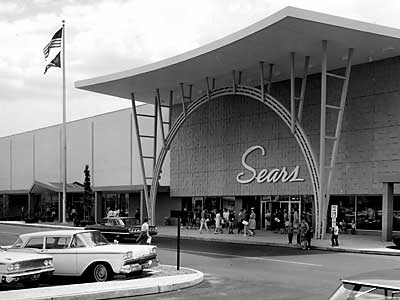
* 1886: Richard W. Sears, a railroad station agent who sells coal as a side job, buys unwanted watches from jeweler and founds R.W. Sears Watch Co. in Minneapolis.
* 1887: Moves company to Chicago and places newspaper ad for watchmaker, hires Alvah C. Roebuck.
* 1893: Firm incorporates as Sears, Roebuck and Co., offering products by mail order to rural residents and farmers at lower-than-general store prices.
* 1896: Issues first general catalog.
* 1906: Opens three-million-square-foot mail order plant in Chicago, largest in world. Opens second plant in Dallas.
* 1908: Richard Sears retires as company president.
* 1909: Company begins selling Sears Motor Buggy. (line discontinued in 1912)
* 1916: Establishes savings and profit sharing program for employees.
* 1925: First Sears retail store opens in catalog center on Chicago's West Side.
* 1927: Launches Craftsman and Kenmore brands.
* 1931: Establishes Allstate Insurance Co.
* 1945: Sears sales pass $1 billion.
* 1953: Establishes Simpsons-Sears Ltd. in Canada.
* 1962: Introduces Vincent Price Fine Arts Collection.
* 1973: Sears moves headquarters to Sears Tower, then world's tallest building.
* 1981: Sears acquires Dean Witter Reynolds and Coldwell, Banker & Co.
* 1985: Debuts Discover Card.
* 1993: Catalog discontinued. Sells 20 percent of Allstate. Sells off Coldwell Banker Residential Services and Sears Mortgage Banking Group.
* 1995: Headquarters move to Hoffman Estates, Ill.
* 1997: Opens Great Indoors stores.
* 2002: Acquires Lands End specialty catalog.
* 2004: Announces merger with Kmart to form Sears Holding Corp.
what's next for Sears, Kmart (FAQ)
Q. Will some stores close?
A. Yes. Sears and Kmart execs will look at the combined company's 3,500 stores with an eye to sell off or lease "non-strategic" locations. That could be less-attractive stores, or possibly even mall anchors that would fetch a better price from another chain.
Q. What about Sears' Hoffman Estates (IL) headquarters?
A. Hoffman Estates will be the home of the merged operations.
Q. Will there be layoffs?
A. "There will be some head count changes that come out of this," said Edward Lampert, chairman of the combined company. He offered no details, but most pink slips are likely to come when stores are closed, and in consolidating Sears' Hoffman Estates and Kmart's Michigan headquarters.
Q. Will Kmart stores convert to Sears stores?
A. The two chains will remain separate operations. But Sears wants to add many more off-the-mall locations, like its Sears Grand stores. And Kmart is where it will find them.
Already Sears plans to convert 50 Kmart stores to the Sears brand by April, part of a separate deal it made for the stores in September.
A half-dozen Wal-Mart stores are part of the Sears off-mall expansion, too. Today Sears Chief Executive Alan Lacy said the Pekin, IL store would be the model for how the new Sears stores would look.
Q. Will some Sears stores turn into Kmarts?
A. It's less likely that Sears will go Kmart. Lampert said Kmart doesn't make sense as a mall anchor. It's going to be on a "store-by-store basis," he said.
Q. Will I be able to be able to buy Craftsman tools at Kmart?
A. Executives said the two chains would "cross-merchandise" at each other's stores. That could include not only Craftsman but Kenmore appliances--already sold at Sears' Great Indoors home centers --and DieHard batteries. All three were identified in the merger announcement as "key" brands. Sears also owns the Lands' End, Covington and Apostrophe clothing lines, which might make sense in Kmart's apparel-heavy mix.
Q. Will Martha Stewart show up at Sears?
A. Martha Stewart herself is out of circulation for a while, but her home furnishings line is a good bet for Sears. It already sells Martha Stewart Everyday goods in Canada, and her brand of paint is featured at the Great Indoors.
Sears likely would have to work out a deal with Stewart's company, but her company's stock is already rising on the prospect of more Martha at more stores.
The announcement specified that Kmart would continue selling not only Martha Stewart Everyday, but also its Joe Boxer, Jaclyn Smith, Route 66, Thalia Sodi and Sesame Street items.
Q. So, will Sears look more like Kmart or Kmart look more like Sears?
A. A little of both. The Sears Grand stores, which have groceries and other everyday items, are already closer to the Kmart mix, and some items like home electronics have done so well there that mall stores have expanded their offerings. Kmart also does some things like pharmacy and health-and-beauty aids that Sears may add.
Sears wants to keep itself as a step up from discounters like Kmart, but there's a lot of room for Sears to steal market share from the likes of Target and Wal-Mart.
A. Yes. Sears and Kmart execs will look at the combined company's 3,500 stores with an eye to sell off or lease "non-strategic" locations. That could be less-attractive stores, or possibly even mall anchors that would fetch a better price from another chain.
Q. What about Sears' Hoffman Estates (IL) headquarters?
A. Hoffman Estates will be the home of the merged operations.
Q. Will there be layoffs?
A. "There will be some head count changes that come out of this," said Edward Lampert, chairman of the combined company. He offered no details, but most pink slips are likely to come when stores are closed, and in consolidating Sears' Hoffman Estates and Kmart's Michigan headquarters.
Q. Will Kmart stores convert to Sears stores?
A. The two chains will remain separate operations. But Sears wants to add many more off-the-mall locations, like its Sears Grand stores. And Kmart is where it will find them.
Already Sears plans to convert 50 Kmart stores to the Sears brand by April, part of a separate deal it made for the stores in September.
A half-dozen Wal-Mart stores are part of the Sears off-mall expansion, too. Today Sears Chief Executive Alan Lacy said the Pekin, IL store would be the model for how the new Sears stores would look.
Q. Will some Sears stores turn into Kmarts?
A. It's less likely that Sears will go Kmart. Lampert said Kmart doesn't make sense as a mall anchor. It's going to be on a "store-by-store basis," he said.
Q. Will I be able to be able to buy Craftsman tools at Kmart?
A. Executives said the two chains would "cross-merchandise" at each other's stores. That could include not only Craftsman but Kenmore appliances--already sold at Sears' Great Indoors home centers --and DieHard batteries. All three were identified in the merger announcement as "key" brands. Sears also owns the Lands' End, Covington and Apostrophe clothing lines, which might make sense in Kmart's apparel-heavy mix.
Q. Will Martha Stewart show up at Sears?
A. Martha Stewart herself is out of circulation for a while, but her home furnishings line is a good bet for Sears. It already sells Martha Stewart Everyday goods in Canada, and her brand of paint is featured at the Great Indoors.
Sears likely would have to work out a deal with Stewart's company, but her company's stock is already rising on the prospect of more Martha at more stores.
The announcement specified that Kmart would continue selling not only Martha Stewart Everyday, but also its Joe Boxer, Jaclyn Smith, Route 66, Thalia Sodi and Sesame Street items.
Q. So, will Sears look more like Kmart or Kmart look more like Sears?
A. A little of both. The Sears Grand stores, which have groceries and other everyday items, are already closer to the Kmart mix, and some items like home electronics have done so well there that mall stores have expanded their offerings. Kmart also does some things like pharmacy and health-and-beauty aids that Sears may add.
Sears wants to keep itself as a step up from discounters like Kmart, but there's a lot of room for Sears to steal market share from the likes of Target and Wal-Mart.
Subscribe to:
Posts (Atom)