Culture (Not Income) is Splitting the Population Along a High-Tech Fault Line
By Beth Snyder Bulik
Advertising Age
New Yorkers may be intrigued by Nike's new iPod-enabled sneakers, but there's plenty of snickering in Paducah.
Conventional wisdom holds that high-tech haves and have-nots are separated by disposable income, but the chasm is yawning ever-wider between people living in metropolitan areas and those in micropolitan areas-the federal government's name for what used to be called "small towns." Even as broadband penetration narrows the much-discussed digital divide of Internet access in cities vs. rural areas, it's being replaced by a broadening technology product gap.
Visit any big city to witness white wires dangling from ears and hordes of BlackBerry-thumbing executives in restaurants at midday. But don't expect a similar scenario when strolling by the Main Street lunch counter-even though those diners may well afford those same devices.
"There is an increasing gap between metropolitan areas and more sparsely populated areas in terms of technology adoption," said analyst Rob Enderle of the Enderle Group. "At some point the slang and jargon used could become a communication problem."
Tech companies are in part at fault. Looking to reach the most people with the least dollars, they concentrate their marketing spending in consumer-dense metropolitan ones, giving city dwellers an information heads-up.
But if hip tech consumers live mainly in metro areas, why shouldn't marketers concentrate efforts there? At least two top consumer electronics marketers declined to comment for this story because that's exactly what they do-put their marketing firepower behind larger cities and metropolitan areas. Still, others say doing so alienates potentially millions in dollars in sales from small-town consumers with money to burn.
"Especially when you're looking at technology adoption, small markets have more opportunity [at retail] to have a conversation and explanation about technology versus larger metros with huge volumes of consumers," said Mike Fasulo, chief marketing officer, Sony Electronics.
Sony does not market by geography, he said, but by behavior (Sony categorizes consumers as techno-socialites, quality of lifers, and performance seekers.) However, it does have SonyStyle retail locations in a wide variety of metropolitan and rural locations. Another important factor is simply the cultural difference between big city and small town life. In cities, cutting edge can be cultural coin. In smaller towns, indifference to technology can be more the norm, especially in the 18-plus demographic.
no social pressure
"Early adoption of trends-whether it's lifestyle, music or technology- tend to begin in more urban areas and trickle out from there," said Catherine Stellin, VP at the Intelligence Group. "In smaller cities, [the reason for slower adoption] is partly money and partly priorities. ... There's also that social pressure you get when 'everyone has one' that's missing." She cited her own parents who live in a small Midwestern town. It's not that they couldn't afford a TiVo or MP3 player for themselves or grandchildren, she said, but "it just wouldn't cross their minds to buy it."
While many agree anecdotally that the metro-micro tech gap is there, it's difficult to get an empirical read on just how big it might be. The Pew Internet & American Life Project tracks a variety of technology adoptions, but only separates Internet access by rural versus urban ("nothing else-yet," said a spokeswoman.)
In 2005, 62% of rural American adults had Internet access versus 70% of urban adults; that 8 percentage point gap is half what it was just two years ago. However, broadband adoption in rural versus urban areas has maintained roughly same gap over the past few years. About 24% of rural American adults had high-speed connections in 2005, compared with 39% of urban and suburbanites in 2005. That's progress from 2003, when rural users made up just 9% of broadband households versus 22% of urban and suburban dwellers.
Widespread Internet access will actually help close the tech gap. "The more Web-centric we all are, the more technology-product connected we are-at least as far as information, if not [product] ownership," Mr. Enderle said.
Marketers looking to reach micropolitan consumers might want to consider local or community marketing. Pop-ups stores, or targeted educational or sales efforts within already-established mass-merchant retailers could be effective, Ms. Stellin said.
Regardless of medium, though, the message for the tech-gadget-bereft outside urban centers should be clear. When dealing with anyone unfamiliar with technology, she said, "Focus on the utility of the product, how will it support their life, simplify it, or entertain them. Not everyone, and in fact a significant number of people, are not impressed with technology."
Jim Nail, chief marketing officer of media and marketing consultancy Cymfony, pointed to Apple as a prime example of a company that "gets" how to market to the tech-sophisticated as well as the newbies. "So much tech product marketing is about features," he said. "But Apple's message is simply 'you get to enjoy your music.' They're talking about a higher order benefit, and that's what works."
Sunday, June 11, 2006


Saturday, June 10, 2006
Pride and prejudice
Macy’s yanks gay display, blasted by both sides
By Kimberly Atkins
Boston Herald Reporter
Macy’s department store found itself mired in a fierce national debate between conservatives and gay activists when it bowed to complaints and removed part of a window display marking Boston Pride Week.
The Downtown Crossing store display featured two male mannequins - one wearing a gay pride rainbow flag around its waist - standing near a list of several planned Boston Pride events.
The display was designed by Macy’s with the approval of the Boston Pride Committee.
But the store yanked the mannequins from the window after MassResistance, the conservative group formerly named Article 8 Alliance which has also campaigned against sex education and gay-themed books in public schools, complained the display was offensive.
“They were male mannequins with enlarged breasts, and one was wearing a skirt,” said MassResistance president Brian Camenker, referring to the gay pride flag wrapped around one figure, cinched with a white belt. “It was really disgusting.”
Elina Kazan, New York-based spokeswoman for Macy’s, said the decision to pull the dummies, but leave the rest of the display, was an effort to strike a balance.
“We believe in diversity, and our customers are very important to us,” Kazan told the Herald, adding that displays supporting Pride Week in previous years did not use mannequins. “But (the display) did offend a few of our customers, and we had to reexamine it.”
That decision upset gay activists, and Mayor Thomas M. Menino, whose spokesman said was “disappointed that Macy’s would bow to this kind of pressure.”
“The mayor believed the window reflected the diversity of our city,” spokesman Seth Gitell said. “This entire episode flies in the face” of that.
Camenker posted pictures of the display on the conservative group’s blog and in an email sent to thousands, urging them to protest, and scores of people inundated Macy’s officials with complaints. Yesterday several Macy’s officials in New York and Boston were unreachable because their email and voicemail boxes were full.
Keri Autlia, vice president of the Boston Pride Committee, said the group was planning a formal response to the story. “In an ideal world, they would put it back up and apologize,” she said.
ACLU of Massachusetts spokeswoman Sarah Wunsch decried Macy’s for “succumbing to the bigotry” of a fringe anti-gay group.
By Kimberly Atkins
Boston Herald Reporter
Macy’s department store found itself mired in a fierce national debate between conservatives and gay activists when it bowed to complaints and removed part of a window display marking Boston Pride Week.
The Downtown Crossing store display featured two male mannequins - one wearing a gay pride rainbow flag around its waist - standing near a list of several planned Boston Pride events.
The display was designed by Macy’s with the approval of the Boston Pride Committee.
But the store yanked the mannequins from the window after MassResistance, the conservative group formerly named Article 8 Alliance which has also campaigned against sex education and gay-themed books in public schools, complained the display was offensive.
“They were male mannequins with enlarged breasts, and one was wearing a skirt,” said MassResistance president Brian Camenker, referring to the gay pride flag wrapped around one figure, cinched with a white belt. “It was really disgusting.”
Elina Kazan, New York-based spokeswoman for Macy’s, said the decision to pull the dummies, but leave the rest of the display, was an effort to strike a balance.
“We believe in diversity, and our customers are very important to us,” Kazan told the Herald, adding that displays supporting Pride Week in previous years did not use mannequins. “But (the display) did offend a few of our customers, and we had to reexamine it.”
That decision upset gay activists, and Mayor Thomas M. Menino, whose spokesman said was “disappointed that Macy’s would bow to this kind of pressure.”
“The mayor believed the window reflected the diversity of our city,” spokesman Seth Gitell said. “This entire episode flies in the face” of that.
Camenker posted pictures of the display on the conservative group’s blog and in an email sent to thousands, urging them to protest, and scores of people inundated Macy’s officials with complaints. Yesterday several Macy’s officials in New York and Boston were unreachable because their email and voicemail boxes were full.
Keri Autlia, vice president of the Boston Pride Committee, said the group was planning a formal response to the story. “In an ideal world, they would put it back up and apologize,” she said.
ACLU of Massachusetts spokeswoman Sarah Wunsch decried Macy’s for “succumbing to the bigotry” of a fringe anti-gay group.
'Fifth Beatle' Billy Preston Made the Greats Even Greater
By Richard Harrington
Washington Post Staff Writer
Billy Preston was one of the music business's true MVPs, someone who had his own substantial hits but whose real gift was making other stars sound better. After all, there's no musician who can claim to have been coveted by both the Beatles and the Rolling Stones in their prime, or to have been touted as Ray Charles's successor by Charles himself.
Go to Preston's entry in All Music Guide, click on "credits" and prepare to be amazed. He was Everysideman, part Zelig, part Forrest Gump, but never anywhere accidentally or incidentally. Preston was always invited to be in the right place at the right time.
Preston, who died Tuesday at 59 in Los Angeles after a long, kidney-related illness that had left him in a coma since November, was a virtuoso on the Hammond B-3 organ. Two albums recorded before he was 20 were aptly titled "The Wildest Organ in Town" and "Most Exciting Organ Ever." His ecstatic, loose-limbed jubilation was acquired at Los Angeles's Victory Baptist Church, where his mother was the organist. The precocious Preston often backed visiting gospel royalty; Mahalia Jackson was so impressed she drafted him at age 10. Church never left Preston -- he called his '70s band the God Squad -- and an exuberant gospel underpinning remained constant in his music.
In the '60s and '70s in particular, Preston had a memorable look: mushroom-cloud-size Afro, ingratiating gap-toothed smile, funky fashions that seemed more dreamed-up than designed. And he had a matching personality that invited you in. The countless artists who sought him out probably did so as much for his engaging character as his dazzling virtuosity on organ and piano.
Take the Beatles, for instance. That relationship went back to 1962, when a 15-year-old Preston was hired for Little Richard's backing band on a European tour that was supposed to be about gospel but that Little Richard decided to make about rock-and-roll. Preston first met the Beatles during their fabled residency at the Star Club in Hamburg; a year later, they'd both made their album debuts with "Sixteen Year Old Soul" and "Please Please Me," respectively.
They'd hook up again in 1969, as the Beatles were about to break up while recording their final album, "Let It Be." George Harrison, always Preston's best Beatles buddy, had quit and walked out of the studio and gone to a Ray Charles concert in London, where Preston was playing organ. Harrison brought Preston back to the studio, where his keen musicianship and gregarious personality temporarily calmed the tension.
In bootlegged "Let It Be" session tapes, one can hear several heated arguments between John Lennon and Paul McCartney about making Preston a group member (Lennon was all for it). That would have made Preston officially "the fifth Beatle," a title he was not loath to exploit over the next three decades. Perhaps as consolation, "Get Back," the only Beatles single to enter the British charts at No.1, was credited to "the Beatles with Billy Preston" -- the first and only time the band shared the spotlight with a sideman. Preston also accompanied the Beatles during their famous rooftop gig in London, the Beatles' last public performance.
The Harrison connection would remain strong as the Beatles signed Preston to Apple Records and co-produced Preston's two albums for the label, "That's the Way God Planned It" and "Encouraging Words." On the first album's title track, one got a sense of the respect Preston engendered: Harrison and Eric Clapton played guitar, Keith Richards was on bass, Ginger Baker on drums. "That's the Way God Planned It" was pure gospel, nowhere more evident than in Preston's incredible performance of the song at Harrison's 1973 "Concert for Bangladesh," from soulful pleading and churchy organ fills to a Holy Spirit-infused dance at song's end.
Preston contributed to many Beatle solo albums, and toured with Harrison and Ringo Starr. In the '70s, he was also a key player with the Rolling Stones on the road and on such classic albums as "Sticky Fingers" and "Exile on Main Street." A sign of their respect: During their mid-'70s world tour, the Stones allowed Preston to play a few of his own songs during their set. By then, he'd finally had some hits of his own, topping the R&B charts with the instrumentals "Outa-Space" and "Space Race" and the pop charts with "Will It Go Round in Circles" and "Nothing From Nothing." Preston also co-wrote Joe Cocker's 1974 hit "You Are So Beautiful," which became a wedding, anniversary and Valentine's Day standard.
Cocker sang "You Are So Beautiful" to George and Barbara Bush at 1989's Inaugural Concert for Young Americans, brilliantly backed by Preston. Lee Atwater, the late Republican National Committee chairman as well as a blues and R&B fanatic, had hired Preston to lead an all-star band in an old-fashioned soul revue. The band opened the show with a rousing rendition of "Sweet Soul Music," and Preston later did an incredible duet with Carla Thomas on "When Something Is Wrong With My Baby."
He would come through Washington in later years as a member of Starr's All-Starr Band. Had those whose work over the decades shone brighter because of his contributions formed Billy Preston's All-Star Band, they probably would have filled the Convention Center. Not the stage -- the center itself.
Washington Post Staff Writer
Billy Preston was one of the music business's true MVPs, someone who had his own substantial hits but whose real gift was making other stars sound better. After all, there's no musician who can claim to have been coveted by both the Beatles and the Rolling Stones in their prime, or to have been touted as Ray Charles's successor by Charles himself.
Go to Preston's entry in All Music Guide, click on "credits" and prepare to be amazed. He was Everysideman, part Zelig, part Forrest Gump, but never anywhere accidentally or incidentally. Preston was always invited to be in the right place at the right time.
Preston, who died Tuesday at 59 in Los Angeles after a long, kidney-related illness that had left him in a coma since November, was a virtuoso on the Hammond B-3 organ. Two albums recorded before he was 20 were aptly titled "The Wildest Organ in Town" and "Most Exciting Organ Ever." His ecstatic, loose-limbed jubilation was acquired at Los Angeles's Victory Baptist Church, where his mother was the organist. The precocious Preston often backed visiting gospel royalty; Mahalia Jackson was so impressed she drafted him at age 10. Church never left Preston -- he called his '70s band the God Squad -- and an exuberant gospel underpinning remained constant in his music.
In the '60s and '70s in particular, Preston had a memorable look: mushroom-cloud-size Afro, ingratiating gap-toothed smile, funky fashions that seemed more dreamed-up than designed. And he had a matching personality that invited you in. The countless artists who sought him out probably did so as much for his engaging character as his dazzling virtuosity on organ and piano.
Take the Beatles, for instance. That relationship went back to 1962, when a 15-year-old Preston was hired for Little Richard's backing band on a European tour that was supposed to be about gospel but that Little Richard decided to make about rock-and-roll. Preston first met the Beatles during their fabled residency at the Star Club in Hamburg; a year later, they'd both made their album debuts with "Sixteen Year Old Soul" and "Please Please Me," respectively.
They'd hook up again in 1969, as the Beatles were about to break up while recording their final album, "Let It Be." George Harrison, always Preston's best Beatles buddy, had quit and walked out of the studio and gone to a Ray Charles concert in London, where Preston was playing organ. Harrison brought Preston back to the studio, where his keen musicianship and gregarious personality temporarily calmed the tension.
In bootlegged "Let It Be" session tapes, one can hear several heated arguments between John Lennon and Paul McCartney about making Preston a group member (Lennon was all for it). That would have made Preston officially "the fifth Beatle," a title he was not loath to exploit over the next three decades. Perhaps as consolation, "Get Back," the only Beatles single to enter the British charts at No.1, was credited to "the Beatles with Billy Preston" -- the first and only time the band shared the spotlight with a sideman. Preston also accompanied the Beatles during their famous rooftop gig in London, the Beatles' last public performance.
The Harrison connection would remain strong as the Beatles signed Preston to Apple Records and co-produced Preston's two albums for the label, "That's the Way God Planned It" and "Encouraging Words." On the first album's title track, one got a sense of the respect Preston engendered: Harrison and Eric Clapton played guitar, Keith Richards was on bass, Ginger Baker on drums. "That's the Way God Planned It" was pure gospel, nowhere more evident than in Preston's incredible performance of the song at Harrison's 1973 "Concert for Bangladesh," from soulful pleading and churchy organ fills to a Holy Spirit-infused dance at song's end.
Preston contributed to many Beatle solo albums, and toured with Harrison and Ringo Starr. In the '70s, he was also a key player with the Rolling Stones on the road and on such classic albums as "Sticky Fingers" and "Exile on Main Street." A sign of their respect: During their mid-'70s world tour, the Stones allowed Preston to play a few of his own songs during their set. By then, he'd finally had some hits of his own, topping the R&B charts with the instrumentals "Outa-Space" and "Space Race" and the pop charts with "Will It Go Round in Circles" and "Nothing From Nothing." Preston also co-wrote Joe Cocker's 1974 hit "You Are So Beautiful," which became a wedding, anniversary and Valentine's Day standard.
Cocker sang "You Are So Beautiful" to George and Barbara Bush at 1989's Inaugural Concert for Young Americans, brilliantly backed by Preston. Lee Atwater, the late Republican National Committee chairman as well as a blues and R&B fanatic, had hired Preston to lead an all-star band in an old-fashioned soul revue. The band opened the show with a rousing rendition of "Sweet Soul Music," and Preston later did an incredible duet with Carla Thomas on "When Something Is Wrong With My Baby."
He would come through Washington in later years as a member of Starr's All-Starr Band. Had those whose work over the decades shone brighter because of his contributions formed Billy Preston's All-Star Band, they probably would have filled the Convention Center. Not the stage -- the center itself.
Thursday, June 08, 2006
Boscov's told to pay $21,000 in discrimination case
Occult classes canceled after church complaints
By JAMES MERRIWEATHER
The News Journal
DOVER, Del. -- Boscov's has been fined $5,000 and ordered to pay $21,000 to two Christians, two Wiccans and a pagan who accused the department-store chain of religious discrimination at its Dover store.
The plaintiffs contended that Boscov's bowed to pressure from church people and illegally dropped classes they planned to teach last fall during the store's Campus of Classes. In its defense, Boscov's said the classes -- including sessions on tarot, talismans, candle magic and the pentagram that drew complaints from Pastor William Jeffcoat of Capitol Baptist Church -- were called off for lack of diversity.
The Delaware State Human Relations Commission rejected Boscov's defense, all but accusing the company's witnesses of lying during two days of hearings completed Feb. 13.
"The commission finds that respondents' proffered reasons ... are unworthy of credence and served as a pretext for discrimination ... " the commission said.
Donna Jackson, a Dover spiritualist who was the lead complainant, was exultant after reviewing the commission's decision, which went out Wednesday and Thursday to parties in the case. While the case was pending, she said, expressions of support came in from Wiccans, pagans and Christians from as far away as Sweden, Ireland, Italy and Spain.
"I'm still shaking," said Jackson, who presented her case without the help of a lawyer. "I'm ecstatic over this.
"I wasn't confident or not confident about the outcome. It was something that we were just like on the edge of our seats with."
Jeffrey K. Martin, a Wilmington lawyer who represented Boscov's, said Thursday that he was weighing the advisability of recommending an appeal to Superior Court. From Boscov's corporate offices in Reading, Pa., a top official said an appeal was a real possibility.
"We're very disappointed with the decision, and we're examining our appeals options currently," said Jack Roach, senior vice president for risk management and loss prevention.
"That's all we can say at this time."
As the lead plaintiff and coordinator of the canceled classes, Jackson will get $4,500 from the department-store chain. Payments of $4,125 each will go to her co-complainants -- her son, Jason, a Christian from Dover; witches Marla Kepner and Chantel Henderson of the Camden-Wyoming area; and Norene Hamilton of Dover, a pagan.
Local practitioners describe paganism as any nature-based polytheistic spirituality, including Wicca, Buddhism, Druid beliefs and gnostic Christianity. Wicca is widely described as an Earth-based religion that finds the spirit of God in the wind, rain and other aspects of nature, drawing on the best traditions of witchcraft.
In its ruling, the Human Relations Commission traced the root of the case to fliers distributed at Pagan Pride Day, held at Boscov's last August, to get out word on the upcoming classes. At the time, Jeffcoat and some followers noted that some of the classes would be taught by practitioners of Wicca, which he described in his testimony as "very, very dark."
At the commission hearing, Jeffcoat and Boscov's officials testified that the decision to cancel the classes was made before his complaint was lodged. Citing testimony, the commission found, though, that another Baptist minister was among people who complained earlier about the courses, which were ostensibly canceled on the same day that an advertisement intended to attract participants to the classes was published in a local newspaper.
Jeffcoat was out of town Thursday and unavailable for comment.
In summing up its decision, the commission, which enforces the state's public-accommodations law, noted that the department-store chain came in for an extra whack or two because of its size.
"With all Boscov's civic involvement," the commission said, "their decision to single out a particular group and their inability to resolve the situation in a nondiscriminatory manner is particularly intolerable."
Hamilton, the pagan, said she didn't find much joy in the monetary award, given the investment of time in the case and the difficulty she faces in getting re-established as a spiritualist in the Dover area.
"But I think it's truly wonderful," she said. "It's a truly, truly wonderful victory for all the people considered to be in so-called minority religions."
By JAMES MERRIWEATHER
The News Journal
DOVER, Del. -- Boscov's has been fined $5,000 and ordered to pay $21,000 to two Christians, two Wiccans and a pagan who accused the department-store chain of religious discrimination at its Dover store.
The plaintiffs contended that Boscov's bowed to pressure from church people and illegally dropped classes they planned to teach last fall during the store's Campus of Classes. In its defense, Boscov's said the classes -- including sessions on tarot, talismans, candle magic and the pentagram that drew complaints from Pastor William Jeffcoat of Capitol Baptist Church -- were called off for lack of diversity.
The Delaware State Human Relations Commission rejected Boscov's defense, all but accusing the company's witnesses of lying during two days of hearings completed Feb. 13.
"The commission finds that respondents' proffered reasons ... are unworthy of credence and served as a pretext for discrimination ... " the commission said.
Donna Jackson, a Dover spiritualist who was the lead complainant, was exultant after reviewing the commission's decision, which went out Wednesday and Thursday to parties in the case. While the case was pending, she said, expressions of support came in from Wiccans, pagans and Christians from as far away as Sweden, Ireland, Italy and Spain.
"I'm still shaking," said Jackson, who presented her case without the help of a lawyer. "I'm ecstatic over this.
"I wasn't confident or not confident about the outcome. It was something that we were just like on the edge of our seats with."
Jeffrey K. Martin, a Wilmington lawyer who represented Boscov's, said Thursday that he was weighing the advisability of recommending an appeal to Superior Court. From Boscov's corporate offices in Reading, Pa., a top official said an appeal was a real possibility.
"We're very disappointed with the decision, and we're examining our appeals options currently," said Jack Roach, senior vice president for risk management and loss prevention.
"That's all we can say at this time."
As the lead plaintiff and coordinator of the canceled classes, Jackson will get $4,500 from the department-store chain. Payments of $4,125 each will go to her co-complainants -- her son, Jason, a Christian from Dover; witches Marla Kepner and Chantel Henderson of the Camden-Wyoming area; and Norene Hamilton of Dover, a pagan.
Local practitioners describe paganism as any nature-based polytheistic spirituality, including Wicca, Buddhism, Druid beliefs and gnostic Christianity. Wicca is widely described as an Earth-based religion that finds the spirit of God in the wind, rain and other aspects of nature, drawing on the best traditions of witchcraft.
In its ruling, the Human Relations Commission traced the root of the case to fliers distributed at Pagan Pride Day, held at Boscov's last August, to get out word on the upcoming classes. At the time, Jeffcoat and some followers noted that some of the classes would be taught by practitioners of Wicca, which he described in his testimony as "very, very dark."
At the commission hearing, Jeffcoat and Boscov's officials testified that the decision to cancel the classes was made before his complaint was lodged. Citing testimony, the commission found, though, that another Baptist minister was among people who complained earlier about the courses, which were ostensibly canceled on the same day that an advertisement intended to attract participants to the classes was published in a local newspaper.
Jeffcoat was out of town Thursday and unavailable for comment.
In summing up its decision, the commission, which enforces the state's public-accommodations law, noted that the department-store chain came in for an extra whack or two because of its size.
"With all Boscov's civic involvement," the commission said, "their decision to single out a particular group and their inability to resolve the situation in a nondiscriminatory manner is particularly intolerable."
Hamilton, the pagan, said she didn't find much joy in the monetary award, given the investment of time in the case and the difficulty she faces in getting re-established as a spiritualist in the Dover area.
"But I think it's truly wonderful," she said. "It's a truly, truly wonderful victory for all the people considered to be in so-called minority religions."
Product Naming: How to Make 50,000 People Hate You
Looking for additional perspective on the fallout from the Lazarus name change? Check out this well written blog entry from Strategic Name Development.
Click here!
Click here!
The Air Apple ?
(submitted to steve's blog by Al Cabino)
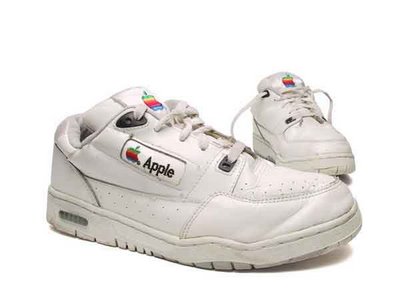
Everyone knows about the Nike + Apple iPod sneakers [http://www.nike.com/nikeplus] (also subject of an upcoming Retail Therapy) but what about these classic super rare Apple sneakers, only given to Apple employees back in the 90s?
Looks like these kicks have some Air too... could they be Air Apple sneakers?
Check them out at Gizmodo, too.
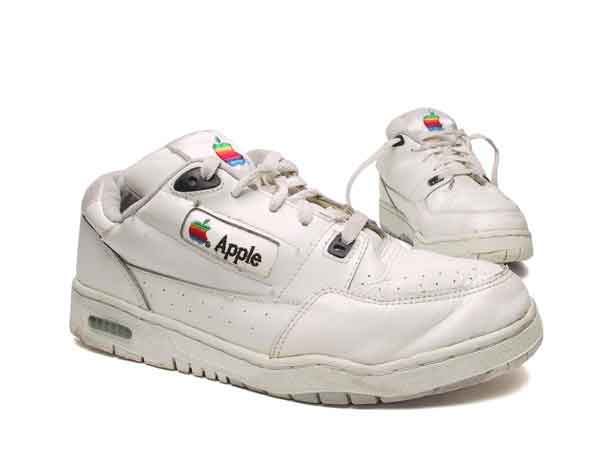
Everyone knows about the Nike + Apple iPod sneakers [http://www.nike.com/nikeplus] (also subject of an upcoming Retail Therapy) but what about these classic super rare Apple sneakers, only given to Apple employees back in the 90s?
Looks like these kicks have some Air too... could they be Air Apple sneakers?
Check them out at Gizmodo, too.
Wednesday, June 07, 2006
long train running
Still chugging along...
At work, they've let me answer basic customer questions on the phone while I train, and I've already gotten some very weird ones, even for that office! It's coming along slowly but surely, and I hope to eventually get that "technician in training" sign off my desk and help some folks for real.
The downtown walks to lunch have been good. I pass by the old downtown Miller & Rhoads department store each day. One day, I'm going to bring a camera with me and shoot some new pictures of it. I have some from about ten years ago from a class project I did in college. You can still see the labelscar from the old sign, though it's been long converted to an office building.
At work, they've let me answer basic customer questions on the phone while I train, and I've already gotten some very weird ones, even for that office! It's coming along slowly but surely, and I hope to eventually get that "technician in training" sign off my desk and help some folks for real.
The downtown walks to lunch have been good. I pass by the old downtown Miller & Rhoads department store each day. One day, I'm going to bring a camera with me and shoot some new pictures of it. I have some from about ten years ago from a class project I did in college. You can still see the labelscar from the old sign, though it's been long converted to an office building.
Haphazard hunts for right fit, fabric can make shoppers blue
BY DEB ACORD
The Fort Wayne Gazette
Call it the jeans conundrum. You want a new pair that doesn't label you as over-the-hill, but you want them to reach over your butt. You want them ... not too tight but not too baggy ... not too high-waisted in that "mom jeans" kind of way, (parodied in a faux ad on "Saturday Night Live" with the slogan "I'm not a woman anymore; I'm a mom") but not too Britney Spears, pre-baby fat ... not too dark (like Wranglers, pressed and starched for a rodeo cowboy) but not too light (that mom jeans commercial again, praising "periwinkle blue") ... soft, just to make them comfortable, but without those fade lines (they're called whiskers) and frayed edges.
Yes, you know exactly what you want, so you head out to a department store where you find a wall of jeans in styles, washes and fits that require a denim dictionary and a week of trying-on time.
Gap alone has 15 blue-denim colors with sometimes perplexing names including "destructed fade," "light authentic" and "sandblasted authentic" (not to be confused with "sanded authentic").
Dillard's has denim stations throughout its store, arranged in juniors and misses styles as well as by designer.
JC Penney offers a helpful guide on its catalog Web site, showing you how to chose one of six styles combined with one of three cuts and one of three rises.
It's enough to make a jeans fan such as Jutta Chester sing the blues. Chester had been trying on jeans for two hours when she stopped to compose herself in front of the three-way mirror at JC Penney.
Chester usually relies on classic Levis, but she was dismayed to find that even that venerable company has gone crazy with new styles, washes and fits.
"I'm so frustrated," she said. "They either have a little tiny zipper or they are huge."
Women who understand the importance of the perfect pair of jeans understand Chester's frustration.
The search for a stylish, properly fitting pair of jeans can take a woman an entire day, as she pulls on dozens of pairs, leaving behind a pile of low-rise and straight-leg rejects.
Many times, after a grueling day in front of cruelly lit dressing-room mirrors, a jeans-buying woman just reverts to old habits, throwing on the high-waisted, roomy-butt, peg-leg, ankle-brushing jeans that forever label her as a fashion loser.
"The fear of failure is one of the main reasons women end up buying more nasty mom jeans," said Sharon Haver, a New York City-based fashion expert and founder of FocusOn-Style (www.focusonstyle.com), a Web-based fashion magazine.
But Haver says the range of jeans on the market is an opportunity, not a problem.
"There is almost no excuse anymore to say, `Nothing fits me,'" she said.
So, it seems, women need to make peace with the idea that they'll have to spend time to get those perfect pairs of jeans. After all, it is important to them, according to 43things.com, a Web site on which people write about their goals, dreams and ambitions. On the site, 262 women listed "Find the perfect pair of jeans" along with "Take better care of my health" (22), "Start a family" (175) and "Pray every day" (152).
Women also need to do away with the idea that they have to stick with a certain style, Haver says.
On her Web site, which features her interactive style column, she frequently sees women write in with the same lament: "I can't wear the same jeans my daughter does."
To that she replies: "Why not?"
"Just because you hit a certain age doesn't mean you can't wear jeans. Find a pair that fits you. If you have a great body, you can wear the same jeans as your daughter if you want to. Today's 50 looks like yesterday's 30."
Haver doesn't think "wearing your daughter's wardrobe" is a fashion failure.
"What's bad is wearing the same frumpy haircut, pink polo and baggy jeans with white sneakers," just because you always wore that.
Carol Nagel can't wear the jeans she wore in the past. She's lost 140 pounds in the past year, shrinking to a size 8 from a size 26.
She's tried on lots of jeans to find perfection, and she stumbled upon a trick to make the job easier: "I've found the brands that look good on me, and I stick with them."
Nagel prefers classic bootcut styles by Liz Claiborne and Polo by Ralph Lauren.
"It's all about comfort and fit. I want to feel good in them, and I want them to look good."
One way to look good is to pay attention to fashion trends, Haver says. "Just watch what other people are wearing."
What are women wearing in New York City right now?
"It's as if all the girls wearing premium boot-cut jeans threw them away one day, and the next day began wearing skinny jeans and flats."
Skinny jeans might not be your favorite, but you might like an accompanying trend, Haver says.
"Tops are getting longer. They are cut to be kind of flowy with a little cling. They look great with a shorter jacket and the best thing - they cover your tush."
And at least skinny jeans won't be mistaken for those unflattering, high-waisted, roomy Mom jeans.
"Those are good for riding a horse," Haver says, "but for any other activity, all they do is make women look horsey."
The Fort Wayne Gazette
Call it the jeans conundrum. You want a new pair that doesn't label you as over-the-hill, but you want them to reach over your butt. You want them ... not too tight but not too baggy ... not too high-waisted in that "mom jeans" kind of way, (parodied in a faux ad on "Saturday Night Live" with the slogan "I'm not a woman anymore; I'm a mom") but not too Britney Spears, pre-baby fat ... not too dark (like Wranglers, pressed and starched for a rodeo cowboy) but not too light (that mom jeans commercial again, praising "periwinkle blue") ... soft, just to make them comfortable, but without those fade lines (they're called whiskers) and frayed edges.
Yes, you know exactly what you want, so you head out to a department store where you find a wall of jeans in styles, washes and fits that require a denim dictionary and a week of trying-on time.
Gap alone has 15 blue-denim colors with sometimes perplexing names including "destructed fade," "light authentic" and "sandblasted authentic" (not to be confused with "sanded authentic").
Dillard's has denim stations throughout its store, arranged in juniors and misses styles as well as by designer.
JC Penney offers a helpful guide on its catalog Web site, showing you how to chose one of six styles combined with one of three cuts and one of three rises.
It's enough to make a jeans fan such as Jutta Chester sing the blues. Chester had been trying on jeans for two hours when she stopped to compose herself in front of the three-way mirror at JC Penney.
Chester usually relies on classic Levis, but she was dismayed to find that even that venerable company has gone crazy with new styles, washes and fits.
"I'm so frustrated," she said. "They either have a little tiny zipper or they are huge."
Women who understand the importance of the perfect pair of jeans understand Chester's frustration.
The search for a stylish, properly fitting pair of jeans can take a woman an entire day, as she pulls on dozens of pairs, leaving behind a pile of low-rise and straight-leg rejects.
Many times, after a grueling day in front of cruelly lit dressing-room mirrors, a jeans-buying woman just reverts to old habits, throwing on the high-waisted, roomy-butt, peg-leg, ankle-brushing jeans that forever label her as a fashion loser.
"The fear of failure is one of the main reasons women end up buying more nasty mom jeans," said Sharon Haver, a New York City-based fashion expert and founder of FocusOn-Style (www.focusonstyle.com), a Web-based fashion magazine.
But Haver says the range of jeans on the market is an opportunity, not a problem.
"There is almost no excuse anymore to say, `Nothing fits me,'" she said.
So, it seems, women need to make peace with the idea that they'll have to spend time to get those perfect pairs of jeans. After all, it is important to them, according to 43things.com, a Web site on which people write about their goals, dreams and ambitions. On the site, 262 women listed "Find the perfect pair of jeans" along with "Take better care of my health" (22), "Start a family" (175) and "Pray every day" (152).
Women also need to do away with the idea that they have to stick with a certain style, Haver says.
On her Web site, which features her interactive style column, she frequently sees women write in with the same lament: "I can't wear the same jeans my daughter does."
To that she replies: "Why not?"
"Just because you hit a certain age doesn't mean you can't wear jeans. Find a pair that fits you. If you have a great body, you can wear the same jeans as your daughter if you want to. Today's 50 looks like yesterday's 30."
Haver doesn't think "wearing your daughter's wardrobe" is a fashion failure.
"What's bad is wearing the same frumpy haircut, pink polo and baggy jeans with white sneakers," just because you always wore that.
Carol Nagel can't wear the jeans she wore in the past. She's lost 140 pounds in the past year, shrinking to a size 8 from a size 26.
She's tried on lots of jeans to find perfection, and she stumbled upon a trick to make the job easier: "I've found the brands that look good on me, and I stick with them."
Nagel prefers classic bootcut styles by Liz Claiborne and Polo by Ralph Lauren.
"It's all about comfort and fit. I want to feel good in them, and I want them to look good."
One way to look good is to pay attention to fashion trends, Haver says. "Just watch what other people are wearing."
What are women wearing in New York City right now?
"It's as if all the girls wearing premium boot-cut jeans threw them away one day, and the next day began wearing skinny jeans and flats."
Skinny jeans might not be your favorite, but you might like an accompanying trend, Haver says.
"Tops are getting longer. They are cut to be kind of flowy with a little cling. They look great with a shorter jacket and the best thing - they cover your tush."
And at least skinny jeans won't be mistaken for those unflattering, high-waisted, roomy Mom jeans.
"Those are good for riding a horse," Haver says, "but for any other activity, all they do is make women look horsey."
HOW TO SHOP FOR JEANS
SOURCE: Focus On Style (http://www.focusonstyle.com/), Sharon Haver
Consider these elements when you set out to buy a pair of jeans:
- Get the right length. The hem should reach the top of your shoe (in a straight leg) or cover your heel (in a boot cut). If you get the jeans hemmed, cut the natural worn edge off and reattach it along the new hem.
- Get the right width. The leg style should complement your thighs. Thin legs? Try cigarette or drainpipe jeans. Large legs? Check out bell bottoms. Straight legs are the most universally flattering.
- How high is too high? Jeans that hit you right below the bellybutton are most becoming. Hip-huggers are for those with flat tummies and no muffin tops (flesh pouring over the sides).
- What kind of fabric? Curvier women look better with denim that has a little stretch to it, and a less-defined waistband.
- The feel? Jeans shouldn't slide up or ride down. Try using a belt to keep things in place.
- The color? The wash should look natural. Faux stone-washed denim that is bleached by the manufacturer doesn't look natural; other fake finishes are fad items.
call me 'el diablo'
06/06/06: what a combination; the supposed day of the anti-Christ and the first day on the new job at the City.
I tried to do myself and all of y'all proud today. I woke up early, got to work on time and watched the office fill with people that I'm not qualified to serve yet. I did try to help when I could, and if it doesn't get on my nerves to have to deal with all these people (and there are a bunch that come in for permits and site plan approvals), this may work, at least for the short term.
The specter of what's ahead has always flummoxed me, especially if I have a pile of the present I have to deal with in front of me. It can beat you down. I was feeling a little worn out for lack of sleep the night before (not worrying, more like unable to sleep) and it seemed like all these new people and new things came at me all at once. I was happy to get out for lunch.
OK, one good thing: the walk to lunch on the City Market is about one-third as long as it was from LMW. I had pizza. Seemingly nobody cares about this detail, but if I don't mention it, invariably someone will ask.
When I came back from lunch, they had evacuated the Municipal Building because someone set off pepper spray in the office next door to mine. No one was injured, but a few people complained of headaches and burning eyes. WSLS-TV, which is across the street, made a big deal out of it and the Fire-EMS blocked off the street in front.
Anyway, other than answering the phone a lot, the rest of the day was pretty mundame.
OK, another good thing: the people I work with are all very nice and I think I'll like them just fine, that is, if I can ever remember all their names.
I tried to do myself and all of y'all proud today. I woke up early, got to work on time and watched the office fill with people that I'm not qualified to serve yet. I did try to help when I could, and if it doesn't get on my nerves to have to deal with all these people (and there are a bunch that come in for permits and site plan approvals), this may work, at least for the short term.
The specter of what's ahead has always flummoxed me, especially if I have a pile of the present I have to deal with in front of me. It can beat you down. I was feeling a little worn out for lack of sleep the night before (not worrying, more like unable to sleep) and it seemed like all these new people and new things came at me all at once. I was happy to get out for lunch.
OK, one good thing: the walk to lunch on the City Market is about one-third as long as it was from LMW. I had pizza. Seemingly nobody cares about this detail, but if I don't mention it, invariably someone will ask.
When I came back from lunch, they had evacuated the Municipal Building because someone set off pepper spray in the office next door to mine. No one was injured, but a few people complained of headaches and burning eyes. WSLS-TV, which is across the street, made a big deal out of it and the Fire-EMS blocked off the street in front.
Anyway, other than answering the phone a lot, the rest of the day was pretty mundame.
OK, another good thing: the people I work with are all very nice and I think I'll like them just fine, that is, if I can ever remember all their names.
Tuesday, June 06, 2006
Big retailers jump into discount gas market
By Teresa F. Lindeman
Pittsburgh Post-Gazette
With gasoline around $3 a gallon, consumers are hunting everywhere for the lowest prices, and more and more that means going to a big box retailer like Costco or Wal-Mart or to a place offering fuel discounts like Giant Eagle's GetGo stores.
"Everybody is in the business now," said Travis Sheetz, vice president of operations for the Altoona, Pa.-based Sheetz convenience store chain.
Nationally, sales through branded oil company stations fell to 52 percent of the total market last year from 55 percent the year before. Grocers, discounters and big box chains moved up to grab 11 percent. In some markets they've taken as much as 20 percent, said David Portalatin, an industry analyst for research firm NPD Group who compiled the rankings.
In the Pittsburgh area, for example, a ranking of gasoline sellers last year put Sunoco and BP in the top two spots, based on sales of gas through stations carrying their brand names. Sheetz ranked third, but the new big-box style of gas retailer — merchants such as Giant Eagle, Wal-Mart and Costco — collectively moved into fourth place, ahead of Exxon.
"Wow," Portalatin said. His figures also showed an impressive spike in gas sales at GetGo linked to the discount program rolled out by Giant Eagle a little more than a year ago.
Retailers of all persuasions have discovered what the gas stations and convenience store owners already knew. "Gas is really a traffic driver," said Sheetz. Like milk, it is one product that consumers have to buy regularly.
Once consumers are in a store, chances of getting them to buy merchandise with higher profit margins go up.
Because it's not exactly hard to find places to buy gas, the newcomers had to get creative to persuade consumers to seek out a particular site.
Giant Eagle's fuelperks! program rewards loyalty card holders by giving them 10 cents off a gallon at GetGo stations for every $50 spent in its stores.
The program, which has been offered by other chains around the country, triggered complaints from a trade group of independent gas station owners who questioned whether it amounted to selling gas below cost. Both the Pennsylvania attorney general's office and the Federal Trade Commission reviewed the Giant Eagle program and declined to take any action. Only the state milk marketing board responded. It requires that milk purchases not be counted toward fuel discounts.
Unable to block the program, Giant Eagle's competitors seem ready to try to develop their own versions.
Grocer Shop 'n Save is considering a program that would help customers earn discounts on gas sold at Sunoco stations, and Foodland is looking at a program involving an independent distributor, according to Hugh J. Campbell, a Sunoco station operator and president of the Petroleum Retailers & Auto Repair Association Inc.
"We have to compete with Sheetz and Costco," said Campbell.
The big-box retailers that have tried offering gas have been successful enough to expand their offerings rapidly, although critics claim the stores are willing to lose money on fuel in return for the store traffic.
Expanding chain
Warehouse club operator Costco, of Issaquah, Wash., had just 40 gas stations in 1998. At the end of 2005, the chain said, it sold more than $3 billion worth of gas through 225 gas stations, a 32 percent increase over the year before.
"Members are willing to wait in line to get gas, knowing that Costco will give them the best value in town," said company executives in the annual shareholders letter, adding that Costco made a profit on gas last year despite the turbulent energy market.
Whether the company always has cheaper prices is hard to tell. A California Web site called LoveToKnow.com claims Costco gas prices usually run between 10 and 20 cents less than the local market.
Enough consumers seem to be buying from the big-box stores to fuel an expansion. Five years ago, there were 445 gas stations at Wal-Mart stores and Sam's Club sites. Now the Arkansas company has a 1,388 stations, according to a spokesman, although most are operated by third parties.
Even hardware chain Home Depot is trying its hand. If four convenience store sites opened in the first half of this year do well, the Atlanta company is projecting it could have 300 by 2010.
Battle for business
Competition for gas customers has, in turn, had the effect of forcing those who have sold fuel for years to develop even more creative ways to attract consumers and profits. Sheetz is in the midst of testing restaurant-style offerings complete with different amounts of seating as well as credit cards with radio-frequency chips that don't have to be run through a machine.
Sheetz has long had a reputation for offering low gas prices but it has demonstrated it is willing to get into the discount battle, too. Last summer, the chain introduced a credit card that offers users rebates on gas and food. The company did not release numbers on how many users have signed up.
"We're real happy with it," said Sheetz. "I think as fuel prices go up it's going to get more popular."
Smaller independent operators are trying everything from adding cash-only pumps to car washes to gas discounts on Sunday to keep customers coming back.
Meanwhile, the new entrants to the gasoline market may have discovered the magic power of gasoline to bring cars to the parking lot, but they've also begun to discover its drawbacks, said Jeff Lenard, a spokesman for the National Association of Convenience Stores. "They're finding out, guess what — there's not much money to be made selling gas."
Credit card fees, real estate expenses and other costs have reduced profit margins and the pinch is exacerbated by the strategy of keeping gas prices down for competitive reasons.
Costco's last year's financial results noted that while the company's gross margins rose in most of its merchandise categories, those improvements were offset by sales of lower-margin goods, primarily gas.
Pittsburgh Post-Gazette
With gasoline around $3 a gallon, consumers are hunting everywhere for the lowest prices, and more and more that means going to a big box retailer like Costco or Wal-Mart or to a place offering fuel discounts like Giant Eagle's GetGo stores.
"Everybody is in the business now," said Travis Sheetz, vice president of operations for the Altoona, Pa.-based Sheetz convenience store chain.
Nationally, sales through branded oil company stations fell to 52 percent of the total market last year from 55 percent the year before. Grocers, discounters and big box chains moved up to grab 11 percent. In some markets they've taken as much as 20 percent, said David Portalatin, an industry analyst for research firm NPD Group who compiled the rankings.
In the Pittsburgh area, for example, a ranking of gasoline sellers last year put Sunoco and BP in the top two spots, based on sales of gas through stations carrying their brand names. Sheetz ranked third, but the new big-box style of gas retailer — merchants such as Giant Eagle, Wal-Mart and Costco — collectively moved into fourth place, ahead of Exxon.
"Wow," Portalatin said. His figures also showed an impressive spike in gas sales at GetGo linked to the discount program rolled out by Giant Eagle a little more than a year ago.
Retailers of all persuasions have discovered what the gas stations and convenience store owners already knew. "Gas is really a traffic driver," said Sheetz. Like milk, it is one product that consumers have to buy regularly.
Once consumers are in a store, chances of getting them to buy merchandise with higher profit margins go up.
Because it's not exactly hard to find places to buy gas, the newcomers had to get creative to persuade consumers to seek out a particular site.
Giant Eagle's fuelperks! program rewards loyalty card holders by giving them 10 cents off a gallon at GetGo stations for every $50 spent in its stores.
The program, which has been offered by other chains around the country, triggered complaints from a trade group of independent gas station owners who questioned whether it amounted to selling gas below cost. Both the Pennsylvania attorney general's office and the Federal Trade Commission reviewed the Giant Eagle program and declined to take any action. Only the state milk marketing board responded. It requires that milk purchases not be counted toward fuel discounts.
Unable to block the program, Giant Eagle's competitors seem ready to try to develop their own versions.
Grocer Shop 'n Save is considering a program that would help customers earn discounts on gas sold at Sunoco stations, and Foodland is looking at a program involving an independent distributor, according to Hugh J. Campbell, a Sunoco station operator and president of the Petroleum Retailers & Auto Repair Association Inc.
"We have to compete with Sheetz and Costco," said Campbell.
The big-box retailers that have tried offering gas have been successful enough to expand their offerings rapidly, although critics claim the stores are willing to lose money on fuel in return for the store traffic.
Expanding chain
Warehouse club operator Costco, of Issaquah, Wash., had just 40 gas stations in 1998. At the end of 2005, the chain said, it sold more than $3 billion worth of gas through 225 gas stations, a 32 percent increase over the year before.
"Members are willing to wait in line to get gas, knowing that Costco will give them the best value in town," said company executives in the annual shareholders letter, adding that Costco made a profit on gas last year despite the turbulent energy market.
Whether the company always has cheaper prices is hard to tell. A California Web site called LoveToKnow.com claims Costco gas prices usually run between 10 and 20 cents less than the local market.
Enough consumers seem to be buying from the big-box stores to fuel an expansion. Five years ago, there were 445 gas stations at Wal-Mart stores and Sam's Club sites. Now the Arkansas company has a 1,388 stations, according to a spokesman, although most are operated by third parties.
Even hardware chain Home Depot is trying its hand. If four convenience store sites opened in the first half of this year do well, the Atlanta company is projecting it could have 300 by 2010.
Battle for business
Competition for gas customers has, in turn, had the effect of forcing those who have sold fuel for years to develop even more creative ways to attract consumers and profits. Sheetz is in the midst of testing restaurant-style offerings complete with different amounts of seating as well as credit cards with radio-frequency chips that don't have to be run through a machine.
Sheetz has long had a reputation for offering low gas prices but it has demonstrated it is willing to get into the discount battle, too. Last summer, the chain introduced a credit card that offers users rebates on gas and food. The company did not release numbers on how many users have signed up.
"We're real happy with it," said Sheetz. "I think as fuel prices go up it's going to get more popular."
Smaller independent operators are trying everything from adding cash-only pumps to car washes to gas discounts on Sunday to keep customers coming back.
Meanwhile, the new entrants to the gasoline market may have discovered the magic power of gasoline to bring cars to the parking lot, but they've also begun to discover its drawbacks, said Jeff Lenard, a spokesman for the National Association of Convenience Stores. "They're finding out, guess what — there's not much money to be made selling gas."
Credit card fees, real estate expenses and other costs have reduced profit margins and the pinch is exacerbated by the strategy of keeping gas prices down for competitive reasons.
Costco's last year's financial results noted that while the company's gross margins rose in most of its merchandise categories, those improvements were offset by sales of lower-margin goods, primarily gas.
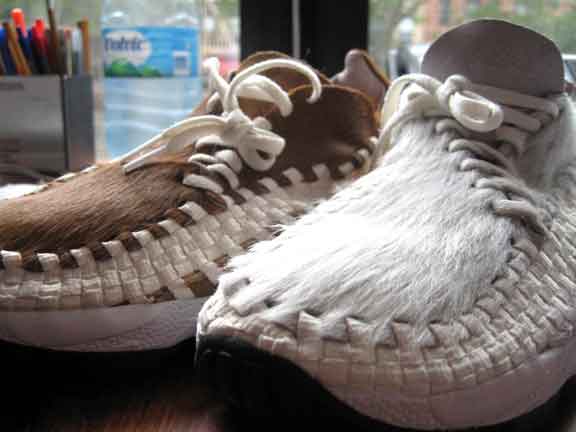
The Nike Ewoks
(submitted to steve's blog by Al Cabino)
Ever wondered what sneakers inspired by the Ewoks from Return of the Jedi would look like?
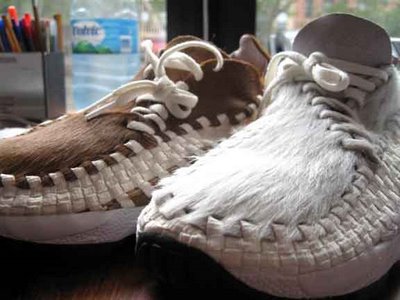
Yeah. Kind of like that.
Ever wondered what sneakers inspired by the Ewoks from Return of the Jedi would look like?
Yeah. Kind of like that.
Name change has hurt Macy’s
 Note from Steve: Be sure to check out Michael Meckler's take on this issue at Red-State.com
Decision to drop ‘Lazarus’ not a hit in central Ohio.
Jeffrey Sheban
THE COLUMBUS DISPATCH
COLUMBUS, Oh. - Macy’s is not as big a draw in central Ohio since the chain’s name was changed from Lazarus last year, market research indicates.
In 2005, customer visits to Macy’s in the Columbus market declined 4.5 percentage points, or by more than 50,000 people, according to the independent marketresearch firm Scarborough Research.
The drop was steeper than Lazarus experienced during the previous five years combined.
Parent company Federated Department Stores changed the Lazarus name on six department stores and two furniture stores in central Ohio in March 2005, ending a 154-year run for a brand that had become synonymous with shopping in Columbus. The first Lazarus store opened in 1851 Downtown and grew into a regional chain of more than 40 stores in Ohio and four other states.
The change was part of Federated’s strategy to retire regional names, such as Bon Marche, Burdines, Goldsmith’s, Lazarus and Rich’s, in favor of a single national brand: Macy’s.
Federated also is converting 400 stores acquired last year from May Department Stores, including Kaufmann’s, to Macy’s. By the end of the year, the company plans to operate 850 stores, most of them under the name Macy’s.
Chicago-based retail analyst James E. Dion said the Columbus market-share data, the first he’s seen compiled, suggests to him that Federated might have misjudged consumer sentiment.
"I think it’s a huge warning flag," he said. "The customers are basically saying, ‘We liked our hometown department store. We liked Lazarus. We trusted it.’ "
Shopper Libby Benson agreed.
"I shopped Lazarus for many years. I went every time I had a chance," said Benson, a model for Lazarus in the 1970s.
While she continues to shop at Macy’s, she’s spending more time in rival Nordstrom and specialty shops.
"Since Lazarus left, I kind of shop around," she said.
According to Scarborough Research, Benson is not alone. Lazarus foot traffic declined modestly between 2000 and 2004, the last full year for the Lazarus name. Nearly 320,000 central Ohioans, or 28.7 percent of adults, said they visited a Lazarus in 2000.
By 2004, the number had declined to nearly 306,000, or 24.3 percent of adult shoppers.
A year later, less than 252,000 adult shoppers, or 19.8 percent of the market, said they visited Macy’s.
"Normally, you would not expect that level of decline," Dion said. "Lazarus absolutely had value as a name, and the customer is saying one size does not fit all."
Store numbers don’t account for it. Since 2001, Lazarus has closed five central Ohio stores: Downtown, Heath, Henderson Road, Northland and Westerville. Since 1997, it has opened four: Easton, Polaris, the Mall at Tuttle Crossing and Tuttle furniture. The company has said the new stores have more than twice the sales volume of those they replaced.
Other department stores, including Sears and JCPenney, have lost market share in the period, while Target and Wal-Mart have gained share. Newcomers in the market — Kaufmann’s, Kohl’s, Nordstrom, Saks Fifth Avenue and Von Maur — also have siphoned customers from Macy’s.
Federated spokesman Jim Sluzewski said the Cincinnatibased company doesn’t disclose customer traffic, and he declined to comment on the Columbus data.
But he said it’s too soon to judge the drawing power of the Macy’s brand, which will not be marketed aggressively on a national basis until the fall, when all the May stores are rebranded.
"At this point, the customer is waiting to see," Sluzewski said. "There’s always concern when we change names because change is difficult. But customers always tell us it’s what’s inside the store that’s important with them."
That’s how shopper Michael Sanders of Gahanna sees it. The 35-year-old father of two hasn’t scaled back his Macy’s shopping compared with Lazarus because the new stores meet his needs.
"To me, it’s the same," he said, leaving the Macy’s at Easton last week with a purchase. "The only thing that changed is the sign on the outside and who I send my payment to."
Neva Kraatz of Reynoldsburg sees more differences between the two, however, and prefers Lazarus.
"Since the change, I’m finding less brand-name assortments and more private labels at Macy’s," she said. "They tend to get more vanilla."
Kraatz also misses the high level of community involvement and philanthropy of a homegrown department store.
"Local businesses give back to the community," she said. "Given the choice of two stores right next to each other, I’d definitely go to the one I felt supported the community."
Monday, June 05, 2006
Sandals with socks! EEK!
Style mavens point out the fashion faux pas of summer, and what you can do to avoid them
By JENNETTE BARNES, Standard-Times staff writer
NEW BEDFORD, Mass. - When summer comes, the layers of taste are sometimes peeled away, like a cover-up revealing a bad bathing suit. It's as if winter is so long, people forget the rules of warm-weather style.
Here, some of the SouthCoast's fashion-forward offer advice on how to avoid a summer fashion faux pas.
1. Socks with sandals.
There's no excuse for the most glaring error of them all, says Angie Bernardo, manager of The Glass Slipper shoe store in New Bedford.
Others agree.
"Oh my God, that's really bad," says an Express employee at the Dartmouth Mall. Ditto for stockings with sandals.
Hands down, these looks are right up there with pants hiked up above the waist or a heavy sweater tucked in.
The solution? Make a choice. If you want the look and comfort of sandals, bare your toes. If you want warmth, or if you have feet that shouldn't be seen in public, wear closed-toed shoes.
If you must:
For people who can pull off the post-hippie nature-loving look, thick ragg socks (the more textured-looking the better) with Birkenstocks might work.
Emphasis on "might."
"I guess if the person can pull it off, that's fine, but I wouldn't say that's a very cool fashion," says the woman from Express.
2. Men in tank tops.
Outside the gym, the ribbed tank undershirt is hard to pull off unless you're Brad Pitt, and even he rarely stoops that low. It may look good in a black-and-white cologne ad, but that doesn't mean it looks good on real men.
"I don't like it," says Celia Brito, owner of Celia's Boutique in downtown New Bedford. A cotton button-front shirt, worn loose at the neck, is a much more "tastefully sexy" way to hit the town, she says.
If you must:
Sleeveless jerseys work for a pickup game, and smooth-knit tanks with decent coverage (no chest hair peeking out) may be OK for activities like beach volleyball. Muscle tone is the look, so if your arms are more Fred Rogers than Vince Vaughn, wear a T-shirt.
3. Busty and braless.
Halter tops are all the rage, but for the bustier woman they just don't work without a bra, says Ms. Brito of Celia's.
If you must:
Stay on the beach. Or, better yet, "Try a sexy top that can be worn with a bra," Ms. Brito says, such as something with ruffles that cover the straps. Or reacquaint yourself with the strapless bra.
4. For men, the sneaker du jour.
"When people hear 'casual,' right away guys think of sneakers," says Michael Friedland, owner of Harve's Shoe Box in Dartmouth.
Since men typically own fewer pairs of shoes than women, they try to make sneakers work with anything below a suit. But the ubiquitous white sneaker isn't the only way to go. Driving moccasins are stylish right now, Mr. Friedland says. They are less casual than boat shoes, but less formal than dress shoes.
If you must:
Match clothing style to the sneakers. If you're partial to white sneakers, that means wearing a lot of T-shirts. Otherwise, die-hard sneaker-wearers looking for a more formal look can try "trail" shoes, which are marketed as low-cut hiking shoes but often look and feel like a brown sneaker. They blend better with khakis.
5. For women, strappy shoes a size too small.
Far too many times, says Ms. Bernardo of The Glass Slipper, she sees women with their heel and toes hanging over the edges of a strappy shoe or sandal.
If you must:
Next time, take more time when you're trying on sandals and buy a bigger size.
6. Too-tight fright.
Just because summer clothes show more skin, that doesn't mean people should put every roll of flesh on display, says Alice Touchette, a dressmaker and designer in Wareham.
"Very often," she says, "women will buy by size rather than cut." As with the teeny sandals, take your time and try on different sizes. A size 10 from one manufacturer may fit well, but another may fit more like an 8, or even a 6.
Men, too, fall victim to this fashion mistake.
"It's better to leave a little to the imagination," Ms. Touchette says.
If you must:
Redefine "tight" to mean fitted, not painted-on.
7. Sparkling like the 4th of July.
While she loves the return of more "girly" details on clothes, Ms. Touchette warns, "Don't overdo the sparkle."
Glitter, sequins, beads and metallics can quickly overwhelm an outfit, especially when multiple pieces are worn together.
If you must:
Set a limit of one or two touches of sparkle, she says. Accessories like shimmery scarves or bags do the trick without going overboard.
8. Shorts too short.
Clothing retailers say longer shorts are back this year, but most people still have the shorter styles of the last few years in their closets. Some women look awesome in high-leg shorts. But for others, Daisy Dukes are just plain impossible.
Anne Frechette, co-owner of A.S. Deams in Westport, says some older women are no longer comfortable in shorts.
"We have a three-quarter length capri pant that takes the place of the shorts some people shouldn't be wearing," she says.
If you must:
Short-shorts are fine if you have the legs for it, and many people do. Before you buy, bend at the waist and make sure the shorts cover whatever you need covered. Another condition: No pleats. They're so 1990.
9. Dirty white shoes or Heels
"White is something you have to keep pristine, or else forget it," says Ms. Bernardo. She cringes to see women go out in white shoes with ripped or scuff-covered heels.
The best look in women's white dress shoes is strappy, without stockings. Pumps are harder to pull off, pristine or not.
"White is one of those colors that if you don't do it in a good way, it's very bad," she says.
If you must:
Clean them ASAP, or consider retiring them in favor of a light but more forgiving shade, such as tan.
10. Bad toenails.
Back to those sock-free sandals: Well-kept feet are a must.
"Always have a fresh pedicure," Ms. Bernardo says. "A lot of people think it's OK to go out with chipped toenails."
Or worse.
If you must:
Foregoing the salon doesn't have to mean bad feet. For men and women alike, a professional pedicure may be nice, but if you can't afford it, at-home hygiene is enough, says Ms. Brito.
Beauty supply stores sell pedicure kits with enough tools of the trade to save on salon bills.
"You can do a really great job at home," she says. "Save the money and buy a cute top."
By JENNETTE BARNES, Standard-Times staff writer
NEW BEDFORD, Mass. - When summer comes, the layers of taste are sometimes peeled away, like a cover-up revealing a bad bathing suit. It's as if winter is so long, people forget the rules of warm-weather style.
Here, some of the SouthCoast's fashion-forward offer advice on how to avoid a summer fashion faux pas.
1. Socks with sandals.
There's no excuse for the most glaring error of them all, says Angie Bernardo, manager of The Glass Slipper shoe store in New Bedford.
Others agree.
"Oh my God, that's really bad," says an Express employee at the Dartmouth Mall. Ditto for stockings with sandals.
Hands down, these looks are right up there with pants hiked up above the waist or a heavy sweater tucked in.
The solution? Make a choice. If you want the look and comfort of sandals, bare your toes. If you want warmth, or if you have feet that shouldn't be seen in public, wear closed-toed shoes.
If you must:
For people who can pull off the post-hippie nature-loving look, thick ragg socks (the more textured-looking the better) with Birkenstocks might work.
Emphasis on "might."
"I guess if the person can pull it off, that's fine, but I wouldn't say that's a very cool fashion," says the woman from Express.
2. Men in tank tops.
Outside the gym, the ribbed tank undershirt is hard to pull off unless you're Brad Pitt, and even he rarely stoops that low. It may look good in a black-and-white cologne ad, but that doesn't mean it looks good on real men.
"I don't like it," says Celia Brito, owner of Celia's Boutique in downtown New Bedford. A cotton button-front shirt, worn loose at the neck, is a much more "tastefully sexy" way to hit the town, she says.
If you must:
Sleeveless jerseys work for a pickup game, and smooth-knit tanks with decent coverage (no chest hair peeking out) may be OK for activities like beach volleyball. Muscle tone is the look, so if your arms are more Fred Rogers than Vince Vaughn, wear a T-shirt.
3. Busty and braless.
Halter tops are all the rage, but for the bustier woman they just don't work without a bra, says Ms. Brito of Celia's.
If you must:
Stay on the beach. Or, better yet, "Try a sexy top that can be worn with a bra," Ms. Brito says, such as something with ruffles that cover the straps. Or reacquaint yourself with the strapless bra.
4. For men, the sneaker du jour.
"When people hear 'casual,' right away guys think of sneakers," says Michael Friedland, owner of Harve's Shoe Box in Dartmouth.
Since men typically own fewer pairs of shoes than women, they try to make sneakers work with anything below a suit. But the ubiquitous white sneaker isn't the only way to go. Driving moccasins are stylish right now, Mr. Friedland says. They are less casual than boat shoes, but less formal than dress shoes.
If you must:
Match clothing style to the sneakers. If you're partial to white sneakers, that means wearing a lot of T-shirts. Otherwise, die-hard sneaker-wearers looking for a more formal look can try "trail" shoes, which are marketed as low-cut hiking shoes but often look and feel like a brown sneaker. They blend better with khakis.
5. For women, strappy shoes a size too small.
Far too many times, says Ms. Bernardo of The Glass Slipper, she sees women with their heel and toes hanging over the edges of a strappy shoe or sandal.
If you must:
Next time, take more time when you're trying on sandals and buy a bigger size.
6. Too-tight fright.
Just because summer clothes show more skin, that doesn't mean people should put every roll of flesh on display, says Alice Touchette, a dressmaker and designer in Wareham.
"Very often," she says, "women will buy by size rather than cut." As with the teeny sandals, take your time and try on different sizes. A size 10 from one manufacturer may fit well, but another may fit more like an 8, or even a 6.
Men, too, fall victim to this fashion mistake.
"It's better to leave a little to the imagination," Ms. Touchette says.
If you must:
Redefine "tight" to mean fitted, not painted-on.
7. Sparkling like the 4th of July.
While she loves the return of more "girly" details on clothes, Ms. Touchette warns, "Don't overdo the sparkle."
Glitter, sequins, beads and metallics can quickly overwhelm an outfit, especially when multiple pieces are worn together.
If you must:
Set a limit of one or two touches of sparkle, she says. Accessories like shimmery scarves or bags do the trick without going overboard.
8. Shorts too short.
Clothing retailers say longer shorts are back this year, but most people still have the shorter styles of the last few years in their closets. Some women look awesome in high-leg shorts. But for others, Daisy Dukes are just plain impossible.
Anne Frechette, co-owner of A.S. Deams in Westport, says some older women are no longer comfortable in shorts.
"We have a three-quarter length capri pant that takes the place of the shorts some people shouldn't be wearing," she says.
If you must:
Short-shorts are fine if you have the legs for it, and many people do. Before you buy, bend at the waist and make sure the shorts cover whatever you need covered. Another condition: No pleats. They're so 1990.
9. Dirty white shoes or Heels
"White is something you have to keep pristine, or else forget it," says Ms. Bernardo. She cringes to see women go out in white shoes with ripped or scuff-covered heels.
The best look in women's white dress shoes is strappy, without stockings. Pumps are harder to pull off, pristine or not.
"White is one of those colors that if you don't do it in a good way, it's very bad," she says.
If you must:
Clean them ASAP, or consider retiring them in favor of a light but more forgiving shade, such as tan.
10. Bad toenails.
Back to those sock-free sandals: Well-kept feet are a must.
"Always have a fresh pedicure," Ms. Bernardo says. "A lot of people think it's OK to go out with chipped toenails."
Or worse.
If you must:
Foregoing the salon doesn't have to mean bad feet. For men and women alike, a professional pedicure may be nice, but if you can't afford it, at-home hygiene is enough, says Ms. Brito.
Beauty supply stores sell pedicure kits with enough tools of the trade to save on salon bills.
"You can do a really great job at home," she says. "Save the money and buy a cute top."
Sunday, June 04, 2006
we all live in a...
(submitted to steve's blog by Al Cabino)
 A really fun yellow submarine by Subeo...! Find out more here.
 A really fun yellow submarine by Subeo...! Find out more here.
the reluctant mac daddy
I’ve been trying to keep from setting up my old Macintosh to recapture some old files I had on it, but it looks more and more like I’m going to have to.
My latest epiphany happened this afternoon when I decided to pull out the old 110MB SCSI Zip drive I have, because most of the Mac's files were backed up on Zip disks.
When I bought it back in 1998, the packaging claimed it could work for either Mac or Windows, but I never hooked up to a PC before a couple hours ago.
Of course, Windows 95 and Windows XP don’t tend to be terribly compatible, so you can surmise that the original (and quite ancient) software and drivers did not work. I figured a quick trip to Iomega’s website could fix this.
Wrong. After spending the better part of an hour downloading the updated software, I found out there was a hardware problem that required me open the CPU to somehow reset the SCSI card.
That’s where I stopped. I think it is possible to get this thing to work, but the instructions I got aren’t clear and I don’t want to mess up my computer. It’d be cheaper to track down a USB Zip drive that to send in the computer for service and replace the card if I broke it.
My latest epiphany happened this afternoon when I decided to pull out the old 110MB SCSI Zip drive I have, because most of the Mac's files were backed up on Zip disks.
When I bought it back in 1998, the packaging claimed it could work for either Mac or Windows, but I never hooked up to a PC before a couple hours ago.
Of course, Windows 95 and Windows XP don’t tend to be terribly compatible, so you can surmise that the original (and quite ancient) software and drivers did not work. I figured a quick trip to Iomega’s website could fix this.
Wrong. After spending the better part of an hour downloading the updated software, I found out there was a hardware problem that required me open the CPU to somehow reset the SCSI card.
That’s where I stopped. I think it is possible to get this thing to work, but the instructions I got aren’t clear and I don’t want to mess up my computer. It’d be cheaper to track down a USB Zip drive that to send in the computer for service and replace the card if I broke it.
A sign of the time
With cellphones' popularity, most teens view wristwatches as unnecessary accessories
Erica Sagon
The Arizona Republic
PHOENIX - Any bare-wristed teen or 20-something can tell you that watches are so five minutes ago. Cellphones are the preferred timepieces, and their popularity is causing watch sales to decline.
"I look at my cellphone all the time anyway for text messaging, so I just end up looking at the time," said Ryan Kennedy, a watchless 20-year-old student at Arizona State University. He stopped wearing a watch when he got his first cellphone as a freshman in high school.
Ditching watches underscores young people's love affairs with the cellphone, an increasingly do-it-all gadget whose capabilities have also replaced alarm clocks and cameras for some people.
A recent survey by Piper Jaffray & Co. shows that wristwatches' time is up among teens.
After polling 700 teens this spring in cities including Scottsdale, 59 percent said they never wear watches. Last time the survey was conducted in fall 2005, 48 percent of teens said they never wear watches.
Although the company polled teens only, the trend is also tied to 20-somethings. In contrast, watches are still popular with older generations, which are more likely to view watches as status symbols or wear them daily out of habit.
While no one is predicting the death of the watch industry, the trend is giving watchmakers something to fret about. Fossil's watch sales have slipped while its apparel and accessories business has grown. Oakley has also reported dips in watch sales.
Fossil said growing its watch business this year would be difficult, but that the lackluster sales are cyclical. It expects consumer spending on watches to pick up in the long term.
Piper Jaffray's survey of teens isn't brightening the outlook for the retailers. The poll found that 82 percent of teens don't plan to buy a watch in the next six months. When teens were surveyed last fall, 76 percent said they would not buy a watch in the coming months.
Teens would rather spend their money on purses, shoes and electronics. In comparison, watches are a less thrilling purchase.
Watchmakers will try to rekindle the appeal of watches to younger consumers, said Piper Jaffray analyst Neely Tammingia.
"We think it'll come through product innovations, whether it be different materials used in making the watches . . . (or) celebrity endorsements and being more visible in teen-related publications and media," Tammingia said. "It's important for them to focus on what is increasingly appearing to be a general indifference to watches from teens."
Evan Wong, 18, of Chandler, sports a watch that he got as a high school graduation gift from his tennis coach. He wears watches regularly, unless he is at the gym or playing tennis, but he understands why many of his friends don't.
"You have your car keys. You have your wallet, your cellphone, your watch, sunglasses. That's a lot of accessories," Wong said. "A cellphone really cuts down on bothering with a watch."
At online retailer Shopping.com, searches for wristwatches have spiked during the holidays but have declined overall during the past two years. The company predicts that as people consolidate the gadgets they carry, watches will evolve as accessories rather than useful timepieces.
Fahim Sultani, 15, of Phoenix, wears a watch to special events like weddings a few times a year, but has friends who carry cellphones and wear watches regularly, too.
"They wear pretty nice watches with jeans and a regular T-shirt," Sultani said. "A lot of them just wear watches more for show than to actually tell time."
Wristwatches are still status symbols for businesspeople, said Michael Strong, owner of Michael's Jewelers in downtown Phoenix.
"They're in business and what they wear is looked on. People observe things like that," Strong said.
"So they like to put on something that would be complimented and would help them with whatever they're doing. A watch is an opening sometimes to a sale."
Erica Sagon
The Arizona Republic
PHOENIX - Any bare-wristed teen or 20-something can tell you that watches are so five minutes ago. Cellphones are the preferred timepieces, and their popularity is causing watch sales to decline.
"I look at my cellphone all the time anyway for text messaging, so I just end up looking at the time," said Ryan Kennedy, a watchless 20-year-old student at Arizona State University. He stopped wearing a watch when he got his first cellphone as a freshman in high school.
Ditching watches underscores young people's love affairs with the cellphone, an increasingly do-it-all gadget whose capabilities have also replaced alarm clocks and cameras for some people.
A recent survey by Piper Jaffray & Co. shows that wristwatches' time is up among teens.
After polling 700 teens this spring in cities including Scottsdale, 59 percent said they never wear watches. Last time the survey was conducted in fall 2005, 48 percent of teens said they never wear watches.
Although the company polled teens only, the trend is also tied to 20-somethings. In contrast, watches are still popular with older generations, which are more likely to view watches as status symbols or wear them daily out of habit.
While no one is predicting the death of the watch industry, the trend is giving watchmakers something to fret about. Fossil's watch sales have slipped while its apparel and accessories business has grown. Oakley has also reported dips in watch sales.
Fossil said growing its watch business this year would be difficult, but that the lackluster sales are cyclical. It expects consumer spending on watches to pick up in the long term.
Piper Jaffray's survey of teens isn't brightening the outlook for the retailers. The poll found that 82 percent of teens don't plan to buy a watch in the next six months. When teens were surveyed last fall, 76 percent said they would not buy a watch in the coming months.
Teens would rather spend their money on purses, shoes and electronics. In comparison, watches are a less thrilling purchase.
Watchmakers will try to rekindle the appeal of watches to younger consumers, said Piper Jaffray analyst Neely Tammingia.
"We think it'll come through product innovations, whether it be different materials used in making the watches . . . (or) celebrity endorsements and being more visible in teen-related publications and media," Tammingia said. "It's important for them to focus on what is increasingly appearing to be a general indifference to watches from teens."
Evan Wong, 18, of Chandler, sports a watch that he got as a high school graduation gift from his tennis coach. He wears watches regularly, unless he is at the gym or playing tennis, but he understands why many of his friends don't.
"You have your car keys. You have your wallet, your cellphone, your watch, sunglasses. That's a lot of accessories," Wong said. "A cellphone really cuts down on bothering with a watch."
At online retailer Shopping.com, searches for wristwatches have spiked during the holidays but have declined overall during the past two years. The company predicts that as people consolidate the gadgets they carry, watches will evolve as accessories rather than useful timepieces.
Fahim Sultani, 15, of Phoenix, wears a watch to special events like weddings a few times a year, but has friends who carry cellphones and wear watches regularly, too.
"They wear pretty nice watches with jeans and a regular T-shirt," Sultani said. "A lot of them just wear watches more for show than to actually tell time."
Wristwatches are still status symbols for businesspeople, said Michael Strong, owner of Michael's Jewelers in downtown Phoenix.
"They're in business and what they wear is looked on. People observe things like that," Strong said.
"So they like to put on something that would be complimented and would help them with whatever they're doing. A watch is an opening sometimes to a sale."
Saturday, June 03, 2006
june 1 article | your new bachelor pad
 This one's all about outfitting a bachelor pad. I thought it was pretty cool.
al for you
A big thanks to internationally renowned sneakerographer Al Cabino for providing so much new content to steve's blog.
Did I mention he has a new MySpace page at www.myspace.com/cabino?
(yeah, I know, I just did. LOL)
Did I mention he has a new MySpace page at www.myspace.com/cabino?
(yeah, I know, I just did. LOL)
Subscribe to:
Posts (Atom)