Wednesday, February 28, 2007

Yeah! I want Cheesy (Tots)!

I'm not hip enough to publicly not like fast food, so I'll admit I eat a lot of it on my "dinner hour" between The City and Big Green. Usually Arby's, McDonald's or Long John Silvers (Long Green Slivers as Eddy calls it).

There's a Burger King on the way as well, and though I'm pretty much off The King after eating so much in college (they were open late), I pop in so every so often I won't suffer from McBurnout, Roast Beef Malaise, or whatever the hell eating too much LJS will do.

The latest trip was largely disappointing as usual, but I discovered a new menu item: something called Cheesy Tots.

This one-time experimental breakfast item apparently caught on at BK and has built up a following. Some people have raved about them, and others have urged its return when taken offf the menu temporarily

I love tater tots (almost went to Sonic to get some actually) and I like cheese sticks, so I figured these golden brown, saucer-shaped chicken nugget-looking bites might be worth a shot.

Not so fast.

Maybe I got a bad batch or something, but I thought they were awful. The mix of mozzarella and cheddar cheeses was decent enough, but the deep-fried coating was hard and starchy and the few potato bits found inside distracted too much from the cheese. The lack of a dipping sauce was a problem, as ketchup didn't work well at all with the other flavors, and there are only so many condiments that might work. Though I might suggest they find some to mask the overall taste :-)

Still, for the price, it wasn't a bad deal. Burger King isn't exactly known for their culinary prowess in the first place (see also: Chicken Fries), and if you're sick of french fries and onion rings, it does add another option to the palette.

Just don't offer me any. I'll pass.

joke week '07 | day 4

An 80-year-old man went to his doctor for his quarterly check-up. The doctor asked him how he was feeling and the 80-year-old said

"Things are great and I've never felt better. I now have a 20 year-old bride who is pregnant with my child. So what do you think about that?"

The doctor considered his question for a minute and then began.

"I have an older friend, much like you, who is an avid hunter and never misses a season. One day when he was setting off hunting, he was in a bit of a hurry and accidentally picked up his umbrella instead of his gun. As he neared a lake he came across a very large beaver sitting at the water’s edge."

"When he realized he'd left his gun at home and so couldn't shoot the magnificent creature, out of habit he raised his umbrella, aimed it at the animal as if it were e his favorite hunting rifle and went 'bang, bang'. Miraculously, two shots rang out and the beaver fell over dead. Now, what do you think of that?" asked the doctor."

The 80-year-old said, "If you ask me, I'd say somebody else pumped a couple of rounds into that beaver."

The doctor replied, "My point exactly".

Tuesday, February 27, 2007

Federated Plans to Change Name to Macy's

MSN Money & Business Wire reports

The management of Federated Department Stores wants to change the company's name. The retailer said a vote on changing its name to Macy's Group will occur at the company's annual meeting May 18. If approved, the name change will go into effect June 1.

"We're no longer a federation of retail stores; Macy's is 90% of our business," CEO Terry Lundgren told CNBC today.

Federated Department Stores, Inc. was originally chosen as the company's name in 1929 by a group of family-owned department stores that joined together under a corporate holding company umbrella.

Federated became an operating company in 1945, and its portfolio over the years has included various regional department store names.

In 2005 and 2006, all regional nameplates were converted to Macy's. The company today operates only Macy's and Bloomingdale's stores, with both brands expanding nationwide.

joke week '07 | day 3

A new supermarket opened near my house. It has an automatic water mister to keep the produce fresh. Just before it goes on, you hear the sound of distant thunder and the smell of fresh rain.

When you approach the milk cases, you hear cows mooing and experience the scent of fresh hay.

When you approach the egg case, you hear hens cluck and cackle, and the air is filled with the pleasing aroma of bacon and eggs frying.

The veggie department features the smell of fresh buttered corn.

I don't buy toilet paper there any more.

Monday, February 26, 2007

Wake Up, Smell the Coffee

Starbucks Coffee founder and chairman Howard Schultz complains that the chain's atmosphere has changed. Actually, it's worse than that: its stores are now an overdesigned, overcrowded mess. Hmmmm...it took them this long to figure out they're weakening the concept?

Gap to close Forth & Towne chain

SAN FRANCISCO (AP) - Gap Inc. is closing the Forth & Towne chain that was supposed to help the struggling retailer sell more clothes to older women, aborting the 18-month expansion so management can concentrate on reviving the company's more established brands.

The decision announced Monday affects all 19 Forth & Towne stores opened since Gap unveiled the concept in West Nyack, N.Y., north of New York City in August 2005. Forth & Towne's other stores are located in Atlanta, Chicago, Houston, Seattle, San Francisco, Los Angeles, San Diego, San Jose and Santa Barbara.

The store closures are expected to be completed by the end of June, jettisoning about 550 jobs. Some of the affected employees may be transferred to one of the San Francisco-based company's other chains - Gap, Old Navy and Banana Republic.

Signaling that some layoffs are likely, Gap is budgeting $7 million to cover severance payments and other benefits for former Forth & Towne workers, according to a filing with the Securities and Exchange Commission.

Gap hoped to develop Forth & Towne into a specialty channel catering to women older than 35 who grew up in Gap jeans but found themselves sized out in the market in middle age. When it launched Forth & Towne, Gap estimated it only held a 3 percent share of over-35 female market compared to an 8 percent share of women shoppers under 35. Gap had hoped to woo boomers - who are at the peak of their earnings and spending power - back with a store that combined the service of a boutique, the broad offerings of a department store - and a more forgiving fit.

"Forth & Towne was a great test of a promising concept and an illustration of the innovative risks you need to take in our business," said Gap Chairman Bob Fisher. "We made the tough decision to close the brand and focus our efforts on stabilizing the existing businesses."

Fisher has been Gap's interim chief executive officer since last month when the retailer ended the nearly 4 1/2-year rein of Paul Pressler after a dismal holiday shopping season that represented a new low point in a prolonged sales funk.

In a key measure of a retailer's health, Gap's same-store sales fell 7 percent last year, deteriorating from a 5 percent decline in 2005. The closely watched yardstick measures sales at stores open at least a year.

Despite its troubles, Gap intends to continue investing in other promising concepts, including a recently launched online shoe store called Piperlime, company spokesman Greg Rossiter said.

Although abandoning Forth & Towne will drive up Gap's expenses by about $40 million during the first half of this year, industry analysts believe the company will be better off without the potential albatross.

"This brand never gained much traction, suffered from fit, style, and image problems and became a big distraction," Lazard Capital Markets analyst Todd Slater wrote in a Monday research note.

Retail analyst Jennifer Black said the expansion never made much sense, given Gap's troubles connecting with shoppers of all ages. "The landscape is so competitive that each retailer has to have a clear reason to be (in existence) and Forth & Towne, never had that," she said.

Gap shares fell 16 cents Monday to close at $19.65 on the New York Stock Exchange.

Scrapping Forth & Towne also may free up some merchandising talent to help with the turnaround efforts at the Gap and Old Navy chains. Analysts are particularly intrigued with the possibility that Forth & Towne's current president, Gary Muto, might now return to Gap, a chain that he led from August 2002 through September 2004.

Gap's sales improved during most of Muto's tenure at the chain. "If he were to return to the Gap brand, (it) would be a positive influence on the division," Stifel, Nicolaus & Co. analyst Richard Jaffe wrote in a Monday research note.

If Muto were to come back to the Gap, it probably wouldn't be as president because the company just promoted Marka Hansen - the former head of Banana Republic - to that job earlier this month.

Muto also once ran Banana Republic, making him a possible candidate to return to an upscale chain that has emerged as the best-performing of Gap's three brands.

Gap and Muto haven't agreed on a new assignment yet, Rossiter said. The company is expected to discuss the ramifications of the Forth & Towne closure Thursday when it reviews its fourth-quarter results in a conference call with analysts.

Forth & Towne's closure underscores the challenges facing clothing retailers catering to the graying baby-boom generation. Many merchants like Gap recently have been intensifying their focus on the niche, inspired by Chico's FAS Inc.'s successful formula for targeting boomers.

But now even Chico's is hitting a rough patch, having registered a 2.2 percent gain last fiscal year in its same-store sales. Chico's slowing same-store sales growth followed double-digit increases in the previous two years.

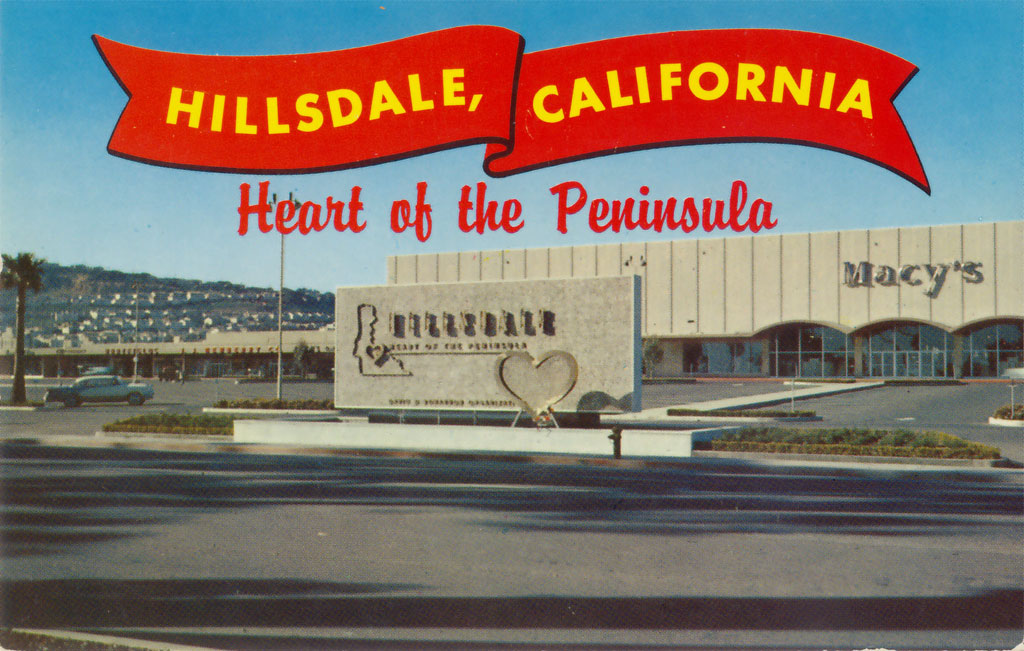
A Shopping Center is Born

David at Retail Memories From Coast to Coast uploaded 2 videos (split) about Hillsdale Shopping Center in San Mateo, California, as it was in 1957 when it opened.

The videos show the center before it was enclosed, activities related to it, and vintage fashions, stores and signage. They serve as almost a class as to "how to shop" in what was then a new style of commerce.

Check them out. I think you'll enjoy them.

A Shopping Center is Born

(photo courtesy of Scott at BIGMallrat's Malls in Northern California and Reno Blog)

'time' for McFly

(submitted to steve's blog by Al Cabino)

TIME Magazine's Lev Grossman blogged about The McFly Project here (scroll to the end)

Nerd World - Lev Grossman - Technology - TIME

joke week '07 | day 2

A motorcycle patrolman was rushed to the hospital with an inflamed appendix. The doctors operated and advised him that all was well. However, the patrolman kept feeling something pulling at the hairs in his crotch.

Worried that it might be a second surgery the doctors hadn't told him about, he finally got enough energy to pull his hospital gown up so he could look at what was making him so uncomfortable.

Taped firmly across his pubic hair were three wide strips of adhesive tape, the kind that doesn't come off easily. Written in large black letters was the sentence:

"Get well quick...from the nurse you gave a ticket to last week."

Sunday, February 25, 2007

joke week '07 | day 1

On the first day of school, the children brought gifts for their teacher.

The florist's son brought the teacher a bouquet of flowers.

The candy-store owner's daughter gave the teacher a pretty box of candy.

Then the liquor-store owner's son brought up a big, heavy box.

The teacher lifted it up and noticed that it was leaking a little bit. She touched a drop of the liquid with her finger and tasted it.

"Is it wine?" she guessed.

"No," the boy replied.

She tasted another drop and asked, "Champagne?."

"No," said the little boy. "It's a puppy!"

Sunday, February 11, 2007

A Winter White That Works for Spring


By DAVID COLMAN

WHATEVER the charms of the International Tennis Hall of Fame gala, held every year during the United States Open, looking for men’s fashion trends there would seem to be a fool’s errand.

But at last September’s event, the tennis legend Stan Smith spotted a spring look months ahead of time: a group of stylish young men had come in black tie and brand-new Stan Smiths, the white, stripe-free Adidas sneakers that have done more to enshrine Mr. Smith’s name in the annals of pop culture than his tennis record ever did.

“It was pretty neat,” said Mr. Smith, 60, who won the United States Open in 1969 and had the shoe named after him in 1971. “For me, they’re my work shoe.”

And now city men are wearing them to work, too, bringing sprightly new meaning to the WASPy old-man expression “white shoe.” A combination of factors — hip-hop stars who brag that they wear a new pair of clean white Nike Air Force 1’s every day; designers like Marc Jacobs (who has worn Stan Smiths since junior high) and John Varvatos (who made Converse Jack Purcells and Chuck Taylors must-haves again) — have converged to make the all-white, old-school sneaker into Le Shoe for the smart set.

They are, it turns out, perfect for young, for old, for rich, for poor. They go with jeans, a suit, even a tux; you can wear them to work, to play and even to appear on Oprah (as Mr. Jacobs did). They can be cheap (basic Stan Smith’s are $55 at adidas.com) or not (the 25th anniversary Air Force 1’s are $2,000 at Barneys New York) or in between. They even come with a brand of fashion approval: several designers now offer their own version of the white sneaker, among them Stefano Pilati at Yves Saint Laurent, Neil Barrett, Dries van Noten and Miuccia Prada.

Sneaker craziness may not sound like anything new, but this time there’s a rub, and like it or not, it involves a toothbrush.

“They need to be clean,” said Daniel Peres, the editor of Details. “It’s a good look, a right-out-of-the-box-clean pair of white sneakers, and it’s the only kind you can wear with dressier clothes, nice jeans or even a suit.” But he reiterated his proviso. “Some people do everything they can to make them look worn and dirty, which is wrong. I’ve seen fashion editors in the Tuileries Gardens in Paris, shuffling their feet in the dirt to make their Chucks look worn in. I just stood there in horror.”

According to a nurses’ advisory site, the best way to keep white shoes dazzling is with Murphy’s Oil Soap and a toothbrush, and those white rubber soles might call for a go with whitewall-tire cleaner. Or you can subcontract the work and take them to the shoeshine man.

Sean Donovan, a sneaker collector who just bought a fresh pair of Stan Smiths for a new job (as a salesman at the Marc Jacobs store, in fact), said he was careful to keep his new shoes in rotation with, say, his white Air Force 1’s. He sprays them immediately with water and stain repellent, which makes normal scuffs easy to wipe off. “If you want to get crazy, you can go at them with an old toothbrush and some Soft Scrub,” he said.

Mr. Donovan, who has about 65 pairs of sneakers, agreed that clean is key. “A white shoe, it makes you feel fresh,” he said. “It’s like when you wash and iron your clothes, it makes you feel like everything’s together.”

Given the care the humble shoes require, the current trend is not without a kind of upended silliness. “It’s really turned an ordinary product into a luxury product,” said Bradley Carbone, an editor at Complex magazine, an urban young men’s magazine, which, naturally enough, follows sneaker obsessions closely. “A few years ago when you had rappers like Fat Joe and Jay-Z talking about wearing a new pair every day, people responded by trying to keep theirs as crisp and clean as possible. So it has an aspirational seal to it, even though it’s on an inexpensive shoe.”

While Mr. Peres likes the look, he won’t be sporting it any time soon. “They draw all attention to your feet,” he said. “I don’t want to have to compete with my shoes.”

one-on-one

For all those interested in what's going on with me, here is an 'interview' I gave myself this morning:

Q: So how are you?
A: I've been incredibly busy with the City and Big Green. So much so that once I've checked my email and read the paper when I get home, I'm pretty well spent.

Q: How's work?
A: Work is work. There's some stuff that bothers me about my City job, but I never know who's reading this blog, so I'll leave that alone.

Q: Done anything fun lately?
A: I've gotten out to a couple of malls as of late, and my mom is hosting a Valentine's party next week, but not a lot of traditional "fun" - type things. I'll get out and do a little more after Big Green slows down and the weather breaks.

Q: What are you reading these days?
A: I found this great book: Service and Style: How The American Department Store Fashioned The Middle Class by Jan Whittaker. As you can tell from the title, this is right up my alley. :-)

Q: Heard any good new music lately?
A: No (laughs). I'm really disappointed in what I hear on the radio these days. There's not much feeling. It all seems like demographic marketing set to a beat.

Q: How's your parents?
A: Good. They always seem to stay pretty stable.

Q: Been to New York lately?
A: Not since Thanksgiving, but I hope to soon. There's several exhibits at the Met and Cooper-Hewitt that I want to check out, as well as MoMA.

Q: Just museums, huh?
A: Okay, there are more than a few stores that are on my radar there, too.

Q: What's with all the shopping anyway?
A: That's a question I don't have an answer for. All I know is that I like it, but not for the sake of it. It's more of an experiential thing. I like stores that make an effort to offer things that people need in a way that is creative, interesting and fun.

Q: Any good stores you wan to talk about?
A: Well, Urban Outfitters for one. They do a great job at marketing to their target audience. The design quality of their stores and advertisements is exceptional.

Q: Do you ever not talk about retail?
A: Sometimes I don't. Actually a lot of times I don't. But I'd be lying if I didn't say it was a big deal to me. Always has been.

Q: What happened to Steve's News Annex?
A: I decided to close it down. It was starting to get to the point that I wasn't updating it much, and it was basically floating around without a purpose other than as a depository for stuff I didn't have space for here. It was fun to have for a while, and I'm proud of what I did there, but it was time to do something different.

Q: Can we expect a new blog in its place?
A: Not likely. I have a couple of ideas for blogs, but I don't have the time or resources to make them any good. It's not like I don't have other plces you can find me :-)

Q: Anything you'd like everybody to know out there?
A: I dunno. I guess the main thing is that despite all appearances otherwise, I'm still here.

Tuesday, January 30, 2007

way to flop

It’s not working.

The enhanced synergies of the Federated-May merger, much documented on this blog, are turning out to be hyperbole, at least in my neck of the woods. A recent visit to several local converted Macy’s stores confirms this.

Status Quo at Valley View
The Roanoke Macy’s seems to be one of the few former Hecht’s that has maintained its previous market position. This was a very typical Hecht’s previously, having been expanded and remodeled only a few years ago and carrying a very standard line of department store merchandise, sans furniture and rugs. Except for some small tweaks, Federated changed little about this store except its signs.

The inclusion of Federated private labels has enhanced the merchandise mix at Macy’s Valley View, though ladies’ apparel is still a little on the dull side, and the Home Store has lost some of its merchandise breadth and depth without seeming like a smaller selection. You have to give them credit for maintaining a semblance of normalcy, though it’s nowhere near as special a shopping experience as the national ads would have you believe.

River Ridge rows away
The Lynchburg location Macy’s currently occupies at River Ridge Mall must have been a ‘cash cow’ for its various owners over the years, because it’s bound to have made far more money than was invested back into it.

This store is a time warp in every sense of the word. Opened by Thalhimers in 1980 when it was still part of Carter Hawley Hale, the store received minor updates when it was purchased by May Company and turned into Hecht’s, but little else in its nearly thirty year existence. In turn, the merchandise has maintained the same general price point over the years by continually trading down its merchandise mix until the formerly upscale store is now a shell of its former self.

With its only bright spot being its involuntary position as a shrine to early ‘80s department store design, the store fails to impress. Macy’s switched out May Company private labels for Federated ones and thinned out an already paltry selection of clothes and home items.

Even with a national brand name and upmarket aspirations, it plays second fiddle to the Belk store a few hundred feet away.

Still Friendly, but not focused
Macy’s Friendly Center in Greensboro has become a retail enigma. The formerly swanky Thalhimers was heavily renovated and expanded into a fairly fashionable (for May Company) Hecht’s in the late ‘90s, only to stop its evolution somewhere around 2001.

Even with a major push to prominently feature Federated private labels like Charter Cub and Alfani ‘shops’ at prominent spots in the main floor misses department with the Macy’s conversion, this store has evolved from kitchen clean and standardized to a dated hodgepodge of fixture and merchandise styles, none of which mesh well together.

The department that bared the brunt of conversion pains is Misses Sportswear. Formerly a reliable source of classic suits and separates, the department’s push to attract younger customers have left its signature lines looking chintzy and Traditional Sportswear looking more matronly than ever.

Marked contrasts exist. A small but somewhat showy millinery section sits next to a comparatively dowdy suit and dress department. Pricey men’s cashmere sportcoats sit near an uninspiring selection of mid-market Bostonian shoes. An upmarket china selection is positioned near a rack of ‘As Seen on TV’ merchandise. To be sure, Hecht’s had similar contrasts at times, but never as pronounced or badly maintained.

Even the handful of high-end brands that sell well at the store can’t disguise the poor housekeeping and muddled vision this pace now has. Multiple burned out light bulbs in the ceiling and merchandise scattered in all the wrong places are things that Macy’s Friendly Center has that Hecht’s Friendly Center hardly ever did.

De-evolution on Wendover
How do you update an innovative department store? Apparently by removing all innovation.

Greensboro’s Hecht’s Wendover opened as a May Company test store for lifestyle merchandising, eschewing many of the traditional rules about merchandising and display in order to make the store more appealing to modern, time-starved shoppers. While not everything they tried was a success, the test results were strong enough that traditional Hecht’s stores started sporting some of the new techniques: brighter lighting, hipper brands, bigger signs, and more self-serve merchandise fixtures.

Macy’s Wendover represents the shunning of just about all that Hecht’s learned in favor of the tried and true, and decidedly boring. The Federated private labels add little to the mix. New merchandise adjacencies replaced a well-done Juniors’/ Young Men’s department with a Juniors’ department sitting next to matronly sportswear. Time saving ‘express’ checkouts near entrances were supplanted with barely-staffed traditional cash-wraps. Displays went from dramatic to anticlimactic. The total effect is antique merchandising set against a whiz-bang backdrop.

Your mileage may vary, but it’s becoming apparent, at least in this area, that things aren’t as great as they should be at Macy’s.

Monday, January 29, 2007

Gap Is in Need of a Niche

By MICHAEL BARBARO and HILLARY CHURA

In the fall of 2004, Gap put on a splashy ad campaign called, “How do you wear it?” with Lenny Kravtiz and Sarah Jessica Parker. It featured the pair dancing in customized Gap jeans — his with metal studs down the seam; hers with a waist-to-cuff velvet ribbon.

It was just the kind of envelope-pushing fashion Gap needed to compete with popular new designer-inspired denim brands like Diesel, Rock & Republic and Seven for All Mankind.

But there was a catch: the bedazzled jeans, which Gap called a “celebration of personal style,” could not be found at its stores.

Consumers had to buy a pair of basic, unembellished jeans at the store and customize them at a special training sessions held at some Gaps, or take a trip to Home Depot and Jo-Ann Fabrics and figure it out themselves.

The marketing tease is a small case study in what has ailed Gap, which ousted its chief executive, Paul S. Pressler, this week after years of dismal performance at its Gap and Old Navy divisions.

At a time when small, narrowly focused fashion brands — Coach, Juicy Couture, Tahari, Laundry — have become ascendant in American retailing, Gap has served up a steady diet of simple, unobjectionable casual clothing designed to appeal to everyone.

How do they wear it, as the ads asked? Increasingly, they just do not.

In an era of niches, when exclusion is as vital as inclusion, Gap has become an anachronism: a single chain, selling only its own brand, with one point of view, chasing shoppers from birth to death.

“If you stand for everything in fashion today, you stand for nothing,” said Paul R. Charron, the former chief executive of Liz Claiborne, who is credited with revitalizing the clothing company by purchasing fast-growing brands like Juicy Couture and Lucky Brand.

“Brands like the Gap, brands broadly available,” Mr. Charron said, “have a special challenge to be relevant in a period when focus and exclusivity are so important.”

Indeed, consumers are abandoning the chain in staggering numbers. Sales at stores open at least a year, a standard measure of a retailer’s health, have fallen or remained stagnant for 28 of the last 30 months.

And the declines have not been small. Sales fell 8 percent in December and November and 7 percent in October — the most crucial months of the year. The word “disappointing” became a common refrain in every monthly news release explaining Gap’s performance.

Gap operates three divisions: Gap, Old Navy and Banana Republic. All three have struggled, but only Banana Republic is on the rebound.

Niche brands, by contrast, have done so well that they have even reversed the fortunes of the American department store. In the last year, the performance of department stores like Nordstrom and Macy’s has quietly overtaken that of specialty clothing retailers like Gap.

The reason? “Consumers want brands, and we are all about brands,” said Stephen I. Sadove, chief executive of Saks Inc., whose sales have improved sharply in the last year on the strength of designer labels like Tahari and Theory.

“It’s very hard for the specialty clothing stores to keep themselves cutting-edge and fresh,” Mr. Sadove said. “There is a lot of sameness.”

Or walk into the handful of specialty clothing chains like Abercrombie & Fitch, American Apparel and Anthropologie, stores that, like Gap, design their own clothing but have managed to thrive by appealing to small slivers of the public.

Those stores’ environments leave no doubt who their shopper is supposed to be — vintage-loving, 30-something urban women (at Anthropologie); trend-obsessed, preppy teenagers (at Abercrombie & Fitch); and socially conscious hipsters in their 20s and 30s (at American Apparel.)

Abercrombie & Fitch is openly hostile to what it considers the wrong customer — typically anyone over 30 — warding them off with booming music, dark shades on the front windows and teenage employees standing out front.

Gap has veered to the other extreme, putting out a welcome mat to nearly everyone, with well-lighted, sparsely decorated stores and ageless fashions.

“The definition of a specialty store is focus,” said Howard Davidowitz, chairman of Davidowitz & Associates, a national retail consulting firm and investment bank.

Gap does not have that focus, Mr. Davidowitz said. And in trying to meet the needs of infants, teenagers, and even the elderly, its designers play it safe, season after season. “The merchandise is booooooring,” Mr. Davidowitz added. “Too basic.”

Patricia Longo, a 36-year-old makeup artist who lives in Manhattan, is the kind of style-obsessed shopper who has little use for Gap these days. She wears Ugg boots, a Betsey Johnson bag, a Pepe Jeans jacket and a cotton taupe Ella Moss dress.

“They don’t have the new fads,” she said of Gap. “When I look for something new and young and trendy, Gap is not coming to my head.”

And it is not that she buys only designer clothes. Ms. Longo covets designer knockoffs, which is why she shops at H&M, the Swedish retailer known for its fresh-from-the-runway fashions.

So what is Gap to do?

A Gap spokesman, Greg Rossiter, said the company was “totally committed to returning these brands to the leadership they enjoyed for so many years.”

For that to happen, retail analysts said, the chain could start by shrinking, to give its clothes the kind of cachet that Gap had decades ago, before it operated 1,295 stores (not to mention hundreds more Banana Republic and Old Navy stores, which bring the total to more than 3,000). Abercrombie & Fitch, for example, has 361 stores for its flagship brand.

Next, analysts said, it could experiment with brands, as several new specialty clothing stores have started to do. When Martin & Osa, a clothing store aimed at people in their 30s created by American Eagle Outfitters, opened in 2006, it carried its own store brand as well as bags from North Face, sunglasses from Ray-Ban and track jackets from Adidas.

Gap used to carry Levi’s jeans but stopped in 1991. Today, it stocks a single outside brand, Converse sneakers.

Finally, Gap could focus on a narrow group of consumers, and tailor clothing to meet their needs — a prospect that would probably require the chain to become much smaller. “They have to pick out a demographic and go after it with a maniacal focus, to the exclusion of anyone else,” said Bob Buchanan, an analyst at A. G. Edwards & Sons.

“If there is one thing you cannot be in the middle of the mall anymore, it is all things to all people,” he added. “And that is what Gap has been trying to do.”

Friday, January 26, 2007

Thanks to Baltimore, Air Force 1 still flying

Nike sneaker boasts 25 years of loyal fans

By Tanika White
Baltimore Sun reporter

BALTIMORE - In the 2002 hit "Air Force Ones," the rapper Nelly extolled his love for the sneaker in the song's title: "I need two pair," he drawled. "Give me two pair."

Clearly Nelly is not from Baltimore. If he were, he'd have far more than just two pairs.

Nike is launching a major promotion for the 25th anniversary of its Air Force 1 - a sneaker that Baltimore had a major role in saving and helping to become an urban fashion sensation of the past generation.

In contrast to the product hype often manufactured on Madison Avenue, the sneaker's following grew initially by word of mouth, before the Internet and with little TV advertising. The shoe originated in 1982, when Nike sales were one-15th what they are now and its future endorsement king, Michael Jordan, was still a freshman at the University of North Carolina.

Curiously, the buzz for the Air Force 1 centered in Baltimore, far from the major fashion centers and the only place where the model was sold for a time after it was all but discontinued.

"No city is as important to the Air Force 1 as Baltimore," Nike acknowledged in a booklet it sent to retailers recently for the 25th anniversary promotion. "The city rebirthed the shoe and set in motion a series of events that would change the way sneakers were perceived in the marketplace."

Nelly's two pairs wouldn't suffice for Melvin Bartee, for example. He has amassed at least 100 pairs of the $80 sneakers over the years, their orange boxes stacked to the ceiling in the basement of his East Baltimore home. "I don't even go down there to look for a pair anymore. I just buy new ones," said Bartee, 41, a youth basketball coach at the Cecil-Kirk Recreational Center.

Keith Holly of West Baltimore said he has at least 50 pairs of Air Force 1's. He buys them two at a time, wears them twice, maybe three times, then gives them away.

And even a trans-Atlantic distance couldn't stem Michael Boateng's passion for Air Force 1's. When he attended high school in West Africa, Boateng, now 29, said, "My parents mailed me the new ones when they came out."

While Nike helped shape the modern athletic wear industry with its line named for Jordan, the lesser-known Air Force 1 model has been the Oregon company's biggest seller, footwear expert John Shanley said. The shoe generated roughly $1 billion a year for the company at its peak, about $600 million in more recent years.

"I remember going to the malls at 7 a.m. and kids would be in line for those shoes," said Shanley, a New York-based analyst who covers the athletic wear industry for Susquehanna Financial Group. "There's no other shoe that ever created that kind of thing. Maybe some of the Jordans."

In 1982, Nike introduced the Air Force 1 as a high-performance basketball shoe. Moses Malone, who became the first basketball player to go directly to the pros from high school after declining an offer to play at the University of Maryland, was one of the first to wear the sneakers, starting a fad in urban areas.

"Back then, shoes had a limited run," Nike spokesman KeJuan Wilkins said. "They'd come out and then they'd go away forever."

By 1983, Nike was ready to discontinue the model for newer styles. But three Baltimore-area retailers at the time - Charley Rudo Sports, Cinderella Shoes and Downtown Locker Room - banded together to implore Nike executives to reconsider.

"The shoes were blowing out of my store," recalled Harold Rudo, then the footwear buyer for his father's store, Charley Rudo Sports. "I flew out to [Nike's headquarters in] Portland, Oregon, and met with the second-in-command."

Rudo and cohorts from the other two sporting goods stores persuaded Nike initially to continue selling two styles of Air Force 1's - white with royal blue, and white with chocolate brown - but only in their stores in Baltimore.

The first weekend the sneakers were re-introduced in Baltimore, Rudo said, he sold more than 100 pairs.

"Then, we started popping out new styles, color by color by color by color. We brought out one to two colors a month," said Rudo, who is known even today as "Mr. Shoe." "We were exclusive, the Three Amigos."

In pre-Internet days, word of mouth propelled sneaker-heads along the East Coast to Baltimore for Air Force 1's.

"We had people coming from New York, Washington, D.C.," Rudo said. "They were coming from all over Pennsylvania. They knew we had 'em, and they'd all come running to Baltimore to buy them from us."

Eventually, Nike concluded that Baltimore was on to something. About 10 years after the shoes' exclusive run in Baltimore, the company re-released the Air Force 1 nationally in the mid-1990s.

"This is something that is now on a global level," said Wilkins, the company spokesman. "People in Japan love the Air Force 1. People in Brazil love the Air Force 1. To think that it really started in Baltimore is kind of amazing. ... It has moved from being a performance shoe to a cultural icon."

Until Nike announced a 25th anniversary promotional campaign for the Air Force 1, only a select few were aware of Baltimore's role in popularizing the model early on.

"So often you think of L.A., New York, Chicago for this kind of thing," said Mike May, spokesman for the Sporting Goods Manufacturers Association.

While Nike poured millions into promoting its Jordan line, it barely advertised the Air Force 1, lending the sneaker an underground appeal. Like Converse's canvas Chuck Taylors and Adidas' Superstar model, Nike's Air Force 1 became a phenomenon with a clean, simple look. As more colors were added, buyers continued to clamor for the shoe because no matter the outfit, there was an Air Force 1 to go with it.

"You can basically get any color to match your clothes, whatever you feel like wearing," said Boateng of East Baltimore. "I've worn 'em to church. I'll be wearing a blazer and then I'll have on my Air Forces."

Today, there are more than 1,700 different styles of Air Force 1's, although the shoe is essentially the same as in 1982 - unusual for Nike sneakers, even Air Jordans. There are versions in patent leather, multi-colored styles and some designed by graffiti artists. Wealthy rap artists and celebrities often take a pair of Air Force 1's and upgrade the "swoosh" with designer monograms, such as Louis Vuitton's signature LVs.

After-purchase customization of the Air Force 1 has become a cottage industry for some city artists and retailers.

Dwayne Gillard, 27, of West Baltimore, had one of his five pairs of white-on-white Air Force 1's professionally decorated at Mondawmin Mall with "Hundred Grand Federation," the logo for his side business as a rapper.

"You gotta have a pair of Air Force 1's. You put 'em on at night, and I swear you look like your feet are glowing," Gillard said. "Then you gotta have a second pair. The second pair you gotta get somebody to customize 'em for you. The third pair is the backup for that first pair. And the fourth and fifth is for when nobody's selling them no more. I got five right now because I know come May, I'm not gonna be able to find 'em."

Baltimore retailers sometimes struggle to meet demand, said Jeffrey Bowden, a spokesman for DTLR, formerly the Downtown Locker Room, which now operates from Atlanta to Chicago.

"It's absolutely a phenomenon," Bowden said. "It's clearly the Baltimore shoe. There were times there where it was hard for us to keep them in stock, through all sizes, from kids' all the way up to men's.

"That real hard-core demographic, they're like, 'Hey, I need a new pair of Airs,' just because they got a scuff on them. And they've got to have every color when they come out," he said. "I'm even guilty of that. I've had hundreds over the years."

Nike officials can't explain why the shoe has had such a foothold in Baltimore, but they are grateful for the love.

To promote the 25th anniversary version of the Air Force 1 - and the just-released Air Force 25 sneaker - the company built a pricey in-store display at DTLR in Mondawmin Mall, one of the first stores to originally sell the Air Force 1, Nike said.

The display shows players of the past in flight jumpsuits, such as Malone, beside a "second coming" of current stars such as LeBron James and Kobe Bryant, who are promoting the new Air Force 25s.

Local sellers don't expect the relationship to wane anytime soon.

"Twenty years from now ... it's going to be the same thing," said Greg Vaughan, manager of Mondawmin Mall's DTLR and a former salesman at Charley Rudo Sports, one of the three stores that saved the shoe. "I'm watching generations of kids growing right into it."

Thursday, January 25, 2007

i LV u

How much do you love Louis Vuitton?

Obviously, the iconic French fashion brand has become increasingly popular over the past few years across a wide spectrum of socioeconomic classes, spawning any number of imitators in its wake. But is it special enough to theme your entire wedding based on the classic LV coated cavas pattern?

I got this email the other day and it cracked me up (I've been on a 'posting spam' kick lately). Don't know if these picturea are real, but they sure are laughable.

The happy bride and groom.

A very creative fabric treatment on the train of the bride's dress.

Good enough to eat?

Only a fine automaker like Oldsmobile is worthy of the LV emblem. :-)

Tuesday, January 23, 2007

a year of spam

Note from Steve: I got this email from my friend Sonya. It cracked me up!

SUMMARY OF MY LAST YEAR 2006 ON THE COMPUTER

  • I must send my thanks to whoever sent me the one about rat poop in the glue on envelopes because I now have to use a wet towel with every envelope that needs sealing.
  • Also, now I have to scrub the top of every can I open for the same reason.
  • I no longer have any savings because I gave it to a sick girl (Penny Brown) who is about to die in the hospital for the 1,387,258th time.
  • I no longer have any money at all, but that will change once I receive the $15,000 that Bill Gates/Microsoft and AOL are sending me for participating in their special e-mail program.
  • I no longer worry about my soul because I have 363,214 angels looking out for me, and St. Theresa's novena has granted my every wish.
  • I no longer eat KFC because their chickens are actually horrible mutant freaks with no eyes or feathers.
  • I no longer use cancer-causing deodorants even though I smell like a water buffalo on a hot day
  • Thanks to you, I have learned that my prayers only get answered if I forward an email to seven of my friends and make a wish within five minutes.
  • Because of your concern I no longer drink Coca Cola because it can remove toilet stains.
  • I no longer can buy gasoline without taking a man along to watch the car so a serial killer won't crawl in my back seat when I'm pumping gas.
  • I no longer drink Pepsi or Dr. Pepper since the people who make these products are atheists who refuse to put "Under God" on their cans.
  • I no longer use Saran wrap in the microwave because it causes cancer.
  • And thanks for letting me know I can't boil a cup water in the microwave anymore because it will blow up in my face...disfiguring me for life.
  • I no longer check the coin return on pay phones because I could be pricked with a needle infected with AIDS.
  • I no longer go to shopping malls because someone will drug me with a perfume sample and rob me.
  • I no longer receive packages from UPS or FedEx since they are actually Al Qaeda in disguise.
  • I no longer shop at Target since they are French and don't support our American troops or the Salvation Army.
  • I no longer answer the phone because someone will ask me to dial a number for which I will get a phone bill with calls to Jamaica , Uganda , Singapore , and Uzbekistan.
  • I no longer have any sneakers -- but that will change once I receive my free replacement pair from Nike
  • I no longer buy expensive cookies from Neiman Marcus since I now have their recipe.
  • Thanks to you, I can't use anyone's toilet but mine because a big brown African spider is lurking under the seat to cause me instant death when it bites my butt.
  • Thank you too for all the endless advice Andy Rooney has given us. I can live a better life now because he's told us how to fix everything.
  • And thanks to your great advice, I can't ever pick up $5.00 I dropped in the parking lot because it probably was placed there by a sex molester waiting underneath my car to grab my leg.
  • Oh, and I can no longer drive my car because I can't buy gas from certain gas companies!

  • If you don't send this e-mail to at least 144,000 people in the next 70 minutes, a large dove with diarrhea will land on your head at 5:00 PM this afternoon and the fleas from 12 camels will infest your back, causing you to grow a hairy hump. I know this will occur because it actually happened to a friend of my next door neighbor's ex-mother-in-law's second husband's cousin's beautician...

  • A South American scientist from Argentina , after a lengthy study, has discovered that people with insufficient brain activity read their e-mail with their hand on the mouse.

Don't bother taking it off now, it's too late!

Friday, January 19, 2007

Speaking Chic to Power

LEADING ROLE - Nancy Pelosi, the speaker of the House, brings to her new position a sense of style that is admired on both sides of the aisle as well as in other departments in Washington.

By LIZETTE ALVAREZ

LAUDING someone for their style on Capitol Hill is a lot like celebrating the best surfer on Florida’s Gulf Coast — it’s all relative, and some would argue irrelevant. Washington has never embraced fashion (nor, for that matter, has the fashion world embraced Washington), and for understandable reasons. In political circles, fashion is a loaded term, smacking of frivolity and vanity.

So, to a large extent, politicians have been fashion agnostic, sticking stubbornly to their dark blue suits, red power ties, multicolored scarves and lacquered hair.

But with the ascent of Nancy Pelosi, 66, widely recognized and admired for her Armani and easy fashion savvy, the days of the dowdy Washington dress code may be numbered. At least that is the hope of a number of women on Capitol Hill, Republicans and Democrats, who see Mrs. Pelosi, the new speaker of the House, as a fashion leader, too.

What’s more, these women do not altogether fear that their seriousness as politicians will be undermined by speaking aloud about hem lengths or helmet hair, or what one of them, Representative Mary Bono, calls the “St. John uniform,’’ a reference to the safe brand of choice on Capitol Hill.

“I am so sick of the matronly box — the rest of America doesn’t dress like that,” said Ms. Bono, 45, who, with her Palm Springs address, affection for the martial arts and her marriage to the late Sonny Bono, is decidedly un-Washingtonian.

“We all want to be taken seriously and you certainly don’t want to be too sexy,” added Ms. Bono, a California Republican, “but you have to maintain your femininity. Pelosi is a beautiful dresser. I’m hoping she has great impact — fashion-speaking, not politically speaking.”

During her first week on the job, Mrs. Pelosi clinched votes in the House on the minimum wage, financing for stem cell research and Medicare drug prices, drawing two veto threats (for research and drugs) from a notoriously veto-averse president.

And she did it looking preternaturally fresh, with a wardrobe that, while still subdued and overreliant on suits, has seldom spruced the halls of Congress. On Jan. 9, a Tuesday, she wore an impeccable black and white tweed skirt suit, with strong shoulders and the jacket nipped at the waist; on Wednesday, she draped a red shawl insouciantly around a red suit outside the White House; and on Thursday, she appeared in a mod, deep-blue velvet, slimming pantsuit.

Fashion authorities say Mrs. Pelosi should be applauded for her color choice (burgundy on Jan. 4, the day she was sworn in), her playfulness with jewelry (chunky, but tasteful, including signature Tahitian pearls) and her suit selection (from velvet to tweed), all of which can be imitated at a more affordable price by women who are not wealthy. Women are already taking note of her style; orders of Tahitian pearls have skyrocketed.

“She wears the clothes and the clothes don’t wear her, and that is the way it should be,” said Pamela Fiori, the editor-in-chief of Town & Country magazine, who emphasized that Mrs. Pelosi’s words are nonetheless more important than her clothes. “If she can have a little bit of influence in the Senate and House or in the home, that is not such a bad thing.”

Just raising the issue of a powerful woman’s wardrobe choices strikes some people as sexist, an undermining of her talents and qualifications. And last week, when a reporter approached several of the female members of the House and Senate, or their staff, to talk fashion, some did not want to engage. Others cringed, at least initially. But when the conversation veered into the nitty-gritty — what do you wear, where do you buy it, what image do you want to project — the women in politics happily chatted away.

“Ah, Ferragamo,” said Senator Dianne Feinstein, 73, a California Democrat, admitting she spoils her feet as a form of revenge on the Capitol’s marble floors.

Women in politics are the first to say that they give serious thought to their appearance because, like it or not, voters at home, powerbrokers on the Hill and the news media are all mindful of the slightest faux pas. It is wrong to look too risqué, they say. But isn’t it retrograde to equate looking good with being empty-headed?

“As women policy makers become more trusted on the issues, they may feel there is more leeway,” Representative Stephanie Herseth, 36, a South Dakota Democrat, said optimistically. She recently got an earful for lightening her hair.

The men have it much easier because unlike women, they seldom are punished for fashion mistakes.

So it is understandable that women in politics are so skittish about their choices. Senator Hillary Rodham Clinton, 59 was tortured for her monthly makeovers when she was first lady. Secretary of State Condoleezza Rice, 52 photographed wearing black knee-high boots, an above-the-knee black skirt and a military-style black coat in 2005, was called a dominatrix by the fashion critic of The Washington Post.

Women in politics are still operating in a male world and don’t want to appear as lacking gravitas.

“This is still essentially a man’s town,” said Susan Molinari, a Republican and the former representative from Staten Island who runs the Washington Group, a government relations and lobbying firm. “Elected officials deal with serious subjects and want to be taken extremely seriously. You evaluate everything you wear. Does this detract? Does this get in the way of my message?”

Even Speaker Pelosi has her limits. Her staff members, after repeated requests, declined to talk about her clothing choices for this article. In a recent interview on “60 Minutes,” Mrs. Pelosi said her husband often buys clothes for her.

The truth is that women’s choices on Capitol Hill are often dictated by their job. Legislators are constantly walking long distances across punishing floors (comfortable, low-heeled shoes are a must), wrestling with finicky furniture (think durable fabrics) and hopping from committee rooms to fund-raisers (versatility is key). It is not enough to look good for a mere three hours, which is why many women favor St. John knits.

“You want something that isn’t fragile, that won’t shred at the sight of a splinter,” said Representative Ellen Tauscher, 55, a California Democrat, who calls the wood furniture she sits on in committee rooms “older than I am.”

“At the same time, you want people listening to what you are saying and not looking at what you are wearing,” said Ms. Tauscher, who is a leader on military issues.

To say that constituents do not care about fashion or image is simply not the case for most politicians. Representative Debbie Wasserman Schultz, 40, a Florida Democrat, said her constituents love to talk about her look.

When she started straightening her hair, her new look landed in newspapers and elicited an avalanche of commentary, mostly positive. The change did not detract from her seriousness; she is now chief deputy whip.

“I say to my constituents, ‘Give me advice,’ ” she said. “And my seniors, everyone, says, ‘Debbie, get yourself a haircut.’ If I look like a schlepper, I’ll hear about it.”

She, too, reaches for the St. John uniform (despite Ms. Bono’s wish). But unlike some other lawmakers, she adheres to a strict budget. Her St. John wardrobe was purchased on eBay, sometimes by her husband, she confided: “You can’t buy that stuff in the store. It’s expensive.”

In fact, the orange skirt suit she wore one day on the House floor last week was Valentino. “Rodeodriveresale.com,” she said conspiratorially. “You know how expensive Valentino is?”

Recalling her entree into Washington politics, Ms. Wasserman Schultz said, “I had to dress more conservative.”

“But being dowdy is not effective, either,” she added. Her closest friend, she recalled, recently ordered her to “stop dressing like your mother.”

Does she feel any freedom to be bold? “Not around here,” she said.

There has been progress. Image consultants said Senator Clinton appears to have finally found her fashion center — long Nehru-ish jackets with pants, often in black, a vivid shirt underneath and bold jewelry. Her hair mostly compliments her age and standing. In fact, many women senators now embrace the black pantsuit. On one day last week, 6 out of 16 of them walked the Senate chamber in black pantsuits.

With so many images of scantily clad celebrities and so few of well-dressed professional women, every little bit helps.

“You don’t have to grow up to look like a librarian,” said Lauren Solomon, founder and director of LS Image Associates, which has clients in the corporate and political fields. “But you don’t have to look like a hooker, either.”

portrait of the mallgeek as a young architecture student

These were done in 1994 for a class I was taking at Virginia Tech. The instructor was pretty laid back, so he wasn't shocked when I picked some fairly ordinary (heavily retail) places as design commentary charettes.

These almost shock me in their clarity. I remember clearly doing these and not thinking a lot about what they were, but looking at them now, I don't know if I have the kind of patience to do all that by hand anymore.

The subject matter shows I haven't changed much since 1994.

We asked this question in college all the freaking time. It became a running gag.

SouthPark isn't much like this anymore.

I was exprimenting with shading. All the cool kids were doing it.

Thursday, January 18, 2007

Grand Old Apothecary, Version 2.0

By MIKE ALBO

NEW YORK - I am a traumatized consumer. Like many Americans, I have spent my entire life so bombarded by salesmanship and advertising that I have become cautious and rattled from all of it. If someone offers me help when I walk into a store, I want to implode into a tiny dot and disappear. I usually say, “No I’m just looking thank you so much!” even when I know exactly what I am looking for because I’m frightened that saying yes will mean I will be spritzed with a noxious tonic and forced to buy it along with a Mitch Albom book and a life insurance policy.

The skin- and hair-care company Kiehl’s, on Third Avenue in the East Village, is one of the few nodes of commerce where I drop my guard. Visiting on a recent afternoon, I knew what I wanted (I have been swimming a lot lately and needed products to counteract the drying effects of chlorine), and as I perused its well-stocked and orderly shelves, a totally relaxed woman in a white lab coat approached me and said, “Hey, find what you’re looking for?”

I’ve heard this line before, but her voice contained no trace of sales desperation. I found it easy to talk to her, and she showed me the Olive Fruit Oil Nourishing Shampoo (8.4 ounces, $18) and Extra Strength Conditioning Rinse (8.4 ounces, $19), offered Ultra Facial Moisturizer (8.4 ounces, $33), and suggested I try All-Sport Swimmer’s Cleansing Rinse (8.4 ounces, $15), designed to cut through the chlorine smell. Instead of pressuring me, she put samples of the rinse in little bottles and threw them in a bag along with a sample of Creme With Silk Groom for hair, and a packet of Abyssine Eye Cream.

Of course I’ve been to Kiehl’s before. If you have lived in New York any time in the past 156 years, then you know it as the Katz’s deli of drugstores, a cherished institution where you take your out-of-town friends because you can trick them into thinking they’re in a museum while you do errands.

Occupying the same space since its founding in 1851 by a Polish family, the store displays druggist relics — old anatomical charts, bottles of potassium chlorate and Epsom salt tins — in its windows as if they were dioramas in the Smithsonian, which, it turns out, holds many old Kiehl’s formulas in its pharmacological products collection. It’s really satisfying to imagine you are buying your basic skin and hair products in the same place where someone said: “I am so stressed out from World War I. Do you have anything for slackened skin?”

Irving Morse bought the store in 1921 and was involved in the development of many products still in circulation, including Blue Astringent Herbal Lotion, Ultra Facial Moisturizer and the Kiehl’s signature product Creme de Corps, which promises on its label that “continued use for 10 days will provide a skin texture heretofore unattainable.” Much of the eccentric language that appears on all of the generic-looking labels was written by Irving’s son, Aaron, a World War II pilot who took over the store in the ’60s. After his death in 1996, his desk was prominently placed in the store, along with some of his vintage motorcycles and his “Easy Rider”-era quotes like “Love what you do, put your heart into it and it will be rewarded.”

Aaron Morse’s Harvard-educated daughter, Jami, stepped in to take over in 1988, moving back home from Austria, where she had married the ski legend Klaus Heidegger and had been teaching aerobics to the Austrian Olympic ski team. (Hey, it was the ’80s.) A clever marketer, she eschewed pushy advertising and relied on word of mouth while supplying magazine editors with products and expensive gifts, which may make her the inventor of swag. The promotional budget was put back into development of new products and preserving key ingredients like squalane, a refined olive oil derivation used in many of its moisturizers, which has a similar chemical makeup to the body’s own sebum, making it highly absorbable.

Ms. Morse wanted Kiehl’s to be a place where avid patrons like Carolyn Bessette Kennedy and an East Village junkie would each feel comfortable, and she trained her staff to be gentle with customers, including high-strung patrons like myself, who could be considered a hybrid of Carolyn Bessette Kennedy and an East Village junkie.

Most of the products are still made at its Piscataway, N.J., factory and delivered like fresh-baked bread every day. In 2000, Ms. Morse sold the company to L’Oréal, which has pledged to maintain the idiosyncratic environment and to stay as faithful as possible to the formulas Kiehl’s developed over its long history.

But now that the brand has exploded onto an international level with more than 25 stores worldwide, this can be a challenge and has provoked some grumbling among the store’s old-school fans. Dealing in a global market means that, yes, some ingredients have changed, but that’s the price we all pay these days for thinking globally.

Keeping up apothecary authenticity is not cheap, and while this can seem justified when purchasing a finely concocted moisturizer or eye cream, you may hesitate before buying an 8.4-ounce bottle of eucalyptus body cleanser for $14.50 when you can pick up a 32-ounce container of folksy Dr. Bronner’s liquid soap at Duane Reade for the same price.

But over all, Kiehl’s satisfies a lot of fantasies you didn’t really know you had about pharmacies — those desires for old-fashioned liniments and salves you harbor from childhood, when you played store in the backyard or watched “Dr. Quinn, Medicine Woman.”

The historical apothecary vibe of Kiehl’s may be the closest we get to seeing a doctor actually use a mortar and pestle to mix medicines. And they don’t care if you are just looking. Funny that the one place that actually may have sold snake oil at some time is where you feel no pressure to buy.

Kiehl’s
109 Third Avenue (between 13th and 14th Streets); (212) 677-3171

ATMOSPHERE -- Early 20th-century New York décor; a cross between the Smithsonian and Duane Reade.

SERVICE -- The funky sales associates in white lab coats are helpful without being oppressive and are armed with free samples.

KEY ITEMS -- Skin and hair care products and fragrances, including special sections for babies, pets and men.

PRICES -- Not CVS cheap, but worth it.