song of the day | august 31, 2005
Lots Of Lovin' - Pete Rock & C.L. Smooth Listen
Never underestimate the depth of a curious mind.
Lots Of Lovin' - Pete Rock & C.L. Smooth Listen
Posted by
Steven Swain
at
4:28 AM
1 comments
Links to this post
Labels: song of the day
This is a vintage photo of the former Forum VI in northwest Greensboro. The 280,000-square-foot mall was originally concieved as an upscale, enclosed counterpart to the open-air Friendly Shopping Center, which is adjacent to its site at the corner of Northline Avenue and Pembroke Road.
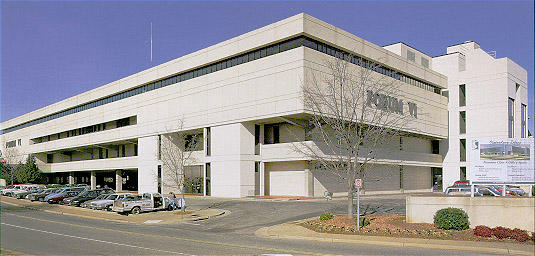
Set into a hillside, the innovative building featured three levels of parking and a two-level mall, with office space located in an upper level. It opend in 1976 with Montaldo's clothing store and K&W Cafeteria as anchors but succeeded only briefly. The addition of a food court and a renovated interior during a mid '80s upgrade did nothing to help the mall's fortunes.
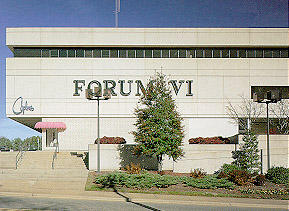
The combination of uncomfortably upscale retail, a fortress-like exterior and an accute lack of space for expansion or larger, more popular tenants led to the slow but sure demise of Forum VI, which closed to the public in 1997 (save for K&W Cafeteria) after Montaldo's went out of business and its replacement, Coplon's, relocated to a freestanding space a couple miles away.
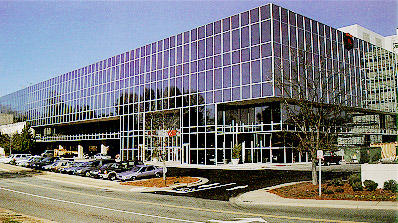
In 1998, Forum VI was gutted, refaced and reborn as Signature Place, an office complex that replaced the mall with office space for such companies as UBS, First Citizens Insurance, Novartis Animal Health and, strangely enough, Tanger Factory Outlets. In its present form, it's substantially more successful, though pretty damn ugly.
Posted by
Steven Swain
at
2:05 AM
7
comments
Links to this post
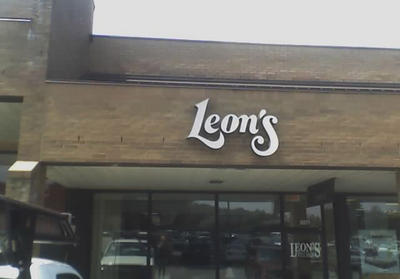
This the last sign I know of with the 1970s/1980s logo for Leon's Style Salons, a chain of beauty salons in Greensboro. Leon's still has locations all over the city, but they converted most of the locations to the newer, boring logo from 1990. This salon was opend circa 1987, so it was too new a sign to throw away, yet it's still outdated. Bad for them, perfect for retro sign fetshists. :-)
Posted by
Steven Swain
at
1:56 AM
0
comments
Links to this post
By ALLEN G. BREED
The Associated Press
NEW ORLEANS -- With much of the city flooded by Hurricane Katrina, looters floated garbage cans filled with clothing and jewelry down the street in a dash to grab what they could. In some cases, looting on Tuesday took place in full view of police and National Guard troops.
At a Walgreen's drug store in the French Quarter, people were running out with grocery baskets and coolers full of soft drinks, chips and diapers.
When police finally showed up, a young boy stood in the door screaming, "86! 86!" _ the radio code for police _ and the crowd scattered.
Denise Bollinger, a tourist from Philadelphia, stood outside and snapped pictures in amazement.
"It's downtown Baghdad," the housewife said. "It's insane. I've wanted to come here for 10 years. I thought this was a sophisticated city. I guess not."
Around the corner on Canal Street, the main thoroughfare in the central business district, people sloshed headlong through hip-deep water as looters ripped open the steel gates on the front of several clothing and jewelry stores.
One man, who had about 10 pairs of jeans draped over his left arm, was asked if he was salvaging things from his store.
"No," the man shouted, "that's EVERYBODY'S store."
Looters filled industrial-sized garbage cans with clothing and jewelry and floated them down the street on bits of plywood and insulation as National Guard lumbered by.
Mike Franklin stood on the trolley tracks and watched the spectacle unfold.
"To be honest with you, people who are oppressed all their lives, man, it's an opportunity to get back at society," he said.
A man walked down Canal Street with a pallet of food on his head. His wife, who refused to give her name, insisted they weren't stealing from the nearby Winn-Dixie supermarket. "It's about survival right now," she said as she held a plastic bag full of purloined items. "We got to feed our children. I've got eight grandchildren to feed."
At a drug store on Canal Street just outside the French Quarter, two police officers with pump shotguns stood guard as workers from the Ritz-Carlton Hotel across the street loaded large laundry bins full of medications, snack foods and bottled water.
"This is for the sick," Officer Jeff Jacob said. "We can commandeer whatever we see fit, whatever is necessary to maintain law."
Another office, D.J. Butler, told the crowd standing around that they would be out of the way as soon as they got the necessities.
"I'm not saying you're welcome to it," the officer said. "This is the situation we're in. We have to make the best of it."
The looting was taking place in full view of passing National Guard trucks and police cruisers.
One man with an armload of clothes even asked a policeman, "can I borrow your car?"
Some in the crowd splashed into the waist-deep water like giddy children at the beach.
Posted by
Steven Swain
at
12:55 AM
4
comments
Links to this post
Be unique down to your toes by designing custom footwear online.
JAMES ZISK
The Orange County (CA) Register
The newest story in sneakers is the development of design-your-own-shoes features on Web sites by Nike, Converse, Vans and the like.
Vans pioneered the idea in 1966 when it was a small Orange County company. Customers could bring in fabrics and have a pair of shoes made. Spokesman Chris Overholzer recalls a favorite company story about the divorced woman who made shoes from a fur coat her husband had given her.
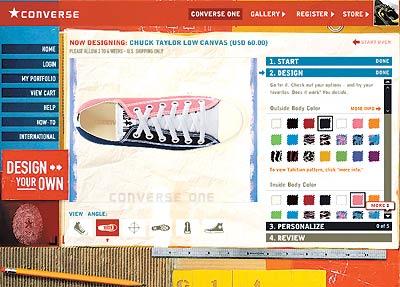
As the company grew, that kind of customization became unwieldy. Now, on the Internet, it's easy. Click-and-paint features give you myriad ways to customize Old Skools or Slip-Ons.
Nike and Converse offer similar options.
And while you're at it, create your own T-shirt, too. Type "design your own T-shirt" into Google and see what pops up.
One person's story
I was excited to read about how Converse had set up a Web application where anyone could design his or her own Chucks. Intrigued by the possibility, I decided to give it a try.
The first dilemma was figuring out which unisex size was right for me. There were simple instructions on the site, but that did not calm my fear of having a personally designed wall ornament if the shoes did not fit.
I found the experience to be downright fun. I had a flood of ideas, but also a nagging feeling that I might come up with nothing more than expensive power-line fodder.
My design was inspired by rockabilly music, so the final touch was a personalized monogram for the heel that reads I IV V - the basic musical structure for most rock 'n' roll. It seemed to be more appropriate than my name or initials. I figured those who know will understand.
I placed the order, and roughly 4-1/2 weeks later I received my designer Chucks. They fit and look great ... to me. I will definitely do it again for myself or as a gift.
Posted by
Steven Swain
at
12:51 AM
2
comments
Links to this post
Labels: sneakers

Shopopolis, Consuming the Future, and other post-Malling of America observations...
This is the blog of William Severini Kowinski, author of The Malling of America, one of my favorite books.
Posted by
Steven Swain
at
11:23 PM
3
comments
Links to this post
Labels: my neighborhood
Please support the American Red Cross efforts to provide relief to disaster-stricken regions of the U.S.
Hurricane Katrina has taken its toll on the Gulf Coast region and South Florida, and its life-changing aftermath is devastating. To make a donation online, click here.
Posted by
Steven Swain
at
5:48 PM
0
comments
Links to this post
Note from Steve: how fitting that this would happen on my birthday.
Chain Store Age
Cincinnati - Federated Department Stores announced it has completed its merger with The May Department Stores Co., forming a company with more than 1,000 stores and $30 billion in annual sales.
“Two great organizations have come together and we see tremendous opportunity ahead,” said Terry Lundgren, Federated’s chairman and CEO.
Federated said it will operate all of May’s stores under their existing nameplates at least through the end of the year. Next fall, it plans to convert most May locations to its Macy’s banner. The company reiterated a promise that there will be no job cuts or layoffs before March 1.
The company also added an additional seven stores (in California, New York and Massachusetts) to its previously announced list of 68 stores that it plans to divest. Together, the 75 stores identified for divesture accounted for approximately $2.1 billion in 2004 sales.
Posted by
Steven Swain
at
3:33 PM
2
comments
Links to this post
In honor of my 30th birthday, I published a picture from each year of my life to the blog during the first month of 2005. Amazingly, I was able find a picture for every year but 1984, 1992 and 1994. Now that I’ve completed the project, here are the pictures:
1975 - newborn
1976 - hair!
1977 - young Newt Gingrich
1978 - clothes dryer
1979 - seriously rocking
1980 - bored
1981 - party
1982 - Easter
1983 - ironically stylish
1984
1985 - forever the stud!
1986 - orange
1987 - fat gut
1988 - madras!
1989 - all-vertical
1990 - stripes
1991 - bad contrast
1992
1993 - prop suit
1994
1995 - rather stunning
1996 - piƱata
1997 - very 'chill'
1998 - college
1999 - loveseat
2000 - a slightly different pose
2001 - LMW
2002 - burgundy and gold
2003 - Chuck E. Cheese
2004 - cap on my head
2005
Posted by
Steven Swain
at
6:00 AM
5
comments
Links to this post
Rock With You - Michael Jackson Listen
It was a hard choice, considering how many songs I've heard over the years, but this is probably the closest to being my favorite song ever that you'll find.
Posted by
Steven Swain
at
4:14 AM
4
comments
Links to this post
Labels: song of the day
I am gratified that I have such wonderful friends, both online and offline. Here's just a sample of why I love all of you out in Steve-land:
__________
Happy birthday Steve! I always think of you as being about 26, but I guess you WERE about 26 when I met you. Anyway, you don't look 30ish , more like 26!!
Ken
__________
Happy 30th, my friend. It's hard to believe that 12 years ago almost to the day, we started at Virginia Tech, dropping our X-Acto Kinves on the floor and trying to diagram the sound they made when they hit. Today, we are old and bitter (well, I was always bitter). Happy Birthday.
Todd M.
__________
I got a story. When I was liking Ed Helms (of The Daily Show) , people on this improv board would wish him a happy birthday, and this had been going on for a couple of years, and evey year, this guy would reply on the board with:
YOUR TAINT IS OLD!
So there's my story.
Anita
__________
Happy 30th Man, and many more!!!
Have a great birthday....ENJOY!
If I lived nearby, I'd meet you somewhere!!!!
Bryan R.
__________
are you going to be 30?
If so, Damn your old.
Ha!
Johnny K.
__________
So you're gonna be 30 tomorrow? Live it up!
Happy Birthday!!!
~Carrie =)
__________
Happy 30th Birthday Enjoy your day, be good!!!
Don't do anything, if you have the chance of getting caught(legally).
Cindy S.
__________
Happy Birthday Steve! You don't look a day past 20... well, in the 1995 picture anyways. ;)
Tim
__________
What a truly selfless and civic-minded way to observe this dubiously important milestone in your young life. You are a model citizen. Now go out tomorrow and drink your self into a blubbering, self-pitying mess.
Happy Birthday!!!
Heather
__________
Happy Birthday, Steve! I hope you have a great 30th birthday!
Evan
__________
Hey steve, its the Big 3-0!!! Congrats buddy. May the good lord bless u with many more years of joy, contentment, style and good taste. Drink up, this rounds on me :)
Shariq
__________
Happy birthday!! Any plans for the big day?
Derek M.
__________
Happy B-day you old son of a bitch, I hope you do something exciting or do someone exciting.
Wayne
__________
HAPPY BIRTHDAY!!!!!!! Hope you have a good one. I sure miss you and hope we can all get together for dinner one evening. Take care and have a real good Birthday.
Sonya
__________
THE BIG 3 0!
Happy Birthday man, I hope you have wonderful Day.
What will your choice of cake be?
Angie, Charlee or Ashley?
We can throw Rachel in as a bonus.................................
Todd R.
__________
Happy birthday old man. You do realize that it's all down hill from here. I hope it’s a good one.
Take care,
Chris
__________
Happy Happy Birthday!!!!!!!!!!!!!!!!!!!!!!!!!!!!!!!
Derek H.
__________
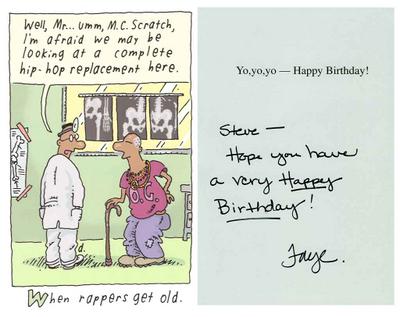
Posted by
Steven Swain
at
11:47 PM
4
comments
Links to this post
Note from Steve: I'm not trying to offend anyone with this, and if anyone is offeneded, please just take my sincere apology now and don't send hate mail. This is seriously a town in Austria. (48' 03"N 13' 51"E). I was laughing my ass off.
The second sign (below) carries the hilarity even further: "Bitte — nicht so schnell!" is German for "Please — not so fast!" (Evidently this type of sign is a commonplace reminder in those parts for drivers to keep their speed down to protect children, but the unintended double meaning in this case is particularly amusing.)
netscape.com
When you think of Austria, no doubt you think of such cities and towns as Vienna, Innsbruck and Salzburg. But there is another one. And because of its name, tourists steal the signs. The name? It's Fucking.
Agence France Presse and Britain's Sunday Telegraph report that the residents of Fucking(pronounced Fooking) are quite perturbed with British tourists who think the name of the town is so hilarious they want to take a piece of it home with them. So they swipe the signs. There are only 32 homes in this charming Austrian village with breathtaking views of lakes and forests and none of its residents understand why their signs are so popular. In fact, sign stealing is the only crime in Fucking.
The good people of Fucking have wised up. They have embedded their signs in concrete. Try stealing one now! We quote. Directly. Exactly. This is what police chief Kommandant Schmidtberger told the Sunday Telegraph: "We will not stand for the Fucking signs being removed. It may be very amusing for you British, but Fucking is simply Fucking to us. What is this big Fucking joke? It is puerile."
Interestingly, it is only the British who seem to have such a fascination with the name of this little town. A local guide told the Telegraph that the Germans want to see the Mozart house in Salzburg, while the Americans only care about the area around which "The Sound of Music" was filmed. The Japanese just want to see Hitler's birthplace in Braunau. The British are different. A woman who runs a guest house told the paper, "Just this morning I had to tell an English lady who stopped by that there were no Fucking postcards."
These Austrians may be on to something about the Brits. The BBC News reports that a Northamptonshire secondary school in Great Britain has had such a problem with its students swearing that they have instituted a five-word limit in each class. When a student swears, the teacher writes a mark on the board. After five marks, no one is allowed to swear for the duration of the class. If the rule is broken? They get a severe talking-to by the teacher. We're thinking there won't be any field trips to Fucking, Austria.
Posted by
Steven Swain
at
11:06 PM
2
comments
Links to this post
Note from Steve: Thanks to Heather for finding this story. My experiences at Abercrombie & Ftch have not been as bad as the writer's, but Mom and I's incident at Sur La Table reinforces that "shopping-while-black" is still a problem, and a widespread one at that.
Mary Andom / NEXT team
Copyright © 2005 The Seattle Times Company
While cruising the mall recently, I couldn't help but notice the sea of white streaming in and out of the Abercrombie & Fitch store.
"Oooh, Abercrombie's having a blow-out sale," my friend said. "Let's go in."
"Uh, I don't know," I told her. "Black folk don't really shop here. I'll walk around the food court or something."
But secretly, I wanted to know what all the buzz was about. I had never had the courage to walk into an Abercrombie before.
"C'mon, it'll only be a minute, promise," my friend said.
As I stepped foot in that store, I felt I was in dangerous territory. An uneasiness swelled in my stomach as the customers looked on in curiosity. Feeling outnumbered and out of place, I tried to look as natural as possible. I shuffled my feet and poked at the clothing. A bubbly sales clerk chirped, "Uh huh, yeah, that tube top looks great with those low-rise jeans," as techno music pulsated in the background.
Every couple of minutes, though, she would look over my shoulder and when I'd catch her glance, she'd squeeze off an uneasy smile. Not once did a sales clerk ask if I needed anything or wanted to try something on.
But I've long dealt with this reality of Shopping-While-Black: either you're ignored or followed.
The billboard of handsome white jocks and beautiful white women frolicking in fields reminded me of how different I am from them. They are tall, slender and fair-skinned or Asian — everyone from the customers to the cashiers.
"Traitor, you don't belong here," that little voice in my head admonished. "Black people don't shop here."
I had had enough and was ready to leave when my friend chimed in, "Great, I found it, he's going to love this shirt."
"OK, let's just get out of here."
When I walked out, I was reminded of the many reasons why I refuse to spend my money in a place like Abercrombie & Fitch:
• I don't have the "A&F look."
• The suburban lifestyle doesn't appeal to me.
• The Abercrombie image is just plain racist.
We all know that beauty is largely defined in this culture as white. Even some of the most popular black actresses and pop stars, such as Halle Barry and Beyonce, have lighter skin and long silky tresses.
At a young age, we are taught that white is beautiful — from Cinderella to Barbie. As a child, I used to smear my mother's dark foundation all over my Barbie's face and plait her hair so she could look just like me.
Imagine what message this is sending to the little black girl with dark skin, textured hair and full lips. Is she not beautiful or American enough?
Abercrombie employs these live Barbies to reinforce the Eurocentric ideal of beauty — or as they call it, the "all-American look." I always thought "all-American" referred to the melting pot theory we're taught in school. But I guess Abercrombie had something else in mind.
This controversial image is at the very heart of a racial-discrimination suit filed against Abercrombie & Fitch by nine Hispanic and Asian employees who accuse the company of unfair employment practices. Perhaps surprisingly, there are no black plaintiffs in the suit. In a way, we've created color-coded fashion associating the urban look of flashy tennis shoes, puffy coats, baggy jeans and jerseys with blacks, and the suburban look of khaki pants, polo tops and Dr. Martens with whites.
And Abercrombie represents this image perfectly, further propagating stereotypes and hatred with its racist message. Does Abercrombie have an obligation to represent minorities on their billboards and in their stores and catalogs? That's for the courts to decide.
But honestly, I cringe at the thought of Abercrombie & Fitch expanding its marketing of self-hate and racism to even more people.
Mary Andom is a Western Washington University freshman. E-mail: NEXT@seattletimes.com
Posted by
Steven Swain
at
8:29 PM
5
comments
Links to this post
…from a guy who’s having his last day as a 29-year-old.
Posted by
Steven Swain
at
6:00 AM
8
comments
Links to this post
Mom and I went to Sur la Table, an upmarket kitchenware store in the vein of Williams-Sonoma, at SouthPark in Charlotte Saturday night. It's one of her favorite stores and it's in my favorite mall.
Sur la Table, which is French for "on the table" is filled with thousands of unique, high quality home products...and a couple of goofy ones.
Guess which ones I'm showing? LOL
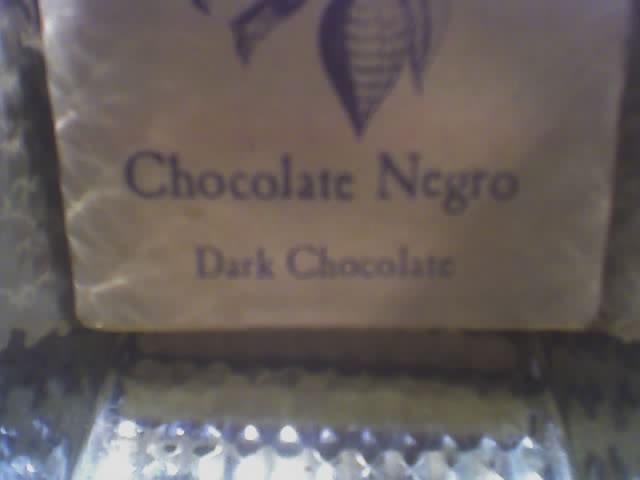
Isn't it great that black folks come in flavors now? I guess I'm 'white chocolate negro' :-)
This is actually a piece of fine chocolate imported from Spain. It looked delicious, but the name could be considered either offensive or damn funny. I chose the latter, though it made me do a double take.
I wouldn't have thought as much about it if we hadn't been followed around the store by no less than four sales associates. It wasn't just an a attempt at service either. None of the other customers (who happend to be white) were getting that kind of attention, and only one of those four was knowledgeable enough to answer our questions. It made us very uncomfortable, and it made me think that they weren't used to black people shopping there.

At the checkout, I saw these "hangover drops." Despite their willingness to track our every move previously, when we got to the checkout, the sales associate refused to answer the question of what these tasted like. So I figure they taste like Jaegermeister and vomit, which is what my hangovers usually taste like :-)
Posted by
Steven Swain
at
2:31 AM
3
comments
Links to this post
Labels: SouthPark
By Krissah Williams
Washington Post Staff Writer
From a generic brick office building at the end of a road in Lanham, Tony Rome is creating a niche in an artless side of hip-hop that some people would rather not discuss.
Rome hooks up rap stars, R&B singers and urban comedians with major corporations that want to reach their fans. The ideal relationship, says Rome, who founded Maven Strategies in 1996, would have an artist write a brand name into a song, feature the brand in a music video and partner with the brand in other promotions, getting paid by the brand's owner along the way.
He began a recent Monday morning meeting at his six-person marketing firm with a bit of genial how-was-your-weekend banter. One company rep had gone to Dream night club in Northeast Washington; another played basketball with her boyfriend at ESPN Zone, and beat him. A company vice president celebrated his young son's birthday.
The conversation circled back around the small conference room to Rome, and on to business.
"So what's the status on the Seagram's Gin Live tour," asked Rome, a cool 37-year-old with a closely cropped afro.
Maven said he is promoting a concert tour for Seagram's Gin, and that he recently arranged a meeting between the liquor brand and singing hip-hop darling Lil' Mo at B. Smith's restaurant. The deal is done, Maven said, and contracts are signed. Seagram's will pay for the concert, the singer will headline the tour, and the posters promoting the concerts will prominently feature the gin.
Everything from gin to luxury cars is on the table, eagerly awaiting placement in a rapper's song or on the banner above a comedian's tour. For a price.
On to the next matter. Has the company that paid to have its product placed in scenes of up-and-coming Houston rapper Slim Thug's new music video approved the final cut? Thug is the latest rapper in hip-hop's dirty south genre, with its big beats and yell-along choruses. Rome declined to name the company that paid for the placement.
"We have the still pictures, but we're waiting for the video," said Lamar Lee-Kane Sr., Maven's vice president of branded entertainment.
The way Rome sees it, "no other media outlet gives away anything for free."
"We are trying to bridge that gap" between hip-hop artists and corporate America, he said.
With that philosophy as a guide, he has built Maven into a player in urban branding and product placement in hip-hop music and videos, advertising industry watchers say.
"In the past, [product placements] were negotiated in a somewhat informal way; what Maven Strategies has done is to really codify the relationship and create a structure for how much people get paid," said Lucian James, president of Agenda Inc., a San Francisco-based brand research firm. "That's one of the holy grails for product placement: to really work out what it is worth."
Rome began showing celebrities the money when he founded his company as an independent sports agency nine years ago, representing NFL players Kevin Hardy and Brian Mitchell. But as America's idols changed, so did Maven. As Michael Jordan grew older, kids no longer wanted "to be like Mike" but like Brooklyn rapper Jay-Z.
Soon Rome was no longer inking deals for football players. A deal in 2000 promoting the national Kings of Comedy tour, headlined by African American funnymen Steve Harvey, Cedric the Entertainer and Bernie Mac, led to a focus on urban entertainment and eventually hip-hop music. Rome got the HBO cable network, Crown Royal Whisky and other sponsors to back the tour with $1 million.
"What we are really about is helping our clients connect with their customers in unique creative ways," Rome said. He also works on product placements in urban films and finding corporate sponsorships for events targeted at African Americans, such as a program to stop childhood obesity.
Maven's prices vary depending on the branding a company is after, but Rome made news last Spring when Advertising Age, the ad world's publication-to-read, splashed a story across its Web site about a deal Maven stuck with McDonald's. According to the story, McDonald's confirmed that if rappers would include "Big Mac" in their lyrics, the fast food giant would pay them between $1 and $5 each time their song was played on the radio. Rome won't discuss the deal with McDonald's in further detail and guards his client list closely.
Most brands that hire Maven for product placement would rather not draw attention to the money exchanging hands between companies and the rappers.
Corporations want consumers to assume that rappers name-dropping hamburgers, cell phones or cars wrote the brands into their lyrics because they love them not because they were paid, said William Chipps, senior editor with IEG Sponsorship Report.
"It has to be organic," Chipps said. "It can't be blatant."
"Organic" is subjective. Robert "T-Mo" Barnett, a member of the once widely popular Atlanta rap group Goodie Mob, is working with Maven on a deal to promote a brand. Maven gave him the name of the product, and he wrote it into the lyrics of the single he is planning to release this year. T-Mo's contract with the company has not yet been signed, and Maven would not identify the brand. How much the company pays him for mentioning the brand depends on the radio popularity of the single.
T-Mo was in the studio recently and laid down the song, which he is calling "What's Happening."
"I was vibing," the rapper said. "It just came natural. I heard a good beat, and I just flowed with it. It was nothing I had to really force.
"I am helping them brand their company and at the same time they are helping me," he said. "I got a brand new baby boy, and I'm trying to feed him right now. I want to be smart about every move I make so I can maximize my earnings."
Larry Khan, senior vice president of R&B promotion and marketing for Jive Records, said this process for making music is "pretty much accepted."
"I guess in days gone by it would have looked like the artist was selling out, but now it has become a part of American culture. It doesn't hurt your street cred," he said.
Hip-hop artists, who often rhyme about their lives, fantasies and aspirations, have been touting their favorite brands in songs for years and subconsciously enticing their fans to buy them.
Hip-hop originally functioned as a sort of "black CNN," as rapper Chuck D of Public Enemy dubbed the music in the late 1980s. And the transition to mainstream pop culture, and thus branding, began innocently -- and unpaid. In 1986, popular Brooklyn rap group Run-DMC released "My Adidas" -- an ode to the sneaker company and their personal style. The song topped the charts and boosted the company's sales. Later, Adidas offered the rappers a paid sponsorship deal, and the relationship between the business and the art was formed.
In the past decade, the link between rappers and brands has evolved along with the music's promotion of bling and living the luxurious life. According to Agenda, brands were mentioned almost 1,000 times in the top 20 singles last year on the Billboard charts. The top brands were: Cadillac (70 mentions), Hennessy (69), Mercedes-Benz (63), Rolls Royce (62), and Gucci (49).
In the popular song "Overnight Celebrity" Grammy-nominated rapper Twista mentioned nine brands, including these:
I can get you on CDs and DVDs
Take you to BeBe and BCBG, . . .
Y'all take a look at her, she got such an astonishing body
I can see you in some Gucci or Roberto Cavalli
Rome said 90 percent of those radio plugs were free product placements and would cost the companies upwards of a billion dollars if they were paid advertisements.
"Hip-hop is really the only music genre that embraces brands in their songs and because they are doing it, I think the hip-hop artists should be paid for it," Rome said.
At least one of those artists was not only paid but says so in his song.
A version of Maven client Petey Pablo's song "Freek-a-Leek," which was one of the most played last year, included this line:
Now I got to give a shout out to Seagram's Gin/Cause I'm drinkin' it and they payin' me for it.
Posted by
Steven Swain
at
2:18 AM
0
comments
Links to this post
The Washington Post
1986: "My Adidas" by Run-DMC helps spark the popularity of the athletic-shoe brand among rap music fans. In 2005, Adidas celebrates its 35th anniversary by releasing a pair of sneakers dedicated to Run-DMC.
1999: Rapper Jay-Z invests in RocaWear, an urban fashion line, and promotes it during his "Hard Knock Life" concert tour. Other rappers, including Nelly, Master P, and 50 Cent, go on to promote their own clothing lines, often in their song lyrics.
2002: "Pass the Courvoisier," by Busta Rhymes featuring P.Diddy, not only promotes the French Cognac, but uses it in its title. The song reportedly helps send Courvoisier's sales soaring.
2002: Jay-Z invests in Scotland-based Armadale Vodka and begins promoting and rapping about the liquor brand. He also incorporates Armadale into some of his lyrics on songs such as "All I Need" off of his double-platinum album, "The Blueprint," to introduce Armadale to the hip-hop audience.
2003: Petey Pablo's "Freek-a-Leek," which includes a fully disclosed product-placement for Seagram's Gin, is released and later tops the chart. At the end of the song, it says: "Now I got to give a shout out to Seagram's Gin 'cus I drink it and they payin' me for it."
2004: Advertising Age reports Maven Strategies struck a deal with McDonald's to find rappers who would include "Big Mac" in song lyrics. The fast-food giant agreed to pay the rappers between $1 and $5 each time their song was played on the radio, according to the industry trade publication.
Posted by
Steven Swain
at
2:12 AM
0
comments
Links to this post
Labels: sneakers
By Michael Hirtzer, The Star
Little work has taken place at Dixie Square Mall nearly two months after a developer delayed purchasing the 57-acre site from the city of Harvey, IL.
John Deneen, of Chicago-based Emerald Property Group, said he needed to remove a large amount of asbestos before he could purchase the mall.
There has been no apparent work done at the site, 154th Street and Dixie Highway, about two months after Deneen made those comments during a city council meeting in July.
The mall remains vacant, still surrounded by a security fence, with no visible activity inside.
City spokeswoman Sandra Alvarado said the city still is undergoing a property title search before the city can close on the property with Deneen.
"We're basically waiting on the title," Ald. Daryl Crudup, 3rd Ward, said Friday. "(The developer and his attorneys) needed some additional information."
Deneen did not return a phone message left Thursday at his office. A secretary said Deneen was out of town until Tuesday.
Crudup said work will begin at the mall after the city transfers the property to Deneen.
"I was hoping we could (start) anywhere from a week to a month," Crudup said. "We're looking good for September."
It is unclear how long it will take to remove the asbestos. It also is unclear when crews will demolish the mall.
Deneen has pledged to tear down several of the existing structures and build several new stores. He has said that a handful of major retailers signed onto the project.
Several projects have failed to bring the mall back to its former glory. After being built in the mid-1960s, Dixie Square was one of the first completely indoor malls.
Since the late 1970s, however, the mall has seen several projects fail.
Crudup, who lives in the 3rd Ward that includes Dixie Square, said the area soon will undergo improvements.
"We're moving on all phases of the renovation," he said.
He said several other projects are in the works, including a beautification project at the nearby Cook County building and the construction of senior housing by the YMCA.
Crudup said the county will expand its parking lot as well as improve its fence and the overall look of the landscaping, while YMCA officials will begin construction next month.
American Kitchen Delights, a nearby food service company, also is expanding. However, an effort to move into the former Montgomery Wards building stalled after Illinois Attorney General Lisa Madigan filed a cease and desist order until the removal of all asbestos from the department store site.
Despite all the setbacks, Crudup still said he is optimistic about the area's future.
"We're moving, and that's the key," he said.
Posted by
Steven Swain
at
1:48 AM
0
comments
Links to this post
KWTX-TV
Today is the 42nd anniversary of the 1963 civil rights March-on-Washington and Martin Luther King’s "I have a dream" speech.
The President and CEO of the Martin Luther King, Jr. National Memorial Foundation says this year's message revolves around young people.
Harry Johnson Senior says children of today need to know and understand what King's dream was. He says that dream of equality has made their lives better.
The foundation is raising money for a memorial on the Washington Mall honoring King. It's raised more than a-third of the $100 million needed.
Groundbreaking is scheduled for late next year and the King memorial is scheduled to be completed in 2008.
TEXT OF KING’S “I HAVE A DREAM” SPEECH
Five score years ago, a great American, in whose symbolic shadow we stand signed the Emancipation Proclamation. This momentous decree came as a great beacon light of hope to millions of Negro slaves who had been seared in the flames of withering injustice. It came as a joyous daybreak to end the long night of captivity. But one hundred years later, we must face the tragic fact that the Negro is still not free.
One hundred years later, the life of the Negro is still sadly crippled by the manacles of segregation and the chains of discrimination. One hundred years later, the Negro lives on a lonely island of poverty in the midst of a vast ocean of material prosperity. One hundred years later, the Negro is still languishing in the corners of American society and finds himself an exile in his own land.
So we have come here today to dramatize an appalling condition. In a sense we have come to our nation's capital to cash a check. When the architects of our republic wrote the magnificent words of the Constitution and the Declaration of Independence, they were signing a promissory note to which every American was to fall heir.
This note was a promise that all men would be guaranteed the inalienable rights of life, liberty, and the pursuit of happiness. It is obvious today that America has defaulted on this promissory note insofar as her citizens of color are concerned. Instead of honoring this sacred obligation, America has given the Negro people a bad check which has come back marked "insufficient funds." But we refuse to believe that the bank of justice is bankrupt. We refuse to believe that there are insufficient funds in the great vaults of opportunity of this nation.
So we have come to cash this check -- a check that will give us upon demand the riches of freedom and the security of justice. We have also come to this hallowed spot to remind America of the fierce urgency of now. This is no time to engage in the luxury of cooling off or to take the tranquilizing drug of gradualism. Now is the time to rise from the dark and desolate valley of segregation to the sunlit path of racial justice. Now is the time to open the doors of opportunity to all of God's children. Now is the time to lift our nation from the quicksands of racial injustice to the solid rock of brotherhood.
It would be fatal for the nation to overlook the urgency of the moment and to underestimate the determination of the Negro. This sweltering summer of the Negro's legitimate discontent will not pass until there is an invigorating autumn of freedom and equality. Nineteen sixty-three is not an end, but a beginning. Those who hope that the Negro needed to blow off steam and will now be content will have a rude awakening if the nation returns to business as usual. There will be neither rest nor tranquility in America until the Negro is granted his citizenship rights.
The whirlwinds of revolt will continue to shake the foundations of our nation until the bright day of justice emerges. But there is something that I must say to my people who stand on the warm threshold which leads into the palace of justice. In the process of gaining our rightful place we must not be guilty of wrongful deeds. Let us not seek to satisfy our thirst for freedom by drinking from the cup of bitterness and hatred.
We must forever conduct our struggle on the high plane of dignity and discipline. we must not allow our creative protest to degenerate into physical violence. Again and again we must rise to the majestic heights of meeting physical force with soul force.
The marvelous new militancy which has engulfed the Negro community must not lead us to distrust of all white people, for many of our white brothers, as evidenced by their presence here today, have come to realize that their destiny is tied up with our destiny and their freedom is inextricably bound to our freedom.
We cannot walk alone. And as we walk, we must make the pledge that we shall march ahead. We cannot turn back. There are those who are asking the devotees of civil rights, "When will you be satisfied?" we can never be satisfied as long as our bodies, heavy with the fatigue of travel, cannot gain lodging in the motels of the highways and the hotels of the cities. We cannot be satisfied as long as the Negro's basic mobility is from a smaller ghetto to a larger one. We can never be satisfied as long as a Negro in Mississippi cannot vote and a Negro in New York believes he has nothing for which to vote. No, no, we are not satisfied, and we will not be satisfied until justice rolls down like waters and righteousness like a mighty stream.
I am not unmindful that some of you have come here out of great trials and tribulations. Some of you have come fresh from narrow cells. Some of you have come from areas where your quest for freedom left you battered by the storms of persecution and staggered by the winds of police brutality. You have been the veterans of creative suffering. Continue to work with the faith that unearned suffering is redemptive.
Go back to Mississippi, go back to Alabama, go back to Georgia, go back to Louisiana, go back to the slums and ghettos of our northern cities, knowing that somehow this situation can and will be changed. Let us not wallow in the valley of despair. I say to you today, my friends, that in spite of the difficulties and frustrations of the moment, I still have a dream. It is a dream deeply rooted in the American dream.
I have a dream that one day this nation will rise up and live out the true meaning of its creed: "We hold these truths to be self-evident: that all men are created equal." I have a dream that one day on the red hills of Georgia the sons of former slaves and the sons of former slaveowners will be able to sit down together at a table of brotherhood. I have a dream that one day even the state of Mississippi, a desert state, sweltering with the heat of injustice and oppression, will be transformed into an oasis of freedom and justice. I have a dream that my four children will one day live in a nation where they will not be judged by the color of their skin but by the content of their character. I have a dream today.
I have a dream that one day the state of Alabama, whose governor's lips are presently dripping with the words of interposition and nullification, will be transformed into a situation where little black boys and black girls will be able to join hands with little white boys and white girls and walk together as sisters and brothers. I have a dream today. I have a dream that one day every valley shall be exalted, every hill and mountain shall be made low, the rough places will be made plain, and the crooked places will be made straight, and the glory of the Lord shall be revealed, and all flesh shall see it together. This is our hope. This is the faith with which I return to the South. With this faith we will be able to hew out of the mountain of despair a stone of hope. With this faith we will be able to transform the jangling discords of our nation into a beautiful symphony of brotherhood. With this faith we will be able to work together, to pray together, to struggle together, to go to jail together, to stand up for freedom together, knowing that we will be free one day.
This will be the day when all of God's children will be able to sing with a new meaning, "My country, 'tis of thee, sweet land of liberty, of thee I sing. Land where my fathers died, land of the pilgrim's pride, from every mountainside, let freedom ring." And if America is to be a great nation, this must become true. So let freedom ring from the prodigious hilltops of New Hampshire. Let freedom ring from the mighty mountains of New York. Let freedom ring from the heightening Alleghenies of Pennsylvania! Let freedom ring from the snowcapped Rockies of Colorado! Let freedom ring from the curvaceous peaks of California! But not only that; let freedom ring from Stone Mountain of Georgia! Let freedom ring from Lookout Mountain of Tennessee! Let freedom ring from every hill and every molehill of Mississippi. From every mountainside, let freedom ring.
When we let freedom ring, when we let it ring from every village and every hamlet, from every state and every city, we will be able to speed up that day when all of God's children, black men and white men, Jews and Gentiles, Protestants and Catholics, will be able to join hands and sing in the words of the old Negro spiritual, "Free at last! free at last! thank God Almighty, we are free at last!"
Posted by
Steven Swain
at
1:54 PM
2
comments
Links to this post
By Libby Copeland
The Washington Post
WASHINGTON - At a boutique where denim dreams come true and almost no one is bigger than a size 10, a woman flags down a salesgirl and confides a terrible problem.
"You don't have a butt?" asks the salesgirl.
"Like, at all," the woman says.
This is as close to an emergency as you can get in the premium-denim world. From the rows and rows of bluejeans, which stretch to the right and left, from floor to ceiling, the salesgirl pulls a pair of Rock & Republic's with high back pockets, designed to magically lift and shape all that is droopy or flat.
There are nearly 30 brands here at B Scene: jeans with small pockets and big pockets and specially angled pockets, jeans with close-together pockets that make a wide butt narrower, jeans with no yoke to make a butt extra round. There are rhinestoned and embroidered pockets to call attention to your butt, and plain pockets to make your butt disappear.
Everyone has a different theory about how to solve the world's butt problems.
"There's so much controversy," says Ilana Kashdin, who once planned to be a doctor and now co-owns this boutique, where she studies the anatomy of denim and the derriere.
Whether you're paying $145 or $520 for premium denim, you want to get the butt right. Every woman does that half-twirl at the mirror, back arched, head craned around. If the jeans are right, the experience is transformative, like putting on a magic cloak.
She says, "Oh. Muh-god."
For a while we were stuck in a dark place, our jeans tragically utilitarian. We bought them in stores decorated with hay bales. We fooled with acid washes and elastic waists. We had poor pocket technology. We had no choice.
Then came beauty, so much beauty. (And status, too, but we'll try that on later.) Now we are clad in the sanctified denim of the 21st century, a pragmatic, pioneer material made decadently new. From our perfect behinds, we can see the future.
In suburban Potomac, Md., B Scene is the province of cute teen-agers and hot moms. They come for sequined shrugs and $120 metallic sandals, velour sweatshirt-and-skirt ensembles ($275), tube tops made of terry cloth. ("Isn't this the material you make towels with?" asks a young man, and the young woman he's with calls him an idiot.)
And they come for the jeans, found in the back third of the store, where a ladder is propped so Ilana can reach the tippy-top shelves.
Premium denim is a tiny percentage of the overall jeans market, but you wouldn't know it from the profusion of brands here. A disproportionate number have names that sound less like fashion lines and more like spiritual causes that Hollywood actors might get involved in. There's True Religion and Blue Cult, Citizens of Humanity and 7 for All Mankind. This makes a certain sense; the notion of denim-as-transcendence will ring true to any woman who has ever looked in the mirror and not recognized her own blue-clad behind.
What if we all adored our backsides? Would we achieve harmony with our bodies? Could this translate to a higher level of consciousness? Are the jeans of the 21st century helping us get there, or making sure we never do?
"I live for jeans," says Becca Walker, 33, who has 20 to 30 pairs and recently bought some made by People for Peace that cost $285 and have the word LOVE embroidered on the butt. These made Becca an object of envy. Women at her son's nursery school were "stalking" her. Her neighbor bought a pair. Walker thinks the jeans were totally worth the money. "I felt a little nauseous afterwards and then I was OK," she says.
At B Scene there are dark jeans for nights out and light jeans for days in. There are white jeans with pink stitching and blue ones with turquoise-colored stones. There are jeans with worn hems to mimic the look you'd get if you let them drag under your flip-flops. There are jeans with wire in the back pockets to give them a perpetually wrinkled look. There's a style called "ripper," with the bottoms and pockets all shredded, and a style with the apocalyptic description "destroyed." There are maternity jeans with a little pouch for the belly. Soon Ilana will be getting shipments of baby jeans, costing $80 to $180, and some extra-fancy adult jeans for $695.
Occasionally, in comes a newcomer to the premium denim world. This can be exhilarating and scary, like going to a foreign country without knowing a word of the native tongue.
"Did you want, like, daytime, nighttime, go both ways?" Ilana asks. "Beat up, not beat up? Does a particular wash catch your eye?"
"I think, whatever?" the woman says.
The newbies often don't know one of the cardinal rules: If they're stretch jeans, buy them small. They'll feel tight at first but then they'll expand "half a size," Ilana says. If a woman isn't willing to buy her jeans this way, Ilana informs her she may have to wash and dry the jeans before each wearing. This is arduous, though not as time-consuming and expensive as dry-cleaning, which some other jeans require.
Ilana, 31 but lithe as a teen, is perfect for the denim lines she carries. Her jeans don't come with a waist size bigger than 32, so if you're larger than a 10 or 12, you're out of luck. (Heftier women may suffer the indignity of being pointed to the store's small collection of men's jeans.)
At the new Denim Bar in suburban Arlington, Va., where the saleswomen dress like bartenders and you may get a free Yuengling if they like you, the owner says he sometimes turns customers away.
"You're just not ready to try on designer jeans," Mauro Farinelli tells them. Certain women try on pair after pair of premium denim and look great, but still complain. They're just not prepared, it seems, to be fabulous.
"We'll be here," Mauro tells them, hoping they'll come to their senses one day and allow him to fulfill their sartorial destiny.
No one would begrudge Mauro his noble cause. Premium denim is not just about beauty; it's about feeling entitled to be beautiful. It's about broadcasting your worth through the Swarovski crystals on your behind. Jeans have become diamonds, art, custom cars. Spend the rent money on a pair, by all means, but do not simply wear them. Know that you are wearing the Degas of denim.
Mauro, then, is an educator. He has studied tailoring and likes to talk about triple-stitching. His store is all dark wood and fine denim, some of it woven on decades-old looms, then blessed with hand-painted logos. Some jeans are so fancy they come in boxes or leather pouches. The most expensive are $645, though Mauro also sells "entry-level" jeans for $100.
Mauro has women who have followed him since his last gig, as a jeans specialist at Saks Fifth Avenue. They say he makes them look amazing. Mauro is equally loyal. He says of one customer, "She buys anything I tell her to buy."
Denim was sober and utilitarian, a thing of the 19th century, a tough fabric for tough men, meant to be worn lots and worn down.
Now it is worn down by our own fussiness. It is washed, sandblasted, hand-sanded, treated with resin. Mauro owns jeans that came with the outline of a chewing-tobacco tin already etched into the back pocket, like ready-made manhood. He's wearing them when a tough-looking man comes out of a Denim Bar dressing room looking gleeful.
"They're hugging my buns!" the man says.
The buns are the anchor of the premium-denim world, and not just because a good pair of jeans will make them look fabulous. ("We don't want any muffin tops," Mauro says mysteriously.)
The backside of a pair of jeans broadcasts your status, and hard-core denimheads will instantly recognize the meaning of each obscure squiggle stitched into a back pocket. It's a tribal marking. It tells you if the owner is wearing a pair of 7 for All Mankind jeans, signaling that she may be mainstream, a girl who follows her friends. It tells you if she's wearing Paige jeans, suggesting she reads InStyle religiously and emulates Jennifer Aniston. Or she may flaunt the hand-painted logo of Evisu jeans, meaning she paid, oh, $520 for them. This signals that she's loaded.
Mauro is a slender, curly-haired guy in his early thirties with a knack for blunt talk. His favorite word is that elegant three-letter word for rear-end, and he often will compliment a customer on hers if it looks good in a pair of jeans she's trying. He will also tell her if it doesn't.
Sometimes, in an attempt to explain the complex science of denim, Mauro will say things like, "You can have a girl with a huge ass" who looks good in one type of jeans, while "another girl, equally titanic," looks better in a different pair.
"Pocketless jeans are the worst, though," he says with disgust.
(Begin optional trim)
These days, Mauro is extremely fond of "raw" jeans, made from virgin denim that has never been washed or treated. Four to five days a week, he wears a particular pair of raw jeans. He has been wearing them like this for more than three months and won't even dream of washing them till it's been six.
Mauro gives a lot of men his pitch on raw denim. He says men are more receptive to breaking in raw jeans because they're more "patient," though it also could also be that they're less turned off by the notion of wearing dirty pants. (On the Web site for a raw jeans maker called Nudie, men ask what to do if their jeans start to smell. The site advises them to put them in the freezer.)
Raw denim is really dark blue and stiff at first, and in the beginning it tends to bleed onto white sneakers and light-colored couches. But after six months of near-constant wear, Mauro says, the jeans will fit him perfectly and will have faded in all the right places. There will be "whiskering" around his crotch and "honeycombing" behind the knees.
"This jean will be unique to me," Mauro says.
Posted by
Steven Swain
at
3:55 AM
4
comments
Links to this post
Labels: sneakers

Myrtle Square Mall, a 442,965 square foot mall, was the first enclosed mall in Myrtle Beach, strategically located within walking distance of the Myrtle Beach Convention Center, residential neighborhoods and many beachfront hotels, with frontage on U.S. Highway 17-Business (Kings Highway) and Oak Street. The mall opened in 1975 and underwent major renovations in 1989.
Since Coastal Grand, another Burroughs and Chapin development, opened three miles away in 2004, the mall has dropped anchors, many of which have moved to the new mall for business...
30 years of Myrtle Square, tourists and all, winding down to November...
Posted by
Steven Swain
at
5:46 AM
6
comments
Links to this post
By ED BEESON
HERALD NEWS
Hip-hop has hardly had much stomach for tongue-in-cheek humor. That is especially true these days when the all-too-serious genre of gangsta rap is as strong as ever. The best-selling rapper on the Billboard hip-hop charts is Young Jeezy, a 25-year-old from Atlanta. His debut album "Let's Get It: Thug Motivation 101," is a dark, unapologetic and downright scary foray into drug dealing and gang banging.
So perhaps it is refreshing that one of the current trends in urban clothing is a bit more lighthearted.
A handful of urban clothing designers are printing T-shirts that inject street lingo into corporate logos for humorous effect. These are urban parodies, comparable to a street-smart version of "Wacky Packages." Those trading cards from the 1970s took a recognizable product like Cool Whip, painted a picture of ghosts circling the whipped cream's familiar container and called it "Ghoul Whip."
Urban parodies are little less cuddly.
These include "Blockhustler," a satire on video rental giant Blockbuster Video; "Hood LIFE," a take on the breakfast cereal; and "Streetbred," which resembles the Starbucks' logo, except the trademarked caffeine goddess has been replaced with a fierce-looking woman who wields two cartoonish pistols. On a parody of Bazooka Joe bubble gum, the phrases "Sucka Free" and "Ain't nothing sweet" surround the main logo, which reads "My Hood." The shirt is signed "A Hood Classics Perspective."
These T-shirts are the product of a Montclair, NJ firm called Hood Classics, which is run by childhood friends Marlin Holmes and Ishmel Fulton, both 25. The two developed their clothing line two years ago "to pay homage to the different people who live in the urban environment," Fulton said.
The idea is to combine self-taught graphic design with street lingo. The end result is at once edgy and everyday. The term "hustler" may be slang for a drug dealer, but as hip-hop has become more mainstream, its meaning has become so diluted that it means, simply, entrepreneur.
When asked about the "Blockhustler" logo, Fulton replied, "The term hustler, it means someone who has ambition, drive, a go-getter."
Either way, said Hood Classics' distributor Derek Ferullo, "You're not going to see these in Nordstrom anytime soon."
Instead, you will see Hood Classics in urban apparel stores like Magic Sneaker in downtown Paterson, where several styles can be seen in its Main Street storefront window.
Fulton claims Hood Classics invented the urban parody T-shirts, which is to say that other parody lines have been designed and marketed by other firms. There is "The Hustler's Depot," a play on "The Home Depot," and a take on Warner Bros. ("If you see police, Warner Brother.") Coming soon are parodies of Kmart, KFC and Baskin Robbins, which Magic Sneaker employees say will have the slogan "31 Ways to Rob."
Get Money Clothing, based in New York, makes "The Hustler's Depot" T-shirt and a shirt that says "Yield 2 G's" (in the shape of a Yield traffic sign.) All the urban parody T-shirts retail for $28 to $30.
Clearly, some shirts fudge the line between parody and promotion of illicit and illegal activities. Police, prosecutors and community activists in Baltimore, Boston and Philadelphia have rallied against "Stop Snitchin'" shirts, a popular and widely bootlegged T-shirt. Antonio Ansaldi, a Boston-based firm, makes "Stop Snitchin'" shirts, as do Introspect Graphics of Prince George, Md., and R. World Shirt Co. of Atlanta. These shirts are emblazoned with a red stop sign and underscored by the word "snitchin'." On the back are messages like "You have the right to remain silent," or "Snitches get stitches."
Sellers defend the "Stop Snitchin'" shirts as harmless sloganeering.
"That term's been around since (mobster Al) Capone. It has nothing to do with gangs at all," said Ruperto Sinad, a clothes buyer for Against All Odds, a 42-branch chain retailer based in Moonachie.
"Some people misconstrue what it stands for. Just mind your own business, basically. Stop snitching on your sister," he said.
But to police and anti-crime activists, "Stop Snitchin'" shirts reinforce an unspoken code of the inner city to not speak out against crime, especially to the police. This frustrates the work of law enforcement officials who rely on witness testimony and plea-bargains - the work of so-called snitches - to nab criminals and break up gangs.
Detectives in the anti-gang unit of the Paterson Police Department were unfamiliar with these shirts, according to Detective Lt. Anthony Traina, the department's public information officer. Neither Paterson City Council members involved in anti-gang work nor officials in county gang interdiction units returned numerous phone calls seeking comment.
At the consumer level, selling urban apparel boils down to one concept: Like a chameleon, it must reflect the tastes and the environment that created it.
"It makes 'em look hood. It makes 'em look hot," Jeffrey Garcia, 22, of Passaic, a Magic Sneaker salesman, said of the Hood Classics shirts. "These days, you can't put no Mickey Mouse on a shirt."
A group of young men spilled into the store, which is bright and spacious. One tall man wearing a red sweatband listened to what sounded like a police radio over a two-way phone. Others had tattooed necks, tattooed hands, plucked eyebrows and broken teeth.
Some discussed color coordination with the clerks. "Is that the right shirt? That's what I'm thinking," one man with dreadlocks asked as he pondered an outfit of blue jean shorts, a white Hood Classics T-shirt and a pair of New Balance sneakers.
Another reached for the white-and-orange Hustlers Depot shirt.
"It just matches my shoes," the man said when asked what attracted him to it. As for the logo? "It what it is."
Posted by
Steven Swain
at
3:40 AM
0
comments
Links to this post
The Associated Press
BLOOMINGTON, Minn. -- The Mall of America has a 74-foot Ferris wheel, a shark tank and a dinosaur museum. But if that puts you to sleep, a new nap store will sell you some shuteye for 70 cents a minute.
The store, to be called MinneNAPolis, is aimed at weary travelers who need a nap after a long flight but aren't staying long enough to book a hotel room, or spouses of shoppers who are traversing the mall's 4.3 miles of storefronts.
"We think it would be really good for husbands at Christmas, when their wives are power-shopping," said mall spokeswoman Julie Hansen.
Founded by PowerNap Sleep Centers Inc. of Boca Raton, Fla., the new store will include at least three themed rooms: Asian Mist, Tropical Isle and Deep Space. Each will have walls thick enough to drown out the sounds of squealing children at the indoor amusement park.
The 70 cents per minute fee works out to $42 an hour. Some pointed out that it would be cheaper to buy an $8 movie ticket and spend two hours sleeping through a quiet movie. At the company's other napping center at the airport in Boca Raton, annual memberships cost $1,200 for unlimited sleep time.
It would be even cheaper to stretch out on one of the mall's wooden benches, but people who work in the mall said they have seen plenty of tired people walking around, but haven't seen many of them doze off in public.
"We've got the view of quite a few benches here, and I can tell you that it just doesn't happen," said Sue Wendler, who has worked in the mall for six years in the marketing office for Mystic Lake casino.
Still, some shoppers had their doubts about paying for a nap.
"Would you get your money back if someone snored?" asked Linda Belz, 54, of Orlando, Fla.
"How do I know there won't be lice in the sheets?" said Ericka Dickerson, of Bradenton, Fla.
PowerNap Sleep Centers did not return a phone message left Friday by The Associated Press. Mall officials said the store would adhere to a one-person-per-room policy.
Posted by
Steven Swain
at
3:36 AM
2
comments
Links to this post
BY JAWEED KALEEM
DETROIT FREE PRESS STAFF WRITER
Jason Hall could go two months without wearing the same pair of shoes. He has Dunks for skateboarding, Air Jordans and Air Force Ones for basketball and Air Max Trainers, to name a few -- all that he'll wear casually, but carefully. He's worn many only once or twice.
They come in combinations of gold and green and pink and brown, with laces that are neon green and bright yellow.
He's not just somebody with a lot of shoes. And he doesn't just buy any pair. They have to be special. And rare, like his Lucky Dunks, which could sell for $700 online. And his Cinder Bisons, which he says could go at $500.
Ever since the athletic shoe market exploded in the mid-1980s with releases like the Air Jordan, people have been collecting sneakers.
But now it's grown to the point that metro Detroit has a store dedicated to limited edition, collectible shoes. Rachel Carroll's Royal Oak store, Burned Rubber, is projected to sell a half-million dollars in shoes before its one-year anniversary in October. Sixty percent of her customers are collectors.
In cities like Los Angeles and New York, there are sneaker exhibitions. This summer marked the debut of ESPN2's "It's the Shoes" (12:30 a.m. Tuesdays), hosted by sneaker guru Bobbito Garcia that takes viewers into the shoe collections of celebrities like basketball player Allen Iverson and hip-hop star Nelly -- sneaker culture is inseparable from sports and rap culture.
There are even books on the topic. One released this year is "Sneakers: The Complete Collectors' Guide" (Thames & Hudson, $29.95), written by Unorthodox Styles, a British group that produced http://www.crookedtongues.com/, a collecting Web site.
Hall says he buys about seven pairs a month, some of which he finds during the four hours a day he spends on Web sites like eBay and NikeTalk, an online discussion board. Most of the shoes he buys originally retailed for around $125, although he refuses to reveal how much he's paid for his shoes, most of which he bought in stores.
Some people would call Hall a sneakerhead. Others could be more jarring and say he's a sneakerfreak.
"I'm just a guy who loves shoes," says the 31-year-old from Detroit. During the day, he's an associate director at WDIV-TV (Channel 4).
He loves the look, the design, the colors, the commercials, the celebrity endorsements, even the smell. "There are sneakers I still smell that I've never worn," he says. A few years ago, he spent six months training himself to recognize shoe models by their scent, but "never really got it down."
When Hall hangs out with his friends, the conversation always turns to shoes. His belt has a silver buckle that reads "MWKC" -- Midwest Kick Collectors, his sneaker-loving posse.
This loose group of friends includes Detroiters Jay Wilkins, 34, and Donavan Allen, 25.
Wilkins, who occasionally DJs, owns 60 pairs that he says are worth at least $3,000. But as he and his friends point out, a shoe is worth as much as somebody will pay for it. One of his best pairs is the Nike Paris Dunk, a 2004 skateboarding shoe that he says could go for $1,800. It's worth so much because only 200 pairs exist.
Allen works at the Detroit Science Center and is the "self-crowned king of discount," he says. Of his 75 pairs, he's gotten most for less than $30. He loves vintage sneakers, which, in an industry so young, can mean a pair just 10 years old. He says he spends "endless hours" online looking for shoes. That's how he scored an original, unworn pair of 1982 Nike Dashers. The price? $17. He got his 1987 Nike Delta Forces the same way. They were $28.
The seller "had no clue what they were," he says about getting vintage kicks so cheap. If he sold the shoes now, "they could go for anything," Allen says. Hall says he has seen pairs like these selling for up to $300 online.
These three don't just buy for themselves, but look out for each other.
"We're looking at our own sizes, we're looking at our friends' sizes," says Allen, who will immediately call his buddies if he finds a connection to score the latest release. "It's all about networking." Since he seriously took up collecting in 1998, Allen has known where to find the rarest and newest shoes with connections to Web sellers and Detroit businesses.
And it's not limited to that. Hall has gone to Chicago, Toronto, Los Angeles and San Francisco specifically to look for shoes. In comparison, Detroit's shoe market is small, he says. But it's not uncommon to hop the border to Windsor -- stores there get special Canadian releases. When he's looking for a shoe, he usually visits about 15 stores. He won't say which, though; if he did he wouldn't be able to find the hottest shoes anymore -- they'd all sell out.
Collecting "at times can be an addiction," Hall says. Three years ago, during the height of his obsession, he spent up to $400 a week on shoes. "I would literally get my paycheck, go cash it on my lunch break, run to Eastland Mall, and buy something before I had to be back from lunch," he says.
He collects Nikes almost exclusively now, as do his friends. But he started out buying Adidas. And he still owns some pairs of New Balance.
Shoestore owner Carroll says collectors generally focus on Nikes. The company targets them with technologically advanced, limited edition and well-marketed shoes, she says. The corporation has capitalized upon celebrity endorsements and rereleases of retro styles. And it doesn't hurt that collectors are brand loyal.
The NBA fined Michael Jordan up to $5,000 a game when he first started wearing the red and black Nike Air Jordans in 1985. Today, there are 20 different models of the shoe and a handful of modern rereleases. Originals Air Jordan Ones can fetch $1,000 online.
The Midwest Kick Collectors don't re-sell their shoes, but Hall knows what he'll do when the game ends.
"When I decide that it's all over, I'm just going to post them all on eBay," he says. With the money, "I'll put a down payment on a Mercedes."
Posted by
Steven Swain
at
5:02 AM
0
comments
Links to this post
Labels: Eastland Mall, sneakers
By Jaweed Kaleem
•Condition: Unworn, mint condition sneakers are called deadstock and are the most valuable. The original shoebox will help, too. The more you wear a shoe, the less value it has.
•Age: Vintage shoes, such as unworn 1985 Air Jordans, are hot. Shoes more than a decade old are typically considered vintage.
•Design: Advanced technology makes a shoe more desirable. For example, the leather on some shoes is laser-engraved, which gets sneakerheads on their toes.
•Color scheme: Air Jordans with colors Michael Jordan wore with the Chicago Bulls -- such as the original red and black -- are more collectible than those he didn't wear, says Robert Paxton, a Royal Oak collector who owns almost 50 pairs of Air Jordans.
•Rarity: Rarity is the No. 1 factor determining whether a shoe is collectible. Rare shoes are described as "quick strikes," meaning a limited edition shoe model of which 3,000 or fewer exist. "Hyper strikes" are produced for specific people or shops -- sometimes just a few dozen pairs per model.
•Imports: Some shoes are released only abroad, and can be more collectible simply because few people in the U.S. have them.
Posted by
Steven Swain
at
5:00 AM
0
comments
Links to this post
Labels: sneakers
Detroit Free Press
There isn't a definitive list of most valuable sneakers, though it's fair to say that Nikes are the most collectible. What's most desirable will vary from collector to collector, but sneaker lovers agree that the following shoes are highly sought.
Nike Dunk Low Pro SB Paris, a.k.a. Paris Dunk
Release: Fall '04, $125
Current value: $1,800.
Rarity: 200 pairs made
Description: Red check, portions vanilla-colored
Nike Dunk High SB (Lucky Edition), a.k.a. Lucky Dunks
Release: April '04, $125
Current value: $700
Rarity: 777 pairs made
Description: Gold-colored leather and tan suede, green No. 7 on front sides.
Nike Heineken Dunk SB, a.k.a. Heineken
Release: April '03. $125
Current value: $700
Rarity: About 700 pairs made
Description: Color scheme similar to that of a Heineken bottle, with a red star on back sides.
Adidas Superstar 35th Anniversary Consortium Series, a.k.a. Superstar, shell toe
Release: Jan. '05, $200-$300
Current value: $600-$1,000 at www.pickyourshoes.com
Rarity: 300-700 pairs made, depending on specific model
Description: Re-releases of the 1970 model popularized in the Run-DMC song "My Adidas."
Reebok Ice Cream Low, a.k.a. Ice Cream
Retail release: Sept. '04, $200
Current value: $299.99 at www.pickyourshoes.com
Rarity: 2,000-5,000 pairs made
Description: Decorated with dollar bill signs, drawings of diamonds and ice cream cones. Endorsed by music producer Pharrell Williams of the Neptunes and N.E.R.D.
Retail prices are averages. Current values are estimates by owners of how much shoes have sold or could sell for on eBay, pickyourshoes.com and other Web sites.
Posted by
Steven Swain
at
4:56 AM
0
comments
Links to this post
Labels: sneakers
Despite controversy, sales are good, says evicted cart operator
By PAUL MEYER / The Dallas Morning News
A company with an off-color sense of humor says it's being forced from a Far North Dallas mall because of a controversial T-shirt depicting violent crime in Oak Cliff.
Charroking, operator of a sales cart in Valley View Center, has stirred up debate since creating a "Welcome to Oak Cliff" T-shirt. The shirt portrays a person holding what looks like a gun with a body under one arm next to an open car trunk.
The company, which has produced a similar shirt for Pleasant Grove, says sales have been through the roof.
But not all are amused. JosƩ HernƔndez, one of the company's three owners, said he first received a letter Aug. 5 from mall management asking him to remove the T-shirt after receiving complaints. On Thursday, he said he received a letter terminating his lease.
Valley View Center officials could not be reached for comment Thursday night.
"We don't see it [the eviction] as a setback. It's just going to make us push harder. We are defending our rights, and we have freedom of speech," Mr. HernƔndez said.
"We never expected how big of an impact it had. Most people get that it's a joke."
The 26-year-old said the shirt is designed to poke fun at stereotypes about the area that maintains one of Dallas' highest violent crime rates.
Charles English, immediate past chairman of the Oak Cliff Chamber of Commerce, said the shirt represents a misperception of the area that he has been dealing with for two decades.
"My reaction is the same as it was 20 years ago. Ignore it," he said.
But he said he knows how engrained the stereotype has become, even as the area has witnessed redevelopment and economic growth.
At an Oak Cliff pawnshop Thursday afternoon, 21-year-old Chase Hollingsworth said that although some may find the shirt offensive, he finds it funny. Just last week, he said, a customer tried to pawn a loaded, sawed-off, double-barrel shotgun with a pistol grip. He quickly rejected the illegal weapon.
"I don't find it offensive because it can be really ragged down here," he said. "But some areas of Oak Cliff are a lot better than others."
Mr. HernƔndez said he has sold more than 1,000 of the shirts in the last two days and has received requests to include other neighborhoods, including Plano and Highland Park. The company will continue to sell the shirts on its Web site.
Posted by
Steven Swain
at
4:53 AM
0
comments
Links to this post
BY SANDRA GUY Business Reporter
Chicago Sun-Times
Is there a future for middle-America department stores?
No, two retail experts said in a report released Monday.
"The mid-market department store will disappear altogether," said Wendy Liebmann and Candace Corlett, principals in WSL Strategic Retail in New York.
Carson Pirie Scott & Co., as well as regional department stores such as Dillard's and Belk's, must either move upscale or become part of a mass-market national chain to survive, Liebmann and Corlett wrote in a report titled "Department Stores Are Transformed."
Department stores will split into two types -- big national chains such as Macy's, J.C. Penney and Sears, or upscale stores in niche markets, such as Nordstrom, Neiman Marcus and perhaps Saks Fifth Avenue.
They call it the "supersize or specialize" model of 21st century retail success.
Two long-time stalwarts of Chicago's retail scene are getting new owners, and separate developments Monday showed just how much the retail landscape is changing.
* Marshall Field's announced it is remodeling its downtown Minneapolis store much like the flagship store at 111 N. State in Chicago, including opening a Barbara's Bookstore and other exclusive boutiques.
The Field's in Minneapolis will feature a Louis Vuitton boutique four times the size of the existing one, and a shop dedicated to Signoria di Firenze hand-embroidered Italian luxury linens. The Minneapolis store already has introduced several boutiques that made their United States debut at the State Street store, such as Field's Culinary Studio, Levenger reading and writing accessories and British menswear shops Thomas Pink and Alexandre Savile Row.
A Field's spokeswoman said the company has yet to decide whether Field's employees will staff the boutiques or whether the suppliers will hire their own workers.
Field's is scheduled to be taken over by Macy's parent company, Federated Department Stores, by Nov. 1.
Federated CEO Terry Lundgren has yet to say what he will do with Field's boutiques, but he has increased the lines of exclusive merchandise sold at Macy's to set it apart from rivals.
Department stores are stepping up their efforts to be unique.
Nordstrom on Monday announced it had bought a majority stake in luxury designer stores Jeffrey New York and Jeffrey Atlanta, and hired owner Jeffrey Kalinsky as Nordstrom's director of designer merchandising for men and women.
*Bids reportedly were submitted Monday for Carson's and four other regional department stores owned by Saks Inc.
Bids also were submitted for the more upscale Saks Fifth Avenue and the department stores as one package.
A Saks spokeswoman was unavailable to comment further, but analysts have said the entire company could sell for anywhere from $22 a share to $30 a share.
The future of Saks Fifth Avenue's store at 700 N. Michigan and Carson's flagship at 1 S. State St. is uncertain.
A sale of Saks Fifth Avenue's stores in Chicago and New York could be part of the deal if all of Saks operations are sold, analysts have speculated.
Speculation also centers on changes at the Carson's store at 1 S. State, a Louis Sullivan design that has undergone a $17 million upgrade and could be transformed by new tenants.
As for mass merchants, Sears and Penney are building stand-alone stores away from malls, but their willingness to invest heavily in them isn't known. Sears will open 48 "Sears Essentials" stores by Oct. 29, but the Hoffman Estates-based retailer has yet to release a construction schedule for 2006.
Posted by
Steven Swain
at
4:33 AM
0
comments
Links to this post
Don't Get Any Better (featuring Patti Austin) - Tom Scott Listen
Posted by
Steven Swain
at
4:03 AM
2
comments
Links to this post
Labels: song of the day
Finally after, three weeks of waiting, is my second column of the month, this time on Costco Wholesale. I’m glad to see it. If any of you took my advice and wrote to the paper asking to see more Retail Therapy columns, I want to express my sincere appreciation.
In her haste to get the column in this week (should have been last week, but that’s old news) my editor or the typesetter made a big boo-boo. I’ve attached a blow-up of what it is.
That is supposed to read .40 carats.
Like I said in the article, Costco buys at a discount and passes on the savings, but honestly, who the hell is proofreading this paper? 40 carat diamond earrings haven't been $400. since, say like, 1812?
If anyone wants to send that in to Jay Leno, be my guest.
Posted by
Steven Swain
at
11:49 PM
2
comments
Links to this post
Today I was waiting on a client who was late and happened to step into the breakroom, where someone had turned the TV on "The Price is Right." I'm a major TPIR fan, and I figured since I was wating, I'd tune in.
A contestant named Evan (not that guy on the left) made it to Contestants' Row. Evan was likely a college student, and even more likely a stoner, because every time he would bid $420. His firends would swoon each time. The one time when $420. wasn't enough, he bid $1,420.
Apparently this dude had smoked enough pot that he decided to do his best Captain Obvious impression. I'll have to admit, it was funny as shit.
The funnier thing was that he almost made it onstage. An item came up (Peavy guitar and amp, for those taking notes) and he bid $420 again. A girl next to him bid $421. He was devastated.
He must have been psychic, because sure enough, the girl next to him had the highest bid without going over. Evan the Stoner almost won!
Posted by
Steven Swain
at
5:51 PM
4
comments
Links to this post
New York Times
Beginning Sept. 1 Uniqlo, a popular Japanese retailer, will introduce Americans to its casual fashions with a temporary shop, Uniqlo@Vice, in the Vice store at the intersection of SoHo and NoLIta. New Yorkers can stock up on the affordable merchandise there until Sept. 30.
Beginning Sept. 15 Uniqlo will spread its wings by opening a stand-alone store in the Menlo Park Mall in Edison, N.J. Two more shops will open this fall in New Jersey, in Rockaway Townsquare and Freehold Raceway Mall.
At 252 Lafayette Street, (212) 219-7788
Posted by
Steven Swain
at
4:56 PM
0
comments
Links to this post
Note from Steve: I'm on the fence on this one.
N.H. woman filed complaint; state attorney general asked to investigate
The Associated Press
ROCHESTER, N.H. - As doctors warn more patients that they should lose weight, the advice has backfired on one doctor with a woman filing a complaint with the state saying he was hurtful, not helpful.
Dr. Terry Bennett says he tells obese patients their weight is bad for their health and their love lives, but the lecture drove one patient to complain to the state.
“I told a fat woman she was obese,” Bennett says. “I tried to get her attention. I told her, 'You need to get on a program, join a group of like-minded people and peel off the weight that is going to kill you.'"
He says he wrote a letter of apology to the woman when he found out she was offended.
Her complaint, filed about a year ago, was initially investigated by a panel of the New Hampshire Board of Medicine, which recommended that Bennett be sent a confidential letter of concern. The board rejected the suggestion in December and asked the attorney general’s office to investigate.
Bennett rejected that office’s proposal that he attend a medical education course and acknowledge that he made a mistake.
Bruce Friedman, chairman of the board of medicine, said he could not discuss specific complaints. Assistant Attorney General Catherine Bernhard, who conducted the investigation, also would not comment, citing state law that complaints are confidential until the board takes disciplinary action.
The board’s Web site says disciplinary sanctions may range from a reprimand to the revocation of all rights to practice in the state.
“Physicians have to be professional with patients and remember everyone is an individual. You should not be inflammatory or degrading to anyone,” said board member Kevin Costin.
Other overweight patients have come to Bennett’s defense.
“What really makes me angry is he told the truth,” Mindy Haney told WMUR-TV on Tuesday. “How can you punish somebody for that?”
Haney said Bennett has helped her lose more than 150 pounds, but acknowledged that she initially didn’t want to listen.
“I have been in this lady’s shoes. I’ve been angry and left his practice. I mean, in-my-car-taking-off angry,” Haney said. “But once you think about it, you’re angry at yourself, not Doctor Bennett. He’s the messenger. He’s telling you what you already know.”
Posted by
Steven Swain
at
4:53 PM
3
comments
Links to this post

The world's first sneaker chocolates, as seen on MTV, brought to you by Al Cabino in collaboration with Swiss chocolate manufacturers and available at Colette in Paris.
Thanks to Alain for sending me the link to this.
Posted by
Steven Swain
at
2:59 PM
0
comments
Links to this post
Labels: Al Cabino
Note from Steve: And you thought THIS blog was commercial! LOL
On-Line Retailers Turn to Blogs to Attract Shoppers
Chain Store Age
On-line retailers are creating their own Web logs, or blogs, to promote themselves to consumers. The strategy seems to be successful. According to a recent study by ComScore Networks, an on-line market-research firm, shoppers who visit blogs spend approximately 6% more than average on-line shoppers.
Bluefly.com, EHobbies and GourmetStation all use blogs as part of their advertising. Bluefly.com sells designer clothes; EHobbies sells hobby goods such as plastic models, kites and science kits; and GourmetStation sells prepared foods. The companies post industry news and trends on their blogs, allowing visitors to engage in discussion about the topics.
Posted by
Steven Swain
at
10:13 AM
2
comments
Links to this post
By Ryan Murphy
Take a trip to your local fairground this summer and you're bound to see a hopeless hillbilly sporting a mullet, the '80s tonsorial style that refuses to go away. Short on top and long in the back, the mullet is affectionately known as "the achy breaky bad mistakey" after its pioneer and patron saint, Billy Ray Cyrus.
While times have changed, man's affinity for these hideous Camaro Cuts unfortunately has not, as evidenced by the mullitude of mullet-dedicated sites on the Internet.
Apart from hockey playoffs and losing a bet, what is it that drives men to voluntarily have their hair shaped like a squirrel pelt? To understand the mullet, you first must understand its history and its many questionable incarnations.
According to lore, the mullet derives its name from the mullet fish, a dull, freshwater creature with an enormous flat head. The men who went in pursuit of these fish typically grew their hair long in the back, in order to keep their necks warm and dry on blustery days. The trend inexplicably spread, marking the first and last time fishermen have been allowed to dictate fashion mores.
These days, the mullet is closely associated with NASCAR, inbreeding, pickup trucks with gun racks, and other general signs of the decline of Western Civilization.
Whether you refer to it as an Ape Drape, a Missouri Compromise or a Mud Flap, there's no denying the many varieties of mullets. Below are some of the most popular versions.
The Classic Mullet
Also known as the Kentucky Waterfall, the Classic Mullet has been a must for hillbilly fashion plates for multiple generations. Over the years, the torch has been passed from heartthrobs like John Stamos and MacGyver, to superstar Mel Gibson and his very own "Lethal Mullet." The Classic Mullet is best accessorized with a barely-there mustache, a pair of Zubaz pants and a dozen screaming children of dubious genetic origin.
The Rattail Mullet
Neither here nor there, the Rattail Mullet is the ideal hairstyle for those who have trouble committing. Wearers of this hideously unkempt style are typically sanitation engineers, junior high school custodians or 11-year-old boys named Tucker.
The Femullet
Sadly, mullets aren't strictly the domain of men anymore. Back in the '80s, field hockey-loving "women" like k.d. lang adopted the hairstyle, opting to keep their long-flowing locks of hair while bidding adieu to their bangs. These days, the Femullet is quickly replacing the rainbow flag as the official sign of lesbian sisterhood around the globe.
The Feather Mullet
Short on top and fulsome and light in the back, the Feather Mullet is the most elaborate of all mullet varieties. Wearers of this fashion tend to be watchers rather than doers, more often than not considering their hair dryer to be the second most important item in their lives after their Camaros.
The Hair Band Mullet
Once upon a time, mullets were actually mainstream. Rockers like Bon Jovi, Poison and Van Halen wouldn't have dreamed of going onstage if the back of their hair wasn't disproportionately longer than the front. With time came new fashions, however, and the Hair Band Mullet is now as obsolete as "totally bitchin'" synthesizer solos.
The Arkansas Mullet
While similar to the Classic Mullet, the wearer of an Arkansas Mullet is unlikely to have more than two teeth, three brain cells and a grade four education. Although friendly and forthcoming, these mulleteers tend to have the mental agility of a shingle.
The Mullatino
Also known as the Meximullet, the Mullatino is any variety of mullet worn by a person of Latin descent. While the Mullatino's history is doubtlessly as rich and layered as the hairstyle itself, the fashion only gained true national prominence in 1989 thanks to the lovely locks of Saved by the Bell's A.C. Slater. The Mullatino proves once and for all that Latinos can be rednecks too.
The Permullet
The preferred hairstyle of '80s icon Michael Bolton, the Permullet is a mullet that has been treated with a curl-inducing perm. Wearers of the Permullet tend to be sensitive and vain, and are just as likely to write you a power ballad as they are to proposition your underage sister.
The Mullhawk
A relative newcomer on the mullet scene, the Mullhawk is the ungodly pairing of a mullet and a mohawk. Wearers of the Mullhawk can typically be seen destroying public property and hurting small animals wherever punk music is being played. Unlike wearers of the Permullet, this breed of mulleteer in not to be toyed with.
The Skullet
The granddaddy of them all, the Skullet is a hairstyle for aging mulleteers still desperately clinging to their hillbilly roots. Unlike other mullets, the Skullet features no hair on the top and, more often than not, a hideous Steven Seagal-style ponytail in the back; think of it as the redneck equivalent of a comb-over. Celebrity practitioners of the Skullet include Hulk Hogan, rocker David Crosby and watermelon-crushing comedian Gallagher. In general, Skullet wearers are just as likely to hit you up for a shot of Metamucil as they are for a pinch of Skoal.
The Virgin Mullet
Something of a redundancy, the Virgin Mullet is any variety of the hairstyle sported by a sexually-unfulfilled individual. Wearers of the Virgin Mullet tend to be quiet, shrinking violets who spend an inordinate amount of time locked in the washroom with their sister's Victoria's Secret catalog.
The Business Mullet
More so than any other variety of the haircut, the Business Mullet exemplifies the spirit of "business in the front, party in the back." Wearers of this style find themselves in the envious position of being able to relate both to powerbrokers from one perspective, and janitors and McDonald's counter staff from the other. Business Mullets can be found in any large southern city where pork futures are discussed with keen interest.
The Crappy Movie Mullet
Whether it's Patrick Swayze in Road House or Jean-Claude Van Damme in any of his films, the mullet has a long and sordid cinematic history. Even superstars like Brad Pitt have gotten into the mix when Hollywood has come calling. Every now and again, however, mullets actually pop up in decent flicks, like Adam Sandler's 'do in The Wedding Singer.
The Jedi Mullet
From Mark Hamill's Luke Skywalker to Ewan McGregor's Obi-Wan, the future is full of dreadful haircuts. Apparently the Dark Side won after all.
let your hair down
Hair today, gone tomorrow? Not when it comes to mullets. So long as cousins are allowed to marry and trailer parks continue to flourish, the vaunted Tennessee Top Hat will never go out of style. Hair's looking at you.
Resources:
www.yourdictionary.com
www.mulletsgalore.com
www.mulletlovers.com
www.infohip.com
Posted by
Steven Swain
at
6:06 AM
9
comments
Links to this post
Make Time For Love - Keith Washington Listen
Posted by
Steven Swain
at
4:54 AM
3
comments
Links to this post
Labels: song of the day
What happens when a store is in serious need of a renovation, but the store is not making enough money to justify spending the big bucks? The blandest, cheapest renovation ever!
The pictures below are of the Belk at River Ridge Mall in Lynchburg, Va. This was originally the flagship store for the former Leggett chain. It opened in 1981 with as glamourous and elegant a design as any store had at the time.
Over the course of nearly a quarter century, styles changed and Lynchburg's economy tanked. Belk took over the store from Leggett, changed the lighting, and removed a plethora of tinted mirrors, but the store itself was mostly unchanged.
Fast forward to now. The store is past due for a renovation, but the department store industry is in a slump and the remodel budget is as low as possible. The solution: use the existing walls and ceilings as much as possible and do a tasteful, if a bit boring, renovation.
What kills me about this, as a admitted retail design snob, is that the remodel's not an improvement over the old design and it's not at all creative. It looks like Kohl's, which is not nearly as classy a store as this store is. This blandness is a circular trap. The blander the store gets, the less people spend, which means the remodels have to get cheaper and cheaper each time until there's no money left and the store dies.
I guess it could be a lot worse, but still, the reults are underwhelming:
BEFORE 1: This is the former Cosmetics & Fragrances department. It's actually held up pretty well considering how long it's been around.
BEFORE 2: This is the former Men's Suits department, tasteful to a fault, but severely dated.
BEFORE 3: Ladies Sportswear. Certainly not awe-inspiring, but better than a lot of stores of its vintage.
BEFORE 4: The escalator well. I'm not sure what they're going to do here, but I can feel a beige-colored disaster coming on.
AFTER 1: The new Family Shoes department, just around the bend from where the 'Before 2' picture was taken. Not bad, but very blah. Note that the original ceiling grid and tiles were reused. Also note that this wall, ceiling and floor design now covers every ench of selling space in the store, or will when they get done.
AFTER 2: Pop Quiz: is the same store as the photos above and below? The answer is no. But it's pretty damn close, don't you think? This is a newly remodeled Belk shoe department in Raleigh, N.C. Same tile, same wood, same paint, same ceiling, same shoes. Someone in Belk store design is on auto-pilot.
AFTER 3: Back to Lynchburg. Need more proof they're playing it cheap? Here's a spot that's being currently renovated in the store. Note the repainted ceiling.
AFTER 4: I will give 'em one thing. I hate that the floors are so beige, but they do look a lot better than the old parquet and worn green carpeting
Posted by
Steven Swain
at
4:08 AM
2
comments
Links to this post
Labels: Belk
D&G jeans ad sinks to new low
BY RIVKA BUKOWSKY
New York Daily News
Men's fashion has hit a new low - and it's really, really low.
An ad for the Dolce & Gabbana fall men's line featuring extremely low-riding jeans - nicknamed "pubic pants" by the fashion press - is an attention grabber, even in New York.
"That's the top of the palm tree!" upper West Side actor Josh Lamon, 24, gasped yesterday when he saw the much-too-revealing photo in the September issue of Esquire.
Krista Olofsson, a Fashion Institute of Technology student sporting multiple piercings, thought the ad went too far below the belt.
"That's a little gross," said Olofsson, 18. "I don't want to see someone's private hair falling out of their pants."
Olofsson thought men's low-riders might briefly catch on in New York, but "then people will say, 'Let's pull our pants up and move on to the next thing.'"
Italian designers Domenico Dolce and Stefano Gabbana are famous for their aggressively sexy style - popularizing the underwear-as-outerwear look and dressing Madonna for her Girlie Show tour.
Veteran adman Jerry Della Femina said the photograph made sense for the envelope-pushing design house.
"People are going to find it disgusting, but they're probably not the Dolce crowd," Della Femina said. "This is a campaign that only people who are sort of edgy and want to buy their clothing will see and appreciate."
After Calvin Klein rocketed to fame with ads featuring a teenage Brooke Shields and a "heroin chic" Kate Moss, designers learned that sex and shock value were good selling strategies.
"Everybody's going to try to out-Calvin Calvin," Della Femina said. "Someone's gonna say, why are we stopping with pubic hair? Let's go all the way!"
But New Yorkers questioned Dolce & Gabbana's fuzzy logic.
Teacher Nikhil Bilwakesh, 28, of Bedford-Stuyvesant, Brooklyn, hated the jeans on sight.
"That looks uncomfortably low," the skeptical shopper said. "I think certain people could swing it, just not me."
Mike DuPoux, 33, of Canarsie also didn't like the look. "It's not appealing," he said.
But the clothing store manager thought the style would show up on some New York streets: "I'll probably see it a lot in Chelsea."
Dolce and Gabbana could not be reached for comment.
Posted by
Steven Swain
at
10:18 PM
7
comments
Links to this post
The Cincinnati Post
Prairie skirts. Cargo pants. Worn jeans.
Sound like something you might find in your own closet?
Actually, it's just some of what kids might be asking their parents to buy as part of their back-to-school wardrobes.
More than ever these days, kids wear is mimicking adult fashion - both old and new. Girls have fitted jackets and tunics. Boys want baggy pants and Vans shoes.
"I feel like they want to dress like the people they look up to the most," said Andrea Lui, a spokeswoman at Old Navy.
Parents this year are expected to spend $13.4 billion on school supplies - about $443.77 a family, according to an annual back-to-school survey by the National Retail Federation. More than half of that family budget will be spent on new clothes and shoes, mostly at department stores and discount chains, the survey said.
But it wouldn't be back-to-school shopping without a slew of big brand names that kids are determined to have. Names this year include Vans, Sperry Top-Sider, Candie's and Guess.
Sound like an '80s flashback?
In a way it is. The brands are back, and so are the styles, especially the '80s preppy look. At Macy's, one of the hottest looks for boys is Lacoste polo shirts, Guess jeans and Top-Sider boat shoes. At Dillard's, girls are picking out pale pink button-downs, bright pink sweater vests and plaid blue-and-green skirts.
Probably even stronger than the preppy return is the bohemian return.
Stores are stocking up on tiered prairie skirts and cowboy boots for girls. And big, baggy cargo pants are in for boys.
And both are expected to want front-zip, mock turtleneck track suit jackets (no hood please, mom). They're easy to find. Get them in blue, gray, black or green at Old Navy. The Children's Place has them in blue, green or white.
"It's very vintage-looking," said Laura McDowell, fashion spokeswoman at T.J. Maxx. "It's all part of the bohemian trend."
By far the biggest must-have this year is jeans. For girls, they are embellished with rhinestones, embroidery and patchwork. The younger the girl, the girlier the embellishment. For boys, it's jeans that are torn, distressed - even dirty-looking. And the older the boys get, the more ratty the jeans they want, McDowell said.
She said it's too early to tell how well that will go over with local schools.
But schools and parents will like another new trend: covering up instead of showing off skin.
"Girls are going to be a little bit dressier now and more covered up," McDowell said. "Boys are going to be more comfortable and relaxed."
Posted by
Steven Swain
at
10:14 PM
0
comments
Links to this post
Labels: Macy's
Uniqlo wants to be No.1 global clothing retailer. Can it challenge the Gap on its home turf?
By Parija Bhatnagar, CNN/Money staff writer
NEW YORK (CNN/Money) - "We don't intend to stop until we become the world's No. 1 casual apparel company."
That sounds like a direct challenge thrown at you if you're Gap Inc., currently the world's largest specialty apparel retailer with 3,000 stores worldwide and annual sales of $16.2 billion.
By comparison, the company who is throwing down the gauntlet, Tokyo-based public company Fast Retailing, parent of Japan's largest clothier "Uniqlo" operates 684 stores in Japan and just a handful of stores in the U.K., South Korea and Hong Kong.
Last year, it raked in about $3.5 billion in total sales.
Needless to say, Uniqlo has an uphill climb before it's in Gap's league, although that's not stopping founder and chairman Tadashi Yanai from making some bold pronouncements such as the one above to investors in its annual report.
For all its big talk, Uniqlo's avoiding a big splash when it makes its U.S. foray next month.
Unlike other international specialty retail players like H&M, Zara and Mexx, who announced their stateside arrival with flagship stores on New York's uber-chic Fifth Avenue, Uniqlo is almost sneaking into the country with three mall-based stores set to open in New Jersey.
Why the backdoor entry?
Uniqlo's executives say they want the stores "to be your neighbor, where you go regularly for your everyday fashion basics." Isn't that Gap's forte? Then if the three pilot stores are successful, the plan is to rapidly expand nationwide.
Further, Fast Retailing says it aspires to reach $10 billion in total companywide sales by 2010, with Uniqlo USA contributing 10 percent to total revenue, or $1 billion within five years.
According to Mike Kiser, Uniqlo's marketing officer for its U.S. operations, each store will be between 8,000 and 10,000 square feet, and will sell women's, men's and children's merchandise.
"I love that they have such a grand vision but they can't underestimate the complexity of growing in the U.S. market," said David Marra, principal and retail analyst with AT Kearney in Tokyo.
In Japan, Uniqlo is best known for selling well-made clothes for "affordable" prices, explained Kiser. Among its core products categories are fleece, denim, knit T-shirts, cargo pants and cashmere sweaters priced between $20 to $70.
"Uniqlo has a completely different business model compared to say H&M or Zara," said Richard Perks, director of retail research with market research firm Mintel in London. "It sells a very limited range of basic apparel but in a large variety of colors and fabric. This allows it to achieve huge economies of scale."
Gap declined to comment on Uniqlo's arrival into the United States.
Is Euro cheap-chic a fad or here to stay?
Observers say Uniqlo's entry breaks an ongoing trend of mostly European specialty fashion chains that have entered the U.S. market over the past few years and created a growing niche market for "disposable" fashion at value prices.
Those already here are Swedish chain H&M, Spanish retailer Zara, Dutch fashion retailer Mexx which was acquired by Liz Claiborne in 2001. Zara's competitor Mango, a women's specialty clothing chain, will set up shop in the U.S. this November.
Liz Claiborne CEO Paul Charron explains that more and more international chains are coming to America precisely for the same reason that U.S. retailers are targeting their own expansion overseas.
"There's pressure on these companies to maintain growth," Charron said. "These chains are tapping out their own market and they view the U.S. as a much bigger market opportunity where consumers are less than satisfied with their options."
"Any American retailer that doesn't take companies like H&M, Zara and Mexx seriously is making a big mistake," Charron added. "These companies have a potent and competitive business model. You have to admire how they play the price/fashion game."
Industry watchers point out that the competitive advantage H&M and Zara have over their U.S. rivals in the ability to quickly bring new designs and fashions into their stores cheaply, thus keeping their inventory looking fresh and in-step with the fad of the moment.
"H&M represents disposable fashion, Zara stands for global chic for women and Uniqlo's value proposition in its updated basics,' said Tom Julian, a senior trend analyst at Fallon Worldwide.
Sanna Lindberg, president of US operations for H&M, said the retailer changes inventory daily at its stores.
"That way we keep surprising our customers," Lindberg said. H&M currently operates 74 U.S. stores and plans to open 25 new stores a year.
Said Julian, "It goes back to these companies' authentic vertical business model which enables them to keep consumers' appetite alive for their products. Unlike many of the American clothing chains, these European retailers own their own factories, their own fabrics and their own designs."
Mintel's Perks, agreed with Julian.
"American fashion retailers look tired next to these European chains. American consumers perhaps are bored with Gap and other American clothing chains because they sell to a broad marketplace, sort of something for everybody. They're not strong on uniqueness and product differentiation."
Casual is still king in the U.S.
Inditex, parent company of Zara, has 17 stores in the U.S. mostly concentrated in the major cities of New York, Houston, Miami and Las Vegas.
Inditex's chief financial officer Borja Dela Cierva told CNN/Money that the company is targeting a very limited expansion of between 3 to 5 stores a year.
"The U.S. is a great opportunity for us but it is not at the core of our expansion plans. America is a very large and competitive market and it's not easy to grow fast," Cierva said.
Overall, Americans are still more casual in their dressing compared to Europeans, he said. Outside of the big cities, analysts say H&M too has struggled to push its Euro cheap-chic urban clothing on American consumers.
Despite its gung-ho attitude, analysts predict a bumpy road for Uniqlo as well. For one thing, Americans probably have never heard of the brand and it will take a huge marketing effort of the company's part to educate U.S. consumers.
"Uniqlo has failed in Europe and China. It's been successful only in Japan where it's perceived to be a rip-off of the Gap," said AT Kearney's Marra. "The company is innovating with its products, retail and marketing strategy in Japan but the U.S. is a completely different ballgame with too may entrenched players already."
Guess Gap can relax -- for now.
Posted by
Steven Swain
at
9:40 PM
3
comments
Links to this post
BY SUSAN CHANDLER
Chicago Tribune
CHICAGO - (KRT) - The Slackers had their day. Now it's the Return of the Suits.
A new generation of males is discovering the suit and tie and the boost to self-esteem that comes with a classic style of dressing, men's fashion experts and retailers say. This isn't your father's suit or the Italian suit or the power suit of the 1980s. Hip young men are going for an edgier "Rat Pack" look - the debonair, rakish look of a young Frank Sinatra or Dean Martin.
"Young men are buying the slim fit, slender cut suits," said Bunky Cushing, a sales consultant at a high-end Michigan Avenue retailer. "They want a hipper, more sophisticated suit, something they can put their iPod in. It's a retro Kennedy look."
Maybe it's not surprising that kids who grew up in the aftermath of the dot-com bust of the late 1990s might not revel in wearing jeans, T-shirts and athletic shoes when they head off to a party or their first job. That's what they've been wearing their whole lives.
This demographic cohort is used to being scheduled by their parents. They've had it drummed into them that getting into a top-notch college is everything. And they've been programmed to believe that having an edge over the competition is the key to success. What better way to stand out than to be a sharp dresser?
The trendsetters among the younger crowd aren't only wearing suits to the office. They're wearing them on their own time, when they're going out on dates or hanging out at nightclubs and bars.
"Suits have really become the new sportswear," said John Jones, co-owner of George Greene, an upscale menswear store on Chicago's Oak Street. "The first ones to go back to the suit were older guys, but now it has moved down to the young guys who are wearing it in a casual way."
Jones could be describing Fernando Beteta, the 29-year-old general manager at NoMi, the chic restaurant in the Chicago Park Hyatt hotel.
A native of Guatemala, Beteta had the importance of formal dressing drummed into him in Italy and Switzerland where he was educated. As a member of Chicago's image-conscious hospitality industry, he wears a suit and tie to work every day.
After work, when he heads off to the Bar at the Peninsula or La Passage or Rockit Bar & Grill, he keeps his suit jacket on and dresses the look down with jeans and an open-collar shirt.
"When you wear a suit, even when you're not wearing a tie, it gives you a better feeling," said Beteta, who was shopping at a Hugo Boss store.
Beteta owns six suits and has at least 60 ties in his wardrobe. Last week, he was trying on shoes, looking for a pair of black, pointy-toed shoes to add to his collection. "They're just so black and shiny, you want to polish them," he said.
It may be the arrogance of youth, but many young guys can't remember the days when suits were the male uniform, and they believe they are doing something completely original by dressing up.
"When you ask them about it, they will tell you they discovered the suit," said Marshal Cohen, chief industry analyst with the NPD Group, which tracks sales of tailored apparel. "They never wore a suit before, they never owned a suit and some of them never saw their father wear a suit."
The return of the suit has cruised below the fashion radar screen for the past year and half, men's retailers say. After many false predictions of a comeback, only brave prognosticators were willing to declare the suit was really back - this time for sure.
But the numbers back them up. For the 12 months that ended June/July, sales of men's tailored clothing were up 9.6 percent from the previous year, according to NPD. In 2004, sales zoomed ahead 23.7 percent.
Even J. Crew, the casual clothing catalog known for its corduroy pants and crewneck sweaters, has jumped on the dressing-up trend. Its August catalog devotes the first 17 pages to pin-striped suits, navy blazers and dress shirts designed to be paired with old-school striped ties and wingtip shoes.
English silk bow ties in unusual colors such as green and pink retail for $35.
"Guys have been missing looking clean and classic but still fun," said Todd Snyder, vice president of men's design for J. Crew. "It's been denim and jeans for so long now, they're ready for the next thing. Men have not really known what to wear."
Suits and jackets are back at the high end of fashion as well.
Retailers from Barneys New York to Saks Fifth Avenue to Neiman Marcus are making big bets that velvet blazers will prove popular with male customers this fall. Designed to be worn with jeans and an open-collar shirt, it's the nightclub version of the Rat Pack look, fashion experts say.
The push for suits is coming from two directions. High-end designers are showing them on the runways, and men's fashion magazines such as GQ and Esquire have been showcasing the suit-jacket-with-jeans look for a while now.
Urban culture is playing a role as well. Some hip-hop and rap artists such as Jay-Z have adopted the suit as a uniform, dropping the baggy pants and oversize T-shirts. Kanye West wore a white suit, white shirt and white tie to accept his Grammy award.
Urban apparel brands including Sean John, Fubu and Phat Farm started dressing up their lines last year, adding blazers, suits and silk dress shirts.
The September cover of Vibe magazine features actor/comedian Jamie Foxx wearing a brocade jacket over an unbuttoned dress shirt and jeans. In an article on fashion, one model wears a Dior Homme pinstripe suit by Hedi Slimane with a striped shirt and bow tie from Givenchy; another sports a Gucci velvet blazer and button-down shirt by Sebastian Meunier.
After almost two decades of khakis and chinos, it would be foolish to declare that Casual Fridays are history. And menswear experts acknowledge that guys who have worn athletic shoes to the office for years are unlikely converts.
"Business casual is here to stay. People like not having to wear a tie when it's really hot or being able to wear a sweater when it's freezing," said Bo Daniels, a 44-year-old investment banker with Loop Capital Markets in Chicago. "It's hard for people to give up certain luxuries. If it goes, it will go kicking and screaming."
Still, Daniels sees young men in his office dressing up more, especially when they are calling on clients, and he likes it.
"I don't think there's any direct sort of pressure to wear it, but it's kind of an old-fashioned staple that when you're pursuing new business, it's a courtesy, it's respect, it's expected," Daniels said.
Nobody needs to convince Joel Splan about the benefits of dressing up.
The 29-year-old manager of clinical information at Northwestern Memorial Hospital staked out the suit and pocket square as his distinguishing mark years ago.
He owns almost 20 suits and somewhere around 45 pocket squares that he mixes and matches with nine pairs of Ferragamo shoes. When he goes out, Splan skips the tie but keeps the suit jacket and dons a pair of Prada wingtips that he wears without socks.
"I could never wear just a pair of khakis and a button-down shirt," he said. "I feel more comfortable in a suit. I've always enjoyed it. Dressing up has never been anything I avoided."
Splan doesn't just do it for himself: "My girlfriend really likes it."
Posted by
Steven Swain
at
12:26 PM
2
comments
Links to this post
By Ryan Murphy
English essayist Joseph Addison once observed, "The greatest sweetener of human life is Friendship." At his best, a friend should be honest, caring, good humored, helpful, intelligent, loyal, and, if possible, able to score you courtside tickets for a Lakers game.
Mind you, finding a single person with all of those enviable qualities is about as easy as finding a supermodel at a Dungeons and Dragons convention.
It's little wonder that French novelist Anais Nin remarked, "I cannot concentrate all my friendship on any single one of my friends because no one is complete enough in himself." What you need are multiple friends, each with a unique specialization.
Here, then, are the men you need riding in your posse.
1. The Drinking Buddy
A master at darts, shuffleboard and any other game during which beer is consumed, your drinking buddy is your right-hand man when it comes to downing ridiculous amounts of alcohol.
He'll egg you on when you need it and call you a "panty waist" when he must, all while drinking Ireland under the table. Chances are you've been going out to bars with him for nearly half your life and you still only know him by his nickname.
Why he's an asset: Not only does he have your back in the event of a rowdy bar fight, he's also willing to buy rounds in order to get the party started. Let's be honest: He might not be much of a designated driver and his financial advice is misguided at best, but no one's better when it comes to anchoring your boat race.
2. The Lovable Loser
He's 34 years old, he never finished college and he sleeps in his parents' basement next to the washer and dryer. To make matters worse, his job requires him to wear a hairnet and remove bubblegum from the undersides of high school desks. Sure, he might not have much going for him, but he's never too busy to return your calls.
Why he's an asset: No matter how bad you have it, he'll always have it worse. If you get a chill, he'll get pneumonia. If you get a cold, he'll come down with avian flu. If you get a beautiful girlfriend... well, the point is he's always available to hold the video camera. Who wouldn't want a friend like that?
3. The Mentor
Unlike all of your other friends, the mentor actually has his act together. He dresses well, he's held in high esteem by others and he's achieved success in ways you can only dream of.
Why he's an asset: Apart from being able to pick up the occasional dinner bill, he's also a fountain of good advice. He's been where you want to go and knows all the pitfalls you're likely to encounter along the way. While your other buddies can give you advice on how to crush beer cans on your head, his perspective can actually help you in your career.
4. The Opposite Sex Friend
She's your tour guide into the freakish inner workings of the female mind, an invaluable spy in the battle of the sexes who has been to the other side and back. She may be a cousin, a former lover or a childhood friend (or all three if you live in Kentucky).
Why she's an asset: Her jump shot is dreadful and she throws like a girl, but she makes up for it by helping you to buy clothes and interpreting your girlfriend's psycho rants. Her brutally honest advice might even help you get laid. As if that weren't enough, she's also your fallback date for big events when other women are too busy "washing their hair."
5. The Admirer
Whether he's your lackey at work or the worst player on your softball team, he's the misguided soul who's chosen you as his role model. For reasons that are lost upon most, he looks up to you in every conceivable way. If it weren't for the fact that you acknowledge his presence, your admirer would very quickly become your stalker.
Why he's an asset: Since he holds you in such high esteem, your admirer will boast about your feats to anyone who will listen -- especially women. You can't pay for PR like that.
6. The Single Guy
A bachelor to the nth degree, the single guy lives life by his rules and has the stories (and tattoos) to prove it. Uncompromising in every way, he reports to no one and is always first in line for a raucous boys' night out.
Why he's an asset: Whenever you need a 10th guy for basketball or someone to kick the party into high gear, you can be certain the single guy isn't out having cucumber sandwiches with the in-laws. He prevents you from getting into impossibly complicated relationships and reminds you of the sweet taste of freedom. He's up for anything, including dozens of activities currently prohibited by state and federal laws.
7. The Connected Guy
Need a mechanic? He knows one, good and cheap. In trouble with the law? No problem, he knows a top-notch lawyer who just happens to owe him a favor. Affable and eager to help, this friend has more connections than Kevin Bacon.
Why he's an asset: In short, he knows someone everywhere and is always willing to hook you up -- just make sure to repay the favor.
8. The Rich Guy
Incredibly wealthy and unbelievably generous, the rich guy is the friend you've dreamt of since boyhood. He has all the best toys and his lavish parties frequently get written up in your local newspaper. Best of all, you know he's good for bail money!
Why he's an asset: In addition to his ability to get you into any club, every now and again you actually get to house-sit one of his sprawling mansions (Beautiful Euro Trash sadly not included) or borrow one of his impossibly expensive toys.
9. The Fitness Guy
A combination of Tony Little and Dr. Phil, this friend has the uncanny ability to inspire your body, mind and soul. He's a trusted companion in the weight room who will make sure you stay focused no matter how many hard female bodies are bent over the nautilus equipment.
Why he's an asset: He motivates you to stay in shape and spots you in the weight room. As long as you take his advice, you'll never get scurvy... again.
10. The Hapless Married Guy
Despite being your age, he already has 2.3 children, a lofty mortgage and a wife who makes Genghis Khan look like a philanthropist. Although he'll never admit it, you're reasonably certain she has his testicles locked away in her purse.
Why he's an asset: Above all else, he reminds you of the intrinsic value of staying single. One look at his weary face and stooped shoulders are enough to make you never want to commit again. As an added bonus, he can also tell you which couches offer the best night's sleep.
11. The Wingman
Like a Tonto to your Lone Ranger, the wingman's goal in life is to make sure you get lucky. He's there to brag about your prowess, back up your laughable lies and cockblock the competition.
Why he's an asset: Easily one of your most selfless friends, the wingman is always willing to take one for the team. When absolutely necessary, he'll even slow dance with your pickup's Sasquatch-like friend just so you can have some alone time.
honorable mention
Your Dog
No matter how you stack it, he's your very best friend. He's always happy to see you at the end of the day, he doesn't mind that you smoke cigars in the house and he's always available for road trips.
Why he's an asset: With his playful spirit and puppyish charm, he's a first-rate babe magnet at parks and fairs, and his loyalty is also off the charts. If any of your other friends could lick their crotch, you'd never see them again, but when Fido does it, it's strangely endearing.
a friend indeed
You can't pick your family, but you can certainly pick your friends, so make sure that each one serves their purpose. And just remember: You serve a purpose too. Now get out there and buddy up.
Posted by
Steven Swain
at
5:53 AM
8
comments
Links to this post

By ERIC WILSON
WEST NYACK, N.Y., Aug. 23 - For the millions of American women over 35 who face the conundrum each morning of a closet full of clothes but nothing to wear, there is little solace to be found at the vast Palisades Center mall here. With nearly 300 stores and more than half of them aimed at teenage consumers, this temple of consumerism in Rockland County, about 25 miles north of Manhattan, is full of clothes, but for women of a certain age, many find little to buy.
"These stores are for skinny little girls," said Irene Giachetti, of New City, N.Y., as she was tugged at by her teenage son on a back-to-school shopping mission. "It's very difficult to find anything for me."
So it is with considerable interest in the retail industry that Gap Inc., the nation's largest chain of clothing stores, chose the Palisades Center to introduce a new chain yesterday aimed at that unwieldy and indefinable category known as grown-ups. These are customers who are past any longing for shrunken polo shirts and low-slung denim styles ubiquitous at youth-oriented stores like Abercrombie & Fitch, yet consider themselves too hip for conservative stores like Ann Taylor or Talbots, and too frugal to pursue the elitist designs that make up that minuscule slice of apparel known as high fashion.
The new chain, Forth & Towne - poetically sandwiched at the mall between branches of Forever 21 and Justice: Just for Girls - is aimed at a market that might be called the new forgotten woman. Even though women of the baby boom, now age 41 to 59, accounted for 39 percent of women's apparel purchases last year, shoppers who are much younger, 11 to 30, enjoy nearly five times the retail options, according to industry figures.
"Retailers have been looking for growth for the past several years, but frankly, they've been looking in all the wrong places," said Marshal Cohen, chief industry analyst of the NPD Group, a market research company. "Department stores had given up on this customer to chase after the youth market, and while 40 may be the new 20, these women want to dress differently."
Baby boomers spent $42.7 billion on apparel last year, compared with teenagers who spent $20 billion, Mr. Cohen said.
Sabrina Sanchez, 50, of Orange County, N.Y., who is trim, but not petite, complained that most stores aimed at women her age stocked clothes designed for larger women, based on national size averages. "I find that clothes are either too mature or too youthful, although Ann Taylor Loft might have a few things," she said. "But you don't want to look too matronly."
The new Forth & Towne stores - 4 more will be opened in malls in the Chicago area beginning next week, 5 more in 2006 and 20 in 2007 - represent the first of several retail spin-offs being developed by fashion companies to cater to older customers. Others include an unnamed project from American Eagle Outfitters and the Ruehl stores of Abercrombie & Fitch.
That trend is largely inspired by the success of Chico's, a rare example of a primarily mall-based retailer that has tapped into the boomer market, surpassing $1 billion in sales by catering to mature women with loose, colorful, easy-to-match separates.
Although baby boomers came of age in the Gap jean jackets and khaki pants, which the chain has sold since its founding in 1969, they have drifted away from the brand as they have aged. Susan Benedetto, 47, of Middletown, N.Y., who was shopping at the mall for school supplies at an Apple store for a son in college, said that she had bought only T-shirts from the Gap in recent seasons. "Everything is geared toward younger women," she said.
Gary Muto, a 17-year veteran of Gap, who was named president of the Forth & Towne brand in April, said in an interview that Gap holds 8 percent of the apparel market for shoppers under 35, compared with 3 percent for shoppers over 35. "They have the highest mean income and spend the most on apparel, and they are underserved," Mr. Muto said.
It is a generation that encompasses an expansive range of ages, body types and tastes, with perhaps the only common characteristic being that they are not typically driven by the same impulses as teenage consumers, the live-or-die pursuit of the latest trend. Forth & Towne is described by Gap executives as a destination for all women over 35: working women, soccer moms, grandmothers, suburbanites and city dwellers.
"These women come in all shapes and sizes," Mr. Muto said. "They want stylish clothes that are age appropriate; they want an easy shopping experience"
When research showed Gap executives that women over 35 cannot be easily categorized because of their eclectic tastes and lifestyles, the company came up with the idea of stocking its stores with four different brands, one in each corner, that address different customer profiles.
Career women who might shop at Ann Taylor or Banana Republic will find similar styles at the front of the 8,000-square-foot Forth & Towne, under the label Allegory, including $48 purple and pink merino wool sweaters and structured jackets, skirts and coats. A second label, Vocabulary, is more like Eileen Fisher and Chico's, with forgiving oversized knit sweaters and a chunky knit flecked oatmeal cardigan at $128.
More casual looks hang in the back of the store, under the name Gap Edition, based on the company's sportswear classics, including jeans and $98 cotton rain jackets in purple, pink and khaki. Prize, the trendiest label, includes a pleated black satin skirt with a grosgrain ribbon waistband, $78, several satin flounce skirts, an $88 plum velvet blazer and a range of lace-trimmed transparent tops.
Austyn Zung, senior vice president for design at Forth & Towne, who formerly worked for Oscar de la Renta, said that her target customers were so varied that she designed for different tastes, but with a common fit. Forth & Towne's biggest innovation is to scale its sizing based on a fit model who is a size 10, rather than the industry standard of 8. Its sizes range from 2 to 20, whereas Gap stocks only to size 16.
Margaret Mager, a managing director of Goldman Sachs, who toured the prototype store Tuesday during previews for retail analysts and the press, and is also a member of its target audience, said she was pleased with the selections.
"It is like four stores in one," Ms. Mager said. "Instead of trying to target too narrow a customer, what they've done is develop a store that has four different ideas that can work for any one customer, because no one is that narrow in what their needs are. "
Banc of America Securities issued a research report describing the Forth & Towne concept as novel, "but perhaps uneven."
"We think the collections are a little hit and miss and are likely to take a while to work out the kinks," the report continued. "Also, with 90 percent of the price points under $100 - in a store that includes outerwear and blazers - not everything may offer the quality the shopper expects."
Analysts also said that because of the slow introduction of the Gap's latest brand - in addition to Gap stores, the company owns Banana Republic and Old Navy - Forth & Towne will have little impact on the company's stock, which has fallen about 7 percent this year.
And as an indication of the degree of skepticism that some members of its target audience hold for the company's approach to mature consumers, a blogger in Chicago noted on April 21, the day Gap disclosed the name of its new chain, that Forth & Towne could be called F.A.T. for short.
"Let people think what they think," Mr. Muto said. "We believe we have an exciting, unique concept these women haven't seen before."
Posted by
Steven Swain
at
12:54 AM
2
comments
Links to this post
Labels: fashion, Forth and Towne, retail, shopping, style, women
Plan to do before I die
1. get my MBA.
2. start playing my bass again.
3. open a store.
4. design a really cool building.
5. get laid again.
6. own a house.
7. start a family.
Things I can do
1. shop my ass off.
2. take decent photographs.
3. be a good friend.
4. navigate my way to any destination.
5. come up with common sense answers to my friend's questions
6. cook, somewhat
7. logically figure out things in the face of emotion.
Things I can't do
1. play sports.
2. stay focused sometimes.
3. handle stupidity.
4. express myself verbally.
5. keep my opinions to myself.
6. stand stereotypes.
7. stop obsessing about things sometimes.
Things that attract me to the opposite sex
1. sense of humor.
2. intelligence.
3. honesty.
4. good with kids.
5. long hair.
6. resourcefulness.
7. interested in talking about things I like to talk about
Things I say most
1. It could be anything.
2. That’ll work.
3. Leave me alone.
4. Well…
5. I remember when…
6. I dunno.
7. If you ask me…
Celebrity crushes
1. Sarah Silverman
2. Mariah Carey
3. Jennifer Lopez
4. Janeane Garafolo
5. Lisa Ling
6. Joan Cusak
7. Lalah Hathaway
People I want to take this quiz
1. Mitch
2. Ken
3. Carrie
4. Anita
5. Heather
6. Derek
7. Bryan
Thanks Marrie for finding this.
Posted by
Steven Swain
at
11:13 PM
6
comments
Links to this post
Labels: me

Road Rage Cards: It's like a bad idea from Spencer Gifts got dumped in radioactive acid and mutated into the cheapest, rudest gag gift ever. Thanks to Anita for pointing this site out.
Posted by
Steven Swain
at
8:28 PM
4
comments
Links to this post
Marshall Field’s announces significant renovation of downtown Minneapolis store
visualstore.com
Marshall Field’s, the Minneapolis-based division of The May Department Stores Co. (St. Louis), has announced plans to remodel its flagship store in downtown Minneapolis. The plans include a transformation of the interior throughout the store and a complete remodel on the first floor, including an expanded Louis Vuitton boutique.
The renovation is underway now and is expected to be complete by fall of 2006. It has started with the relocation of Marshall Field’s Optical from the fifth floor to a more visible and modern space on the first floor.
In the fall, the existing Louis Vuitton boutique will relocate from its current space on the first floor to a new, contemporary boutique more than four times its original size. The new 1700-square-foot boutique will be one of the largest Louis Vuitton boutiques in the Midwest and will feature an expanded assortment of leather goods, luggage and accessories. It is scheduled to open in late October 2005.
In addition, Barbara’s Bookstore, the largest independent purveyor of books in the Chicago market, will open at the Minneapolis store in the fall, occupying approximately 1500 square feet on the lower level. And Signoria di Firenze, maker of hand-embroidered Italian luxury linens, will expand its exiting space on the lower level to 350 square feet.
The company says the remodel is part of its overall strategy “to establish a clear point of differentiation by injecting newness into its assortments, creating excitement in its stores and making the shopping experience more convenient for its guests. Marshall Field’s continues to raise the bar in retail beginning with the dramatic reinvention of its State Street store in Chicago, and continuing with Marshall Field’s recently announced plans to open a new store in Bolingbrook, Ill., and significantly remodel and expand its store at the Twelve Oaks Mall in Novi, Mich.”
Posted by
Steven Swain
at
3:36 PM
6
comments
Links to this post

Never again will you have to choose between having sushi or having a USB memory drive--thanks to the USB sushi drive from Dynamism.
Thanks to Anita for finding this
Posted by
Steven Swain
at
6:40 AM
0
comments
Links to this post
This is a classic photograph of Tanglewood Mall in Roanoke, Va. when it was still a dominat shopping center. This photo was taken just after the 1985 renovation in the JCPenney court and it shows the new tile floors, planters, staircase and glass railings, and the relocation of one the old center court escalators.
It also shows three of the retail fixtures of Tanglewood's glory days: World Bazaar, Wrangler Wranch, and the French Quarter mini-mall on the upper level. World Bazaar and Wrangler Wranch were gone a couple of years after this picture was taken, both victims of changing tastes and bad financial mangement. The French Quarter would live into the early '90s, only to be replaced by Goody's Family Clothing in 1995.
Today, the tile has been replaced, the escalator has been reunited with its twin from center court (which at the time of the photo was located in the former Woolco court) and Tanglewood looks remarkably similar to that photgraph even after the last renovation. It also tends to be almost as empty these days as that photograph.
Posted by
Steven Swain
at
4:29 AM
5
comments
Links to this post
Labels: Tanglewood Mall
By NATALIE GOTT
RALEIGH, N.C. (AP) - Robert A. Moog, whose self-named synthesizers turned electric currents into sound, revolutionizing music in the 1960s and opening the wave that became electronica, has died. He was 71.
Moog died Sunday at his home in Asheville, according to his company's Web site. An inoperable brain tumor had been detected in April.
A childhood interest in the theremin, one of the first electronic musical instruments, would lead Moog to a create a career and business that tied the name Moog as tightly to synthesizers as the name Les Paul is to electric guitars.
Despite traveling in circles that included jet-setting rockers, he always considered himself a technician.
``I'm an engineer. I see myself as a toolmaker and the musicians are my customers,'' he said in 2000. ``They use the tools.''
As a Ph.D. student in engineering physics at Cornell University, Moog - rhymes with vogue - in 1964 developed his first voltage-controlled synthesizer modules with composer Herb Deutsch. By the end of that year, R.A. Moog Co. marketed the first commercial modular synthesizer.
The instrument allowed musicians, first in a studio and later on stage, to generate a range of sounds that could mimic nature or seem otherworldly by flipping a switch, twisting a dial, or sliding a knob. Other synthesizers were already on the market in 1964, but Moog's stood out for being small, light and versatile.
The arrival of the synthesizer came as just as the Beatles and other musicians started seeking ways to fuse psychedelic-drug experiences with their art. The Beatles used a Moog synthesizer on their 1969 album ``Abbey Road''; a Moog was used to create an eerie sound on the soundtrack to the 1971 film ``A Clockwork Orange.''
Keyboardist Walter (later Wendy) Carlos demonstrated the range of Moog's synthesizer by recording the hit album ``Switched-On Bach'' in 1968 using only the new instrument instead of an orchestra.
``Suddenly, there was a whole group of people in the world looking for a new sound in music, and it picked up very quickly,'' said Deutsch, the Hofstra University emeritus music professor who helped develop the Moog prototype.
``The Moog came at the right time,'' he said Monday.
The popularity of the synthesizer and the success of the company named for Moog took off in rock as extended keyboard solos in songs by Manfred Mann, Yes and Pink Floyd became part of the progressive sound of the 1970s.
``The sound defined progressive music as we know it,'' said Keith Emerson, keyboardist for the rock band Emerson, Lake and Palmer.
Along with rock, synthesizers developed since Moog's breakthrough helped inspire elements of 1970s funk, hip-hop, and techno.
Charles Carlini, a New York City concert promoter, staged Moogfest in May 2004 to mark a half-century since Moog founded his first company while still in college. Emerson, Rick Wakeman of Yes, and Bernie Worrell of Parliament/Funkadelic were among those who played, and a second Moogfest was held a year later.
Moog had ``this absent-minded professorial way about him,'' Carlini said.
``He's like an Einstein of music,'' Carlini said. ``He sees it like, there's a thought, an idea in the air, and it passes through him. Passing through him, he's able to build these instruments.''
``A lot of people today don't realize what this man brought to the masses,'' Carlini said. ``He brought electronic music to the masses and changed the way we hear music.''
But the now-pervasive synthesizer's ability to mimic strings, horns, and percussion has also threatened some musicians.
In 2004, musicians extracted a promise from the Opera Company of Brooklyn to never again use an advanced kind of synthesizer, called a virtual orchestra machine, in future productions.
A deliberate man with brushed-back white hair and a breast pocket packed with pens, Moog drove an aging Toyota painted with a snail, vines and a fish blowing bubbles.
``When I drive that thing around, people smile at me,'' he said. ``I really feel I'm enhancing the environment.''
He spent the early 1990s as a research professor of music at the University of North Carolina at Asheville before turning full-time to running his new instrument business, which was renamed Moog Music in 2002. The roster of customers includes Nine Inch Nails, Pearl Jam, Beck, Phish, Sonic Youth and Widespread Panic.
Moog is survived by his wife, Ileana; two daughters, a son, a stepdaughter, and his former wife, Shireleigh Moog.
A public memorial is scheduled for Wednesday in Asheville.
Posted by
Steven Swain
at
3:45 AM
2
comments
Links to this post
Chain Store Age
Seattle - Nordstrom has announced two high-fashion moves. It is buying luxury specialty retailer Jeffrey in a deal reported to cost in excess of $50 million and has hired Jeffrey’s founder, Jeffrey Kalinsky, as Nordstrom’s director of designer merchandising.
Kalinsky will continue to operate his two namesake stores—one in Atlanta and the other in New York—as president and CEO.
Jeffrey stores did about $35 million in sales last year, according to Nordstrom.
Posted by
Steven Swain
at
3:52 PM
3
comments
Links to this post
Chain Store Age
Bentonville, Ark. - Country superstar Garth Brooks has signed a multiyear contract to sell his music exclusively through Wal-Mart Stores. The deal means Brooks’ recordings will be available only at Wal-Mart stores, Sam’s Club and on line at walmart.com.
Posted by
Steven Swain
at
3:50 PM
0
comments
Links to this post
Note from Steve: how do you know the casualization of the workplace has gone too far? Read below.
By DAVE CARPENTER, AP Business Writer
Just as one of the hottest summers in years started to sizzle, a Peoria, Ill.-based insurer took a bold step for a conservative company in a staid industry: It let its employees wear shorts to the office.
Not just any shorts on any day, mind you. They must be the type worn to church or the boss' barbecue, according to RLI Corp. Vice President Mike Quine, and the temperature has to be at least 90.
"It creates a little different kind of culture," said Quine, whose "Condition 90" memo in June proved one of his most popular ever with employees. "It makes people more relaxed."
During heat waves at least, shorts in the office are the new frontier of business casual, the relaxed style of garb that began often substituting for suits and ties in the late '80s and early '90s.
While Fortune 500 corporations are sticking with the long-pants look, some smaller firms across the country have loosened their policies to the point where what once was appropriate for the beach or the ballpark now works in the office too.
"Work can be challenging enough without oppressive heat and humidity," explained spokesman Kevin Dugan of Cincinnati-based FRCH Design Worldwide, an architecture and design firm whose 175 employees are encouraged to wear shorts on particularly sweltering days.
In a true sign of dresswear-decadent times, a few firms have even instituted Flip-Flop Fridays. Garden of Life, a nutritional supplements maker based in West Palm Beach, Fla., lets its 160 employees wear shorts and flip-flops on summer Fridays for a $10 donation to charity that is matched by the company.
But beware where you wear those shorts — some business etiquette experts say they can easily send the wrong message.
"I tend to think shorts are too casual," said CEO Peter Handal of Dale Carnegie Training, a Hauppage, N.Y.-based firm that trains corporations in management and workplace issues. "That's just not businesslike."
The most casual Handal ever dresses at work is khakis and a shirt with a collar and no tie. In any case, shorts and tank tops are hardly necessary in an air-conditioned office, he noted.
"If you want to come to work in a T-shirt because it's ungodly hot, then you just put on another shirt when you get there," he said.
Despite the authorization of shorts at a few companies, the overall trend toward more casual attire may be slowing down. More employers have drawn up formal dress codes to ensure that workers don't push relaxed standards too far, and recent survey results show a desire among employers to see the work force adopt more conservative fashions.
Handal sees evidence that companies are actually getting dressier in the last couple of years, with Fortune 500 and other large firms becoming more formal in their business dress.
Similarly, business etiquette expert Lydia Ramsey has noticed a swing back toward business professional attire and away from business casual among the companies that hire her because ultra-casual creates sticky issues. The problem, she said, is "a lot of skin" — a loosening of standards that extends all the way to men showing chest hair and women showing cleavage, with sandals and flip-flops galore.
"In the last few years in the summertime, people really do let go," said Ramsey, who owns the firm Manners That Sell in Savannah, Ga. "Some companies are really trying to go back in the other direction" because their clients aren't comfortable with it, she said.
But the bounds of what's professional dress are a bit fuzzy these days.
"It's a real touchy issue to call someone into the office and try to tell someone that they aren't dressed properly," Ramsey said. "No one wants to do that."
RLI, a property-casualty insurer with $584 million in revenue last year, only switched away from coat-and-tie to business casual five years ago. Seeing positive morale results, Quine now sees to it that the 350 headquarters employees are reminded in the daily company e-mail that they can wear shorts and sandals or Birkenstocks — no rubber flip-flops, please — the next day if it's going to be 90 degrees outside.
The company didn't want employees wearing shorts every day for reasons of professional appearance, he said. But little did Quine know the area would experience about two dozen workdays above that temperature this summer.
"It seemed like a good idea at the time," he said with a laugh.
Posted by
Steven Swain
at
2:26 PM
7
comments
Links to this post
By STUART ELLIOTT
THIRTY days hath September, but that may not be enough time to look through the month's advertising-stuffed magazines.
For years, September has brought heavy issues of monthlies, traditionally women's fashion and beauty magazines like Elle, Harper's Bazaar and Vogue. More recently, other magazines are also producing ad-thick issues, in categories like men's lifestyle, health and fitness, shelter and travel.
"We even did our bit in the fashion area," said Bill Congdon, the publisher of Popular Mechanics, listing ad pages in the September issue from Wrangler, Dickies, Levi's and Wolverine boots.
Marketers of products like apparel and cosmetics, which seek to reach consumers as the fall fashions begin to appear, have been joined by automakers, whose new-model years begin Oct. 1; retailers, hoping to stimulate demand ahead of the holiday season; sellers of products like sneakers and video games, sponsoring promotions tied to National Football League games; and marketers of children's merchandise, taking aim at parents as school starts.
"Advertising follows the seasons, and everyone's got this big season in September," said Jill Seelig, publisher of O: The Oprah Magazine and O at Home, which like Popular Mechanics are parts of the Hearst Magazines division of the Hearst Corporation.
As a result, how easy or difficult it is to page through - or in some cases, lift - the September issues of the major monthlies has become a barometer of the intensity of demand for ads beyond September. A look at ad-page counts for next month compared with September 2004 suggests that the slow recovery that began this year - through July, ad pages rose 1.9 percent, according to the Publishers Information Bureau - is picking up speed, but still lags other media.
"We're having a very, very good year," said Thomas A. Florio, the publisher of Vogue, part of the CondƩ Nast Publications division of Advance Publications, "but I don't call it till it's over."
Vogue, which usually runs more ad pages in September than any monthly, will do it again. The almost 691 ad pages the issue carries will break a record of nearly 651 ad pages, set last September.
"It's a big number to stand in front of every year to look at," Mr. Florio said, adding: "You never point to the outfield. You keep your head down and do your business."
That attitude is echoed by his colleagues and competitors.
"I'm already worried about next September," said Esther Laufer, associate publisher for marketing at Cosmopolitan, owned by Hearst, after booking 248.6 ad pages for the September 2005 issue, up 9.4 percent from last September.
The issue was thickened with ads to celebrate the 40th anniversary of the makeover of Cosmopolitan by the editor Helen Gurley Brown, and "some people ran multiple pages they may not have run otherwise."
"You used to be able to read the year or quarter" based on September's results, Ms. Laufer said. "Now it's month to month."
The ups and downs of the bumpy market have thinned the September issues of many magazines.
Results for Out were "a little disappointing," said Joe Landry, publisher of Out and other magazines owned by LPI Media, referring to a 19.7 percent decline from last September. Gains in categories like personal care and home entertainment products were offset, he said, by lost ad pages from liquor, fashion, car and drug brands.
"We're going to be down slightly for the year," Mr. Landry predicted, after a 27 percent gain in 2004, although there will be some compensatory growth in ad pages for a new Out sibling, Out Traveler, publishing six issues compared with four in 2004.
As for next year's demand, "I can't even go there yet," Mr. Landry said.
One magazine that routinely hits triple digits in September ad pages, Vanity Fair from CondƩ Nast, suffered a 20.4 percent decline. The publisher, Louis Cona, attributed the shortfall to the absence of several ad inserts that ran in September 2004, including a 40-pager from Guess featuring Paris Hilton.
"It's those one-time opportunities," Mr. Cona said. "You take it when you get it and you take your lumps next year." Although Vanity Fair is likely to end 2005 with fewer ad pages than in 2004, he said, "revenue will be up."
Ad pages in InStyle, a newcomer to the ranks of hefty September publications, will be down 1.8 percent - "virtually flat" compared with last September, said Stephanie George, the magazine's president.
"We'll probably be up 5 percent by year's end," said Ms. George, whose magazine is part of the Time Inc. division of Time Warner. Categories like automotive, beauty and fashion continue to be strong, she added.
Ms. Seelig of O said she remained cautiously optimistic, despite a 25 percent decline at O from last September. The October issue will be "the second-biggest in our history," she said, with more than 200 ad pages. And requests for proposals from advertisers and agencies for future buys are "coming fast and furious," she said.
Publishers whose September issues fared well said they expected that momentum to continue. "I don't like to brag, but they're all up," said Tom Beusse, president for magazine publishing at Rodale, listing titles including Bicycling, Men's Health, Prevention and Runner's World.
"I have a saying I like to use a lot: 'Fit is the new rich,' " Mr. Beusse said. "Rodale has long owned this space, but it wasn't particularly mainstream. Advertisers are now using fitness and health as a platform, even if they're not in the category." He cited autos and consumer electronics as examples.
At the Meredith Corporation, which publishes more than a dozen magazines like Better Homes and Gardens and Ladies' Home Journal, "September was better than August, and October will be better than September," said Jack Griffin, president of the publishing group.
Among the ad categories contributing to the improvements, he added, are toiletries and cosmetics, prescription drugs, fashion and financial services.
Those advertisers were also credited with helping results at Parenting magazine, published by Time Inc., which will run the most ad pages for any September issue in its 18 years, said Jeff Wellington, vice president and group publisher, and Good Housekeeping, the venerable Hearst women's service magazine, where ad pages increased 29.8 percent from last September.
"And you're talking about a $200,000 page, not a $20,000 page," said Patricia Haegele, senior vice president and publisher, referring to the magazine's rate card.
With September issues closed, what next for hustling publishers?
"We're still chasing our last couple ads for October," said Peter King Hunsinger, publisher of GQ, part of CondƩ Nast.
Longer term, look for the race to sell paper ads to be complemented - if not someday supplanted - by the race to sell pixels, as Web sites like style.com and men.style.com, the online homes of GQ, Vogue, Details and W magazines, ramp up efforts to attract advertisers during September.
Posted by
Steven Swain
at
12:17 AM
0
comments
Links to this post
Labels: sneakers
The Washington Post
What do foot doctors, who presumably see patients after they've picked the wrong shoe, think about all of the technology shoe companies are touting?
By and large, they think it confuses consumers.
In interviews, several podiatrists offered roughly the same set of guidelines for sneaker buying: The shoe must have a strong sole and mid-sole (the thick area above the sole) to absorb the impact of everyday walking or running, a rigid heel counter (which curves around the heel) to keep the foot stable and a toe box that is big enough and high enough to prevent chafing.
"For the average person, buying any reputable shoe that adheres to these rules is perfect," says Harold Glickman, chief of podiatric surgery at Sibley Memorial Hospital in the District of Columbia and president of the American Podiatric Medical Association.
But who can sell a junior high school student on a stable toe box when he's surrounded by Reebok G Units, endorsed by Allen Iverson, and Nike Air Force Operates, worn by Carlos Boozer? And would the hipsters care if their vintage Adidas Boston Supers didn't offer the proper cushioning?
Still, the podiatrists try.
The APMA puts its "seal of acceptance" on a wide range of sneakers, each submitted by the manufacturer and tested by independent podiatrists. Ten styles of Reeboks made the cut, most of them designed for walking. Nike does not submit shoes, Glickman says - perhaps because an endorsement from the APMA is less potent than one from Serena Williams or Kobe Bryant.
Stephen M. Pribut, a podiatrist and president of the American Academy of Podiatric Sports Medicine, knows how to sort out the good, the bad and the mediocre. To demonstrate, he goes to a specialty footwear store in the District, Fleet Feet.
Pribut favors the Brooks Addiction Walker, which has a strong heel counter, plenty of cushioning and a rigid structure. "For a lot of people, this might be too much shoe," he says. "But it's the ultimate motion control for a walker."
The Nike Free is a different matter. "It deserves that surgeon general box on cigarette packs - 'This could be dangerous to your foot health,' " he says. "It allows the shoe to do whatever it wants to do. Feet need guidance."
Tobie Hatfield, a Nike engineer, says the Free is not designed to "replace any other shoe. We've said all along that Nike Free is a tool" for strengthening the feet, he says, adding that consumers must ease into it over time. "You might wear it two, three days a week. When you get back into your other shoes, you can push yourself that much harder."
Posted by
Steven Swain
at
12:14 AM
0
comments
Links to this post
Labels: sneakers
Sometimes you get writer's block and sometimes you're tired. If you're both blocked and tired, you post menus to chicken restaurants.
The Warren Street Festival wore me out yesterday, so I'm fresh out of material for today, but dinner tonight was good and I'll give a shout out to Mrs. Winner's Chicken and Biscuits for hitting the spot. Enjoy.
Posted by
Steven Swain
at
7:30 PM
0
comments
Links to this post
To foil comment spammers, I added a "word verification" code to each comment page. Now, to post a comment on any steve's blog entry, you must enter the word verification security code in the box at the bottom of the comment page. Above is an example.
What this does is to prevent automated systems from adding comments to the blog, since it takes a human being to read the word and pass this step. If you're a blogger and you've ever received a comment that looked like an advertisement or a random link to an unrelated site, then you've encountered comment spam. A lot of this is done automatically by software which can't pass the word verification, so enabling this technology is a good way to prevent many such unwanted comments.
I apologize for any inconvenience, but it's a step that had to be taken.
Posted by
Steven Swain
at
4:42 AM
4
comments
Links to this post
This is the dude I was named after...thankfully my mom changed the spelling:
Since late in the 1800s Warren Street has been a center of African American business in Rocky Mount and Franklin County.
Over a hundred years ago Stephen Warren, a former slave, built a house at what is now the intersection of Warren and West Court Street in Rocky Mount, Virginia. They say the area had to be cleared of pine trees. He and his wife Caroline reared six daughters and a son. They were ancestors of a large number of descendants.
Warren Street was named for Steve Warren, the father of "Miss Ollie", owner of Miss Ollie's Restaurant and Boarding House at the intersection of West Court and Warren Street. Although no official records exist at town Hall, old fire maps indicate the name first was used after 1945.
Posted by
Steven Swain
at
3:52 AM
0
comments
Links to this post
I'm taking pictures and popping popcorn at the Warren Street Festival today, (that's my mom at the festival in 2002 over to the left) so I'll leave you with some stories from the other site: Steve's News Annex
TARGET OR WAL-MART?
By Kristen Convery
"Once it's in, they'll go there": A marketing expert said even Wal-Mart protesters have trouble resisting its prices The new big-box...
Come in and see the great outdoors
Brett Corbin
Business First of Louisville
A Bass Pro Shops Outdoor World location scheduled to open in mid-November at River Falls Mall in Clarksville will feature...
Makeover planned for Lenox
Lisa R. Schoolcraft
Atlanta Business Chronicle
Major expansion plans now hitting the aisles at Lenox Square mall and one of Atlanta's ritziest stores would mark the first time in a decade that the Buckhead mall has announced a project of...
Shoplifting forcing stores to change merchandising
By Margaret Webb Pressler
The Washington Post
WASHINGTON -- At CVS, the diabetic test strips and the perfume are now behind locked glass cabinets, with a bell to ring for service. Nearly all over-the-counter medicines are behind plexiglass...
Everybody dance
By Beth Gillin
Philadelphia Inquirer Staff Writer
From fifth-graders on the movie screen to wedding couples in the studio, Americans in swelling numbers are giving ballroom dancing a whirl...
Posted by
Steven Swain
at
3:41 AM
0
comments
Links to this post
I was checking out Paradox Unbound and I found a blog entry on Colorgenics. Supposedly this web-based exercise can gauge your current mood based on what colors you pick in succession. it was too neat not to try, so I tried it.
So what do my colors say about me?
You are very ambitious and because you seek and need recognition, you try in your own way to impress people and you want to be looked up to - to be both popular and admired. You feel that there is a gap which separates you from your fellow man, or woman as the case may be, but this anxiety is an unnecessary one. Keep on the way you are going and you may surprise yourself.
Being a likeable person you get on well with neighbors and friends. You don't need anything to 'Rock your boat'. You want to 'love' and to be loved'.
Loneliness is soul destroying and at this time you feel lost and lonely, perhaps it is because you feel so frustrated that you are prepared to go out of your way to become emotionally involved with someone who could accept you for what you are. You are egocentric, antagonistic and quick to take offense, although it must be said, you can control your pent-up up emotion and thus avoid open conflict.
You are an emotional, sincere and impressionable individual experiencing frustration and unnecessary stress. You vehemently resist any form of pressure from outside sources, insisting on your independence as an individual. You want to be a decision maker - to make up your own mind without interference. You wish to be able to draw your own conclusions and arrive at your own decisions. You detest uniformity and mediocrity as you want to be regarded as one who gives authoritative opinions. Your favourite expression could well be that 'I may not always be right but I am never wrong'. You're a perfectionist and even though you may feel that the other person's point of view may be right, you find it extremely difficult to admit that you could be wrong.
You need to be respected as an exceptional individual. This is the only way that you can hope to achieve the status that you wish to achieve. You set yourself very high standards - and come what may - you abide by them.
Posted by
Steven Swain
at
3:04 AM
9
comments
Links to this post
Designer brand reportedly wants to sell company
visualstore.com
Tommy Hilfiger Corp. (Kowloon, Hong Kong) has hired J.P. Morgan Chase & Co. to conduct an auction for the business.
The once-hot fashion brand, which has been struggling in recent years, had considered a sale earlier this year but could not proceed because the company had been the target of a tax investigation. That case was settled last week.
Despite its recent sales and business problems, the company is expected to generate interest because of its well-known brand. Speculation has already mentioned Liz Claiborne Inc. and Jones Apparel Group, as well as private equity firms, which have recently shown great interest in retail brands.
The company’s clothing, which once thrived as an urban brand, has lost much of its status in that market and it has been trying to remake itself with a more upscale line.
Posted by
Steven Swain
at
2:50 PM
0
comments
Links to this post
It’s bad enough that my column has been running sporadically in the paper with no explanation from my editor why. I have at least three articles written and submitted for publication that she supposedly “loved.” It’s worse that when I turn to find one of my stories on their usual two week rotation, and in my place, there’s a wire service article on IKEA, which is a four hour drive from Roanoke to the nearest store. But really tears it is that Nora Jones of Roanoke County is questioning me suggesting a store in Figsboro when Northwest Hardware in Roanoke supposedly “has as much as you want or need.”
Now I’m really pissed.
If you know Nora, or happen to be Nora, I want to tell you that your comment may have been well-meaning, but honestly, it stinks. I don’t live in Roanoke, and not all my stories are about Roanoke. The newspaper is distributed in 26 counties in Virginia and 22 of those are not that that close to Roanoke or a location of Northwest Hardware. For those people who live in my neck of the woods, Franklin County, Figsboro is much closer.
But that was not the point of the article anyway. The need for pickling lime was a literary device to tell readers about how bigger stores are removing items that may not be popular nationwide but hold some regional significance and how smaller local stores are taking up the slack and putting their own unique spin on the shopping experience. It was not “Hey y’all! This is the only place to buy this stuff.”
I don’t think I’m speaking a foreign language to my readers, nor do I think that fine local content that’s readily available and praised by the writer’s editor should be placed to the side like some kind of wasted effort in favor of generic wire service stories.
Ladies and gentleman of Steve-land, may I ask this of you? If you think my Retail Therapy columns should be published more than they are (and I hope you do), please do me a favor and write to Stephanie Ogilvie at Stephanie.Ogilvie@Roanoke.com and tell her that she needs to get on the ball and give the world more Steve Swain columns. Just don’t mention that I asked you to, okay.
Posted by
Steven Swain
at
5:55 AM
4
comments
Links to this post
Note from Steve: Would you trample children and old people using walkers for an outdated computer? If you wouldn't, then you probably don't live in Henrico County, Virginia. See the story below about how stupid people can be sometimes.
Mob scene, several hurt in rush for cheap laptops
From NBC12 News, Richmond, Virginia
Tuesday, August 16, 2005
What started as a sale turned into a mob scene as thousands of people pushed their way through the Richmond International Raceway gates to buy a $50 iBook laptop computer from Henrico County Schools Tuesday morning.
An estimated 5500 people were on hand when the gates were opened. What followed can only be described as chaos as dozens rushed to get to the head of the line. People were trampled, shoved and pushed.
Starletta Wilson pointed to her child’s broken stroller, “Yeah, they pushed me, look at my child's stroller... they actually pushed me and stampeded over me. Those people who are down there now were behind us."
Dustin Coppinger, who attended the sale, said he saw an older man run over by anxious buyers, "An old man in a walker was trampled to the ground. Trampled to the ground... walked all over," he said.
Alice Jemerson was one victim who got trampled." Look at my knees. They ran on top of me. I just starting kicking the people," she said.
There were also heat problems as 17 people were treated for heat exhaustion. Four were taken to the hospital.
There were only 5 police on the scene when the gates were opened at 7 o’clock. Seventy additional officers were called in including 20 in riot gear. Twenty-two firemen were also needed.
Despite the chaos, Henrico County officials insist there was ‘adequate planning.’ Paul Proto with Henrico County General Services says in preparing for the event, “all that was necessary was done.”
Many who were there disagree. Steven Poor, who managed to get a laptop, said the problem was simple. “Just poor County management,” he said.
And a Henrico Police official told NBC12 News that Henrico General Services had been informed well in advance of the sale that the five off-duty officers that were retained wouldn’t be enough.
In four hours, the 1000 surplus computers had been sold.
Posted by
Steven Swain
at
1:48 AM
6
comments
Links to this post
By CATHY HORYN
The New York Times
MEN have never exactly been alien to Vogue. Winston Churchill posed in the uniform he wore to the coronation of Queen Elizabeth II, Ernest Hemingway lounged bare-chested in Cuba, and the clowns of "Monty Python's Flying Circus" did the full monty. We saw Hitchcock's pear-shaped profile and Mick Jagger's lips - or, as Tom Wolfe put it around the time that he himself was photographed in Vogue, by Irving Penn: "This boy has exceptional lips. He has two peculiarly gross and extraordinary red lips. They hang off his face like giblets."
You can't say that Vogue has ever neglected distinguished men. Still, the news that Big Mama has spawned an offspring called Men's Vogue may come as a surprise to even the more liberal-minded sons (and daughters; let's be fair) of the feminist generation. Men's Vogue, which arrives on newsstands Sept. 6, joins Teen Vogue as the latest spinoff of this CondƩ Nast title under its editor, Anna Wintour, who is already brooding on Vogue Living.
Jay Fielden is the editor of Men's Vogue. A soft-spoken, likable Texan, Mr. Fielden, 35, began his career in 1992 in the typing pool at The New Yorker, which was sort of the literary equivalent of the mailroom at William Morris. "All I had to do was learn how to type," he said in a yonder-lies-the-cottonwood drawl.
He eventually became an editor, and in 2000 Ms. Wintour hired him to be the arts editor of Vogue. She said that Mr. Fielden was her first choice to run Men's Vogue after S. I. Newhouse Jr., the chairman of Advance Publishing, the parent company of CondƩ Nast, suggested to her last fall that there was an audience for such a magazine.
"I mean, he's sort of the target reader, Jay," Ms. Wintour said in her flower-laden office on the 12th floor of the CondƩ Nast building in Times Square. The target reader is a man over 35 who earns more than $100,000 a year, is already living the life he wants rather than merely chasing it, and presumably isn't too embarrassed to be seen reading a magazine that for more than a century has been associated with women.
"When people ask me, 'Who is this magazine for?' I say, 'Well, did you ever wonder who are the guys on the arms of the women who read Vogue?' " Thomas A. Florio, the publisher, said. Although the first issue is considered a trial until Mr. Newhouse gives the go-ahead for a second one (probably next April), Mr. Florio said it had the highest number of advertising pages (164) for a CondƩ Nast introduction, more than double what he expected.
The advertisers also reflect the editorial content, which is about lifestyle and accomplishment rather than trendy fashion and how to get a date. They include Hinckley yachts, Kiton suits and distillers of rare Scotch. Bergdorf Goodman and Barneys New York bought multipage spreads that emphasize their specialized brands, and, Mr. Florio said, Gucci agreed to shoot an advertisement that looked less "slick" than its usual campaigns.
Just who is on the arm of the Vogue reader represents, if nothing else, an interesting anthropological study of men and masculinity at the beginning of the 21st century.
The articles Mr. Fielden commissioned - a number of them from New Yorker writers like John Seabrook, Nick Paumgarten and Michael Specter - suggest a robust appetite for a literate, adventuresome life. There is a profile of the painter Walton Ford, who each summer takes a 250-mile walk from his New England front porch to his printer's; a feature called "Life Studies" that opens with a photographic portrait of John Currin in his TriBeCa studio; an article and fashion spreads about the English obsession with weekend shooting parties; a look at Roger Federer and the contents of his tennis bag; and a feature on the New York town house that the architect David Chipperfield designed for Nathaniel Rothschild. There are front-of-the-book pieces on wine, cellphones equipped with G.P.S. tracking systems and a quirky piece by Jeffrey Steingarten about his favorite meat slicer.
George Clooney is on the cover, photographed on the set of the Edward R. Morrow biopic he directed. And though there is plenty of fashion in the magazine, it takes a moment before you realize that it is all shown on so-called real men, not models.
It's hard to think of a contemporary magazine that is analogous to Men's Vogue. In a way, it's a paean to the urbanity of The New Yorker, the glamour of Vogue and the cosmopolitan sparkle of Esquire of the late 60's and early 70's before, it seems, the world was divided into gay and straight.
"I'm a guy who loves magazines," said Mr. Fielden, who was raised in San Antonio, where his father is a retired dentist and his mother teaches ballet. "I grew up reading them and would carry The New Yorker around like an acolyte, with my dictionary, when I was 15. Magazines were a connection to something a long way away. They were meaningful. It's eerie, half my life later, to be doing a magazine like this. You feel the momentum of where you came from and what you've been thinking for years and how it all starts to make some strange, interesting sense."
There has been a pronounced shift among men's magazines in recent years toward a younger, fashion-conscious consumer or, in the manner of titles like Maxim and FHM, toward the unabashed booze-and-broads genre. By 2003 FHM, Maxim and Stuff had acquired five million new readers, a gain that encouraged other magazines to tart up their content. "They were, in my opinion, being blinded by the success of Maxim," Mr. Florio said. "It was completely counterintuitive."
According to his analysis of the leading men's magazines, there has been a steady drop-off of readers over 35 in the last several years. But it's difficult to know if these readers left because of editorial content or if they were part of an overall retreat from print media.
Mr. Florio said he and Mr. Fielden found little resistance in focus groups to a men's magazine connected with Vogue. (Fifty-one percent of the participants said they would buy the magazine on the newsstand.) Despite the title Mr. Fielden and Ms. Wintour have not positioned Men's Vogue as a fashion magazine, or even as one with a conspicuous shopping angle.
Lee Eisenberg, the former editor of Esquire, sees shrewdness in their approach. He has not seen Men's Vogue, but based on a description of the contents, he said, of Mr. Fielden and Ms. Wintour: "They've obviously identified a demographic and a potential reader who's not being served by men's magazines. They also seem to realize they're not going to reach that guy through style." Mr. Eisenberg, who led Esquire at different times in the 70's and 80's and has just completed a book, added that he doubts that men in the targeted audience will have hang-ups about reading a woman's title. "I think we've passed that day and age," he said.
Still, Mr. Fielden is sensitive that some men might be self-conscious about reading Men's Vogue in the company, say, of their fellow commuters. "Well, men care," said Mr. Fielden, who is married and expecting his second child. "I'm no psychoanalyst, but I know that much. I felt, though, that I was in this unique position, being a guy with my background - raised in Texas, came to New York - to understand this feeling that men have about their masculinity and what they associate with a magazine like Vogue."
He seems eager that the magazine reflect a broad-gauged reader, whatever his sexual orientation. "I think this magazine is open to all readers, and that it doesn't try to stereotype or imagine what it is a person does in his private life."
Mr. Fielden, as many know, has an affinity for Saul Bellow, and he keeps on his desk a clipping of an obituary noting that that Nobel Prize-winner had flair and curiosity. "He's by no means the inspiration for this magazine," Mr. Fielden said, "but he's an iconic figure that lived a certain way, which is inspirational. And I think we all need a figure like that in our lives. And if a magazine can somehow reduce that into its pages, then that's something that can be compelling."
Posted by
Steven Swain
at
12:23 AM
0
comments
Links to this post
Thanks to Carrie for finding this article :-)
By Deborah Ball and Ann Zimmerman, The Wall Street Journal
Two years ago, Wal-Mart Stores Inc. held a series of meetings with the world's top liquor makers at its alcohol-free headquarters in the middle of a dry county. The subject, say several people who were there: What did Wal-Mart need to do to sell more vodka, whiskey and rum?
The results of those meetings are now starting to hit store shelves. In a move partially meant to spur flagging growth at stores open more than a year, Wal-Mart is pushing into hard liquor, one of the rare product categories where the world's largest retailer is very small.
Using its classic strategy that has transformed how Americans buy everything from bread to diapers, Wal-Mart is likely to shake up the booze business with its low prices, carefully chosen products, big displays and fast deliveries. The push is changing how Wal-Mart lays out some stores and influencing where it builds some new ones. Meanwhile, liquor stores and distributors are anxiously watching to see how the giant's moves will affect them.
Wal-Mart has picked a prime partner. The Bentonville, Ark., company has teamed up with Diageo PLC, the world's biggest liquor company, much as it works with Procter & Gamble Co. and Kellogg Co. Together, Wal-Mart and Diageo are developing new merchandising and products. They have come up with a new plan for a select number of Wal-Marts that triples the shelf space dedicated to spirits.
"We're putting hard liquor in our stores where we can," says John Westling, Wal-Mart's senior vice president for nonperishable food. "This is an area where we are focused on growing sales."
But selling more alcohol raises complicated issues for a company that presents itself as a folksy all-American enterprise and an arbiter of social mores. In addition to banning risque magazines from its stores and selling sanitized versions of CDs with controversial song lyrics, Wal-Mart forbids alcohol consumption on company property and at company events. When Wal-Mart executives put business meals on expense accounts, they must personally pay for any alcoholic drinks. Some store managers have balked at the effort to promote liquor sales, citing local sensitivities.
Groups such as Mothers Against Drunk Driving question whether busy supermarkets can police liquor sales as adequately as stores that sell alcohol only. Wal-Mart says it requires its salespeople to request ID of anyone who appears to be under 27 and that its training is adequate.
Wal-Mart is also finding that selling booze is a lot harder than selling toilet paper. Twenty-four states allow supermarkets to sell hard liquor, but restrictive rules make it practical for large chains to get into the business in only about 17 of them, liquor-industry experts say. Even among those 17, Byzantine laws regulate selling hours and tough rules for getting a liquor license are common. In some cases, stores must close off aisles or sections during hours when alcohol sales aren't permitted.
The campaign is forcing Wal-Mart to bend some of its most firmly held business tenets. Everywhere it sells alcohol, state laws require Wal-Mart to buy through distributors, a layer it typically eliminates to squeeze costs. And because Wal-Mart forbids alcohol consumption at its home office, sometimes its buyers must jump through extra hoops to test the merchandise they bring into the store.
Wal-Mart's push into alcohol is part of its ambition to be a one-stop store catering to almost all of its customers' needs from coast to coast. The company began selling groceries in a big way only about 10 years ago. For years, Wal-Mart's stores were concentrated in the Midwest and South where many states don't allow supermarkets to sell spirits. As it began competing more directly with grocers who sell hard liquor, it realized it needed to stay competitive. Costco Wholesale Corp. and some other rivals are well ahead of Wal-Mart in the liquor department.
The company also recently has struggled with narrowing profit increases and slowing sales gains at its stores open more than a year. Selling booze should help: Even at a discount, hard liquor carries a large profit margin and is growing faster than beer and wine.
Yesterday, Wal-Mart reported fiscal second-quarter net profit of $2.81 billion, up 5.8 percent from a year ago, its smallest gain in nearly four years. The company posted $76.81 billion in sales, a 10 percent increase over last year. Same-store sales increased 3.5 percent for the period.
In 4 p.m. New York Stock Exchange composite trading, shares of Wal-Mart fell $1.53, or 3.1 percent, to $47.57. The company's shares are down about 10 percent since the beginning of the year, compared with a 1 percent rise for the Standard & Poor's 500.
Wal-Mart has sold beer and wine as well as limited amounts of hard liquor for years. Alcohol sales accounted for about $1 billion out of the company's $285 billion in sales for the fiscal year ended Jan. 31. Wal-Mart executives have privately said the retailer aims to quintuple alcohol sales to $5 billion in the next five years, according to several spirits executives, who were briefed on its plans.
Mr. Westling, the Wal-Mart executive responsible for alcohol products, says the company doesn't have a specific sales target for liquor. Wal-Mart declined to make other executives available to comment for this article, citing the sensitivity of the project.
Some major liquor manufacturers are eager to get their products into Wal-Marts as they look for new ways to boost sales. "Retailers are very important to Diageo and to our plans for sustainable, profitable growth," says Diageo Chief Executive Paul Walsh, in a written reply to questions.
Executives from Diageo, which recently expanded its office in Bentonville to 13 people from just a handful, say they started lobbying Wal-Mart to sell their brands such as Johnnie Walker Scotch and Smirnoff vodka in about 2001. Diageo had recently acquired U.S. spirits group Seagram Co., lifting its share of the $48 billion U.S. liquor market to 23 percent. Last year, Wal-Mart named Diageo its first "category captain" for spirits, its term for the coveted position it designates to one supplier in each area. The captain helps Wal-Mart shape plans for a specific range of products.
Wal-Mart buyers, in turn, started giving the spirits maker advice on new products. While the retailer routinely helps food and beverage companies come up with new products, it had never done so in hard liquor.
Early last year, during a visit to Diageo's U.S. headquarters in Stamford, Conn., some senior Wal-Mart buyers and top Diageo marketing executives toured a local supermarket, Diageo executives say. They spotted a milk drink with dulce de leche, a caramel-like flavor that has spread in recent years to ice cream, candies and other desserts. The Wal-Mart buyers urged Diageo to come up with a dulce de leche spirit, something Diageo hadn't considered, Diageo executives say.
Within months, Diageo designed a dulce de leche liqueur it named Caraluna. Wal-Mart pushed Diageo to work quickly to have it ready to test during the critical Christmas shopping season and agreed to a trial in its Arizona stores. Diageo invented a nonalcoholic whipped topping version of Caraluna that it served on ladyfingers in the liquor aisle so shoppers could sample the flavor of the new liqueur.
Diageo managers are now tweaking Caraluna, which it renamed Dulseda for trademark reasons, in preparation for a national rollout.
When Wal-Mart opened a new store in Pineville, Mo., last January, it borrowed a well-worn trick from the liquor industry: planting a liquor store just over the border of a state or county with restrictive booze laws. Shoppers from Wal-Mart's hometown of Bentonville often make the 10-mile drive to Pineville to stock up on liquor. The new store, featuring a separate 5,000-square-foot section selling 750 milliliter bottles of Johnnie Walker Black Label and Hennessy cognac for less than $29, has been a success, Wal-Mart has told suppliers. By contrast, a nearby independent liquor store, Hilltop Liquor & Tobacco Store, was recently selling the same size bottles of those two brands for about $35 and $34, respectively.
"We would not have enough space in that store, if we hadn't built a separate liquor department," says Mr. Westling of Wal-Mart. "We are looking at our other stores where we are running out of stock quickly in spirits and trying to find where we can get more space from."
Encouraged by the Pineville experience, Wal-Mart recently asked Diageo executives to scout out other similar sites. Wal-Mart has started to include liquor in the prime end-of-aisle spot reserved for special promotions, rotating it with beer and wine. It plans to close a Sam's Club in a town just south of Bentonville because it couldn't secure a liquor license. It will reopen the store several miles away in Fayetteville, where the company recently secured a license.
Wal-Mart is making other adjustments to meet liquor-sale requirements in various states as it struggles to catch up to competitors with large liquor sections. In Florida, it has gotten around a law restricting the sale of liquor in grocery stores by walling off the liquor department and building a separate entrance in some of its new stores.
"If they wanted to pull consumers from their competitors, they had to have bigger spirits departments," says Mark Kyle, international customer director of Allied Domecq PLC, which was recently acquired by Pernod Ricard SA and Fortune Brands Inc.
As with other Wal-Mart expansions, the push into booze is scaring some small retailers. To gird against big-box retailers such as Costco and Wal-Mart, Tom Williams, owner of a liquor store in Waltham, Mass., joined with 12 other stores to form a business group that pools its resources to do joint marketing and promotions. "Look what they've done to other categories -- independent pharmacies, optical shops. They've crushed them," Mr. Williams says of Wal-Mart.
Some distributors are also nervous that Wal-Mart could squeeze the profit margins they have long enjoyed because of heavy state regulations. After the repeal of Prohibition, the states established what is called a "three-tier system" that requires the makers of alcohol to use a middle man, or distributor, to sell to bars and stores. The goal of the system was to help in regulating the industry and to prevent the large manufacturers from having too much power over mom-and-pop retailers.
Wal-Mart's entrance into the business could help spur changes already taking place in the distribution business. Over the past few years, Glazer's Wholesale Distributors, the No. 3 liquor distributor in the U.S., has invested in computer software, including some that is compatible with Wal-Mart's systems, to compile inventory and sales data faster, enabling it to restock shelves at individual stores more quickly. While Wal-Mart still must place orders with each Glazer distributor in individual states, Glazer has appointed one manager to run interference should problems crop up with pricing or late deliveries.
Wal-Mart's move comes amid challenges to distributors' role in controlling the sale of alcohol. Earlier this year, the Supreme Court ruled that states could no longer ban the direct sale of wine across state lines. And a closely watched Costco lawsuit challenges a Washington state law requiring retailers to buy wine from a distributor rather than directly from a manufacturer. But liquor industry officials say any significant changes to the sale of hard liquor as a result of these cases would likely be years away.
Wal-Mart's corporate culture, which has long eschewed alcohol, complicates the company's hard-liquor ambitions. It bans the consumption of alcohol at all corporate events -- including a recent barbecue where Diageo won a vendor-of-the-year award. In recent months, Wal-Mart has, for the first time, allowed spirits makers, including Diageo, to display but not open their products at Wal-Mart events such as its big semiannual vendor meetings, say spirits executives who were present at one of the meetings.
Because Wal-Mart executives aren't allowed to drink on company premises, spirits manufacturers sometimes book hotel rooms in Bentonville or take executives to the few local members-only clubs that have liquor licenses to sample products.
Bob MacNevin, head of national accounts for Pernod Ricard, says that when his team flies to Bentonville for meetings with Wal-Mart, they make special arrangements. The executives ship sample bottles of Jameson Irish whiskey and Wild Turkey bourbon to their hotel ahead of time because they can't buy their brands locally. Oftentimes, they leave Arkansas with the bottles unopened. "They are very, very careful," he says.
Unlike many rival grocery chains, Wal-Mart prohibits alcohol ads in its monthly circular and doesn't permit spirits promotions outside the liquor aisle, blocking cross-promotions with food or glassware, for example.
Even when Bentonville headquarters approves a liquor display, some Wal-Mart store managers decline to install it. This is allowed, under Wal-Mart's policy of letting local store managers have some say in adjusting their merchandise and marketing for local taste. To combat that, liquor makers are instructing their distributors to meet with individual Wal-Mart store managers to show them sales data to argue that selling spirits helps overall sales.
"We have held Wal-Mart 101 presentations with our distributors," says Allied Domecq's Mr. Kyle. "We pull the numbers and show them the opportunities."
Posted by
Steven Swain
at
11:23 PM
4
comments
Links to this post
It's the preppy look, and it's back from the '80s
By Kate M. Jackson, Boston Globe Correspondent
The words ''preppy comeback" make Paige Esser chafe in her Lilly Pulitzer skirt. The notion of a comeback -- particularly in New England -- is oxymoronic for people like Esser, for whom chinos, madras, and polos never went out of style.
''To me, prep extends way beyond fashion. It's a way of life," said Esser, 31, a human resources director from Hingham who recently moved to Washington, D.C. ''While I'm happy to see the style enjoying another moment in the sun, I think many people miss the whole point of preppy clothing, which is timeless, never trendy."
This year, with designers from Juicy Couture to the Gap rolling out hundreds of variations of the rugby shirt, the cat is out of the Bermuda bag: Preppy fashion is not just for Muffy and Biff of Andover anymore. It is for Madison and Tyler from suburban high schools who wear preppy-inspired polo shirts from Abercrombie & Fitch or American Eagle. It's ''preppy couture" for fashion-conscious urban professionals whose Nantucket Reds -- distinctive brick-red sailcloth slacks -- may be from Marc Jacobs's collection, not Murray's Toggery Shop.
These conflicting preppy styles have converged in a perfect storm of pink and green that is barreling full speed toward fall and could stick around a while. However, the prevalence of prep has some old-school prepsters experiencing a fashion-related surrealism not seen since the mid-1990s, when upper-class suburbia went hip-hop.
When fashion adopts the style of an entire culture, a simple trend often becomes a movement, said Kathy Gordy-Novakovic, director of fashion marketing for Cotton Inc.
''Fashion is cyclical. After years of showing a lot of skin, fashion is becoming more buttoned up and tailored down. The preppy trend itself could be tied into the 'new luxury' consumer we're seeing more of these days," she said. ''Preppy is a look that is synonymous with affluence and higher education; it's an old-money wardrobe. People may want to take on that look of someone who is very well educated or wealthy."
''I believe it has a lot to do with the Republican administration, the uncertainty in our world, the war, etc.," Esser said. ''People want to go back to a time where cardigans and pearls represented all that was good and decent in America. Also, there is a reason cardigans have stood the test of time: They just make more sense than a poncho or a fishnet sweater."
The last time preppy fashion reached this level of popularity was in the early 1980s, when Ronald Reagan ushered in a new age of conservatism. While it appears to be happening again, this trend -- unlike the preppy mania of the 1980s -- arrived in a more organic manner, drawing its influence from traditional seedbeds of fashion: the inner city and the music industry, according to Gordy-Novakovic.
''One thing that is really driving this trend is how much hip-hop has adopted this look," said Kelli Delaney, editor in chief of Celebrity Living magazine. ''Kanye West and P. Diddy have been seen sporting preppy attire like polo shirts, button-down shirts in bright colors, and khakis for a while now."
According to Lisa Birnbach's ''The Official Preppy Handbook," preppy fashion is famously low-key because it is inspired by a class of people who don't care to flaunt their wealth -- except for the not-so-subtle message of wearing clothes that suggest constant skiing, tennis, and sailing.
Emily Donnan, 22, is perhaps the most classic kind of preppy because she wasn't even aware that her fashion choices defined her as such. ''To be honest, I never considered myself preppy, because it was the norm at home," said Donnan, who grew up in Chatham and recently graduated from Middlebury College in Vermont. ''I never realized that not everyone popped their collars and not everybody's dad wore bleached out Nantucket Reds on a regular basis during the summer.
''Personally, I like the return of the classic look; however, because I consider 'old school' simplicity to be an element of traditional preppy style, I feel that some of the clothes and trends are overdone," said Donnan.
Trish Bridier, who is the granddaughter of Phillip C. Murray -- the founder of Murray's Toggery Shop and creator of the original Nantucket Reds -- said that while Nantucket has always been ''preppy," the island is changing. ''People are dressing up more and we're seeing younger customers who have adopted preppy style as a fashion look," she said.
As a result, Bridier said Murray's has added low-rise Nantucket Reds and Lacoste polos that have a slimmer fit and come in a cotton-Lycra blend. ''We're also selling more cocktail dresses," she said. ''And lots of ribbon belts."
Ann Perrino, creator of Ann Veronica handbags, said she's having a similar experience in Cape Elizabeth, Maine. ''New generations are seeing hand-printed fabric with a preppy feel for the first time and are loving it," she said. ''More tertiary styles, more imagination, and more affordable fashion brings a wider audience; however, there is a downside. With preppy being a mainstream trend right now, product quality -- once a prerequisite -- may now be a novelty."
Jim Bradbeer, president of Lilly Pulitzer, said he's thrilled to see that his company's fashions are appealing to a whole new generation and demographic as a result of the resurgence of preppy style. ''We've modernized our fabrics and cuts and have moved beyond our core pockets like Palm Beach and New England. We are selling well in Cincinnati, Kansas City, and Denver, and started shipping to Canada for the first time," he said.
''We've always made happy clothes," said Bradbeer. ''Fashion has been dark and neutral for about 12 years, so a whole new generation is finally being exposed to these bright-colored styles for the first time -- and they're embracing them."
Kelly Reardon, 26, a Boston management consultant to nonprofit corporations, is admittedly ''a little obsessed" with preppy style. ''I absolutely love it. I bought a giant L.L. Bean tote for work that is green with pink straps and has a pink monogram of my initials," she said.
Celine Carroll, 35, of Cohasset said she loves the ''khakiness" and colors of the preppy styles that are currently so widely available. ''It brings me back to the days when I lived in my peach Le Tigre shirt and painters pants," she said.
Gary Zerola, 34, an attorney and self-proclaimed fashion zealot from Boston, said he reads Italian fashion magazines to bone up on the latest trends. ''To be honest, I was shocked to see the preppy style coming back, but I'm into it. I wear the clothes, but I put my own spin on it. I think my look is more urban, less country club," he said.
To accommodate this new generation besotted with preppy styles, stores and boutiques that are typically trendy are suddenly flush with madras and plaids. On the racks at Jasmine Sola in Hingham, halter tops and low-rise pants have been replaced by pastel polos and madras print blazers and skirts. And they're flying off the shelves, according to sales clerk Ashley Marscalek. This year, Juicy Couture -- a brand Jasmine Sola has carried for several years -- rolled out its own line called ''Preppy Couture." Until now, Juicy Couture's designs tended to be more urban and sexy.
''The Juicy stuff has been extremely popular this season, especially with the 12- and 13- year-old girls," said Marscalek.
If 2004 was the year of the mesh trucker hat, 2005 could go down as the year of the grosgrain ribbon belt. While it's hard to calculate how deeply ingrained prep has become, it's definitely a trend that's carrying into the fall, said Jenn Debarge-Goonan, a style expert at TJX Corp. in Framingham, which owns T.J. Maxx and Marshalls.
''The customer is demanding it. We'll continue to see preppy styles this fall, but with a twist," she said. ''For instance, we're seeing cropped denim jackets worn over untucked polo shirts. People will take the basic pieces and add something -- a metallic belt or scarf -- and make it their own."
Posted by
Steven Swain
at
11:16 PM
0
comments
Links to this post
By Kate MacArthur
CHICAGO (AdAge.com) -- McDonald’s is recruiting Russell Simmons, P. Diddy and Tommy Hilfiger to perform a miracle makeover: Turn its employees' mundane uniforms into hip street wear.
As it attempts to change its image from a fat purveyor to phat icon, the world’s largest youth employer is turning to these style-setters for what could be an $80 million makeover for its army of workers. The idea is to turn employees into walking brand billboards as they circulate among their peers.
Exploratory talks
“We’re looking at how do we make our uniforms more appealing, more desirable,” said Bill Lamar Jr., chief marketing officer for McDonald’s USA. He said the talks were “purely exploratory,” although a massive and costly overhaul has been planned.
Marlena Peleo-Lazar, chief creative officer for McDonald’s USA, is overseeing the initiative and has tapped former music executive Steve Stoute, founder and chief creative officer of Translation Consulting and Brand Imaging, New York. Mr. Stoute, whose clients include Verizon and Yahoo, is charged with connecting McD’s with designers.
Making the uniform 'relevant'
With roughly 30,000 McDonald’s employees that fall within young-adult age bracket, “it’s very important to take [uniforms] from what they have to wear to what they want to wear,” Mr. Stoute said. “It’s a very important aspect of employee pride. McDonald’s has evolved and become a lifestyle brand ... since it now is relevant to our lifestyle, let’s go one step further and make its employees relevant to our lifestyle as well.”
If the idea doesn’t get lost in translation, McDonald’s would end up rotating through a series of contemporary versions of the original Ray Kroc designs that would be changed in rotations. “You’re taking the original inspiration of McDonald’s and having very famous contemporary designers do a twist on it,” said Mr. Stoute. The ultimate test is whether employees would wear the outfits outside of work as a fashion statement. It typically costs $4,000 to $6,000 to outfit a restaurant with uniforms. Restaurants choose from among corporate-approved styles.
Among the top designers the chain is eyeing: Mr. Simmons’ Phat Farm; P. Diddy’s Sean John; American Apparel; American Eagle Outfitters; Abercrombie & Fitch; Fubu; Rocawear; Tommy Hilfiger and others.
Delivering a brand experience
“Employees are becoming more and more important every day in delivering a brand experience,” said Allen Adamson, managing director at Landor, a branding and identity consultancy that's part of WPP Group. “How people feel about a company and brand directly affects their ability to deliver on the promise. Job One is to feel good about the company and Job Two is to understand the brand idea so they can deliver the brand and live its promise.”
Fashion is one of the “languages” that McDonald’s is tapping into to improve its relevance with young adults. When the burger behemoth launched its “I’m lovin’ it” platform nearly two years ago, fashionable crew uniforms in the Netherlands became the rage and customers begged to buy their own versions.
The chain follows other hospitality companies -- especially hotels and airlines -- that for years have been tapping catwalk fashion designers to improve the look and cachet of their employee apparel. Delta’s Song hired Kate Spade to dress its flight crew, while W Hotels hired Kenneth Cole. Even the Italian police wear Armani.
Conformity vs. individuality
One challenge will be in making a design that fits American youth’s sensibilities toward individuality.
“This is not a country that loves uniforms,” said Stan Herman, president of the Council of Fashion Designers of America, who has designed uniforms for McDonald’s, FedEx and JetBlue. “Everybody wants to be an individual. You go to Europe and Asia and they love their uniforms. Even the sanitation workers in Paris are so proud of their blues. That’s why McDonald’s is thinking this way.”
Posted by
Steven Swain
at
1:36 AM
2
comments
Links to this post
Note from Steve: I don't agree with the author's assertion that all the growth of retail chains is bad. He does have a couple of good points, though. But only a couple :-)
Oh my yes, there is indeed one force that is eating away the American soul like a cancer
Mark Morford
SF Gate Columnist
Do you want to feel like you might as well be in Tucson or Boise or Modesto or Wichita or Muncie and it no longer freakin' matters, because we as a nation have lost all sense of community and place? Why, just pull over, baby. Take the next exit. Right here, this very one.
Ah, there it is, yet another massive big-box mega-strip mall, a giant beacon of glorious community decay, a wilted exclamation point of consumerism gone wild. This is America. You have arrived. You are home. Eat it and smile.
There is the Target. There is the Wal-Mart and there is the Home Depot and the Kmart, the Borders and the Staples and the Sam's Club and the Office Depot and the Costco and the Toys "R" Us and of course the mandatory Container Store so you may buy more enormous plastic tubs in which to dump all your new sweatshop-made crap.
What else do you need? Ah yes, food. Or something vaguely approximating it. There is the Wendy's and the Burger King and the Taco Bell/KFC hybrid (ewww) and there is the Mickey D's and the Subway and the Starbucks and the dozen other garbage-food fiends lined up down the road like toxic dominoes, all lying in wait to maul your arteries and poison your heart and make you think about hospitals.
And here's the beautiful part: This snapshot, it's the same as it was 10 miles back, same as it will be 10 miles ahead, the exact same massive cluster of insidious development as you will find in roughly 10,000 noncommunities around the nation and each and every one making you feel about as connected to the town you're in and the body you inhabit as a fish feels on Saturn. In the dark. In a hole. Dead.
You have seen the plague. I have seen the plague. Anyone over 30 has seen the plague evolve from a mere germ of disease in the late '80s to a full-blown pestilence of big-box shopping hell. I was recently up in northern Idaho, where my family has owned a beautiful house on a lake in a tiny burg near the Canadian border for 40 years, and to get to this region you must pass through the explosively grown resort town of Coeur d'Alene, and the plague is there perhaps worse than anywhere within a 75-mile radius.
I am officially old enough to remember when passing through Coeur d'Alene meant stopping at exactly one -- one -- traffic light on Highway 95 on the way north, surrounded by roughly one million pine trees and breathtaking mountain vistas and vast, calming open spaces, farms and fields and sawmills and funky roadside shops and gorgeous lakes for miles.
There are now about 20 traffic lights added in as many years, scattered down a 10-mile stretch of highway and each and every one demarcates a turnoff into a massive low-lying horribly designed strip mall, tacky and cheaply built and utterly heartless, and clearly zero planning went into any of these megashops, except to space them so obnoxiously that you have to get back in your goddamn car to drive the eighth of a mile to get to the Target to the Best Buy to the Wal-Mart to the Super Foods and back to your freakin' sanity.
Do you want to know what depresses the American spirit? Do you want to know why it feels like the center cannot hold and the tyranny of mediocrity has been loosed upon our world? Do you want to know what instills more thoughts of suicide and creates a desperate, low-level rage the source of which we cannot quite identify but which we know is right under our noses and which we now inhale Prozac and Xanax and Paxil by the truckload to attempt to mollify?
I have your answer. Here it is. Look. It is the appalling spread of big-box strip malls, tract homes like a cancer, metadevelopments paving over the American landscape, all creating a bizarre sense of copious loss, empty excess, heartless glut, forcing us to ask, once again, the Great All-American Question: How can we have so damned much but still feel like we have almost nothing at all?
Oh and by the way, Coeur d'Alene has a distinct central portion of town, well off the toxic highway. It is calm and tree lined and emptily pretty and it is packed with, well, restaurants and art galleries. And real estate offices. For yuppies. Because, of course, there are no local shops left. No mom-and-pops, few unique small businesses of any kind. No charm. No real community per se. Just well-manicured food and mediocre art no true local can actually afford and business parks where the heart used to be.
I have little real clue as to what children growing up in this sort of bizarre megaconsumerist dystopia will face as they age, what sort of warped perspective and decimated sense of place and community and home. But if you think meth addiction and teen pregnancy and wicked religious homogeny and a frightening addiction to blowing s-- up in violent video games isn't a direct reaction to it, you're not paying close enough attention.
This is the new America. Our crazed sense of entitlement, our nearly rabid desire for easy access to mountains of bargain-basement junk has led to the upsurge of soulless big-box shops which has, in turn, led to a deadly sense of prefabricated, vacuous sameness wherever we go. And here's the kicker: We think it's good. We think it helps, brings jobs, tax money, affordable goods. We call it progress. We call it choice. It is the exact opposite.
Result No. 1: Towns no longer have personality, individuality, heart. Community drags. Environment suffers. Our once diverse and quirky and idiosyncratic landscape becomes ugly and bland and vacuous and cheap.
Result No. 2: a false sense of safety, of comfort, wrought of empty sameness. We want all our goods to be antiseptic and sanitized and brightly lit and clean. In a nation that has lost all sense of direction and all sense of pride and whose dollar is a global joke and whose economy is running on fumes and whose goods are all made overseas and whose incompetent warmongering leader makes the world gag, that toxic sameness is, paradoxically, reassuring.
Result No. 3: We are trained, once again, to fear the different, the Other, That Which Does Not Conform. We learn to dislike the unique, the foreign, foreigners. We lose any sense of personal connection to what we create and what we buy and I do not care how cheap that jute rug from Ikea was: When they are mass-produced in 100,000 chunks in a factory in Malaysia, it ain't quirky.
Sameness is in. Sameness is the new black. It is no different than preplanned Disney World vacations or organized religion or preplanned cruises or themed restaurants where all edges have been filed off and every experience has been predigested and sanitized for your protection because God forbid you have an authentic experience or nurture genuine individual perspective or dare to question the bland norm lest your poor addled soul shudder and recoil and the Powers That Be look at you as a serious threat.
I have seen the plague and so have you. Hell, you're probably shopping in it. After all, what choice do you have?
Posted by
Steven Swain
at
11:34 PM
7
comments
Links to this post
Labels: Starbucks
Note from Steve: I always said I had a thankless job, but leave it to CNN to prove it. Thanks to Todd Martin for submitting the story.
P.S. I'm asking for a raise soon; I'm getting screwed! :-(
By Jeanne Sahadi, CNN/Money senior writer
NEW YORK – Most of us work hard for a living. And if we're lucky, we're well compensated for the effort.
But there are some jobs you should take only if you really love the work because the investment you make to get the job and the hours you keep aren't necessarily commensurate with what you earn.
Not that all careers in this category are necessarily low-paying, at least not by national standards.
But they may require a great deal of time and money in graduate education, offer working conditions that only passion can excuse, and there may be such a long run for the roses that you forfeit prime working and child-bearing years just to achieve a salary that college peers were earning a decade earlier.
Here are just three of those jobs.
Architects
For every Philip Johnson or Frank Lloyd Wright in a generation of architects, there are countless more who work without fanfare on the everyday buildings where we work, live and shop.
Architects may spend up to seven years completing undergraduate and master's-degree studies, or up to three-and-a-half years in a master's program if they majored in another area during college. To be eligible to take the licensing exam, they also must log three years as interns working for licensed architects.
Architects with a master's might enter the work force with between $50,000 and $80,000 in student loan debt. But as first-year interns, they might earn only $34,000, the national median according to the 2005 compensation survey by the American Institute of Architects. Meanwhile, several steps up the ladder, senior architects earn a median of $68,900.
Chefs
There's a reason they say if you can't stand the heat get out of the kitchen. Restaurant kitchens usually aren't air conditioned, so temperatures can top 100 degrees in the summer, said Stephan Hengst, spokesman for the Culinary Institute of America (CIA).
Since most restaurant chefs are not on track to become the next Jean-Georges Vongerichten or Wolfgang Puck, they can expect far more modest incomes.
Culinary school graduates who might have spent two to four years and tens of thousands of dollars to get their degrees might get a low-level job on the kitchen line paying around $32,000 soon after graduation (more if they had experience prior to culinary school).
By the time they work their way up to sous-chef after perhaps three or four years, they might make around $55,000, Hengst said.
Benefits are more likely to be included if they work for a chain rather than a small, independently owned restaurant.
And the hours they log on their feet average about 12 hours a day, Hengst said, although 80- to 100-hour weeks aren't unusual for some.
When you work behind the scenes in a restaurant, kudos aren't delivered directly by the customer, but rather indirectly by their returned plates: the emptier, the better.
Academic research scientists
A career with one of the most disproportionate ratios of training to pay is that of academic research scientist.
A Ph.D. program and dissertation are requirements for the job, which can take between six and eight years to complete. (See correction.) Add to that several years in the postdoctoral phase of one's career to qualify for much coveted tenure-track positions.
During the postdoc phase, you are likely to teach, run a lab with experiments that require you to check in at all hours, publish research and write grants – for a salary that may not exceed $43,000.
The length of the postdoc career has doubled in the past 10 years, said Phil Gardner, director of the Collegiate Employment Research Institute at Michigan State University. "It's taking longer and longer to get there. You can't start a family. It's really tough."
And it's made tougher still by the fact that in many disciplines, there aren't nearly as many tenure-track positions as there are candidates.
So, to those who earn their MBAs in two years and snag six-figure jobs soon after graduation, your jobs may be hard, but maybe not quite as hard as you think.
Correction: An earlier version of this story understated the number of years it takes to get a PhD in the sciences. CNN/Money regrets the error. (Return to story.)
-----------------
Read about some surprising six-figure jobs: stunt driver; auctioneer; matchmaker; head groundskeeper; and fashion-trend forecaster.
Posted by
Steven Swain
at
11:04 PM
4
comments
Links to this post
By MARK JEWELL
ASSOCIATED PRESS
BOSTON - A century ago, New England was the world's shoemaker. Factories in towns such as Brockton, Haverhill, Marlboro and Peabody drove the local economy, churning out millions of pairs of shoes that were shipped from nearby ports to Europe and beyond.
Most of those factories have long since gone quiet, but last week's $3.8 billion sale of Canton-based Reebok International Ltd. to German-based Adidas-Salomon AG continues the erosion of what was once one of the region's signature industries.
The Reebok sale was the latest in a series of industry mergers that has also swept up two other Massachusetts shoemakers - Saucony and Converse - in recent years and threatens more lost jobs.
The symbols of New England's shoemaking legacy are still easy to see in Lynn, the North Shore city of 80,000 where three of every five workers was once employed by shoe factories. But Lynn's last shoe plant shut down five years ago, and the few remaining brick factories are either vacant or being converted to loft apartments.
"It's a factory town, and we're embracing what we once were," said Diane Shepard, archivist librarian at the Lynn Museum and Historical Society.
The industry emerged alongside textile mills in the early 19th century. With easy access to ports and waterways, entrepreneurs employed new manufacturing techniques and relied on low-cost raw materials from the South to mechanize and expand the industry, giving New England a global reputation as a shoe supplier. Shoemaking equipment was produced by United Shoe Machinery Corp., whose rebuilt Beverly headquarters is a local landmark.
The industry eventually spread to neighboring New Hampshire and into Maine, home to brands such as Bass, Rockport and Eastland.
Regional links among shoe and leather makers and machinery suppliers kept the industry healthy through much of the 20th century.
"As long as those historical links stayed intact, the regional industry did well," said Bob Forrant, a historian at the University of Massachusetts-Lowell who has studied New England's industrial past.
But the industry was challenged by the emergence of Midwestern meatpacking plants, which produced leather that could be transported on an expanding rail network to shoemakers nationwide. New England's high labor costs also drove jobs to the South and eventually to East Asia.
"The companies began to see the potential for making more money by moving the work, at first to other places in the United States and then to the global economy," Forrant said.
Reebok in the 1980s became one of the first major sneaker makers to move production jobs to East Asian countries with low labor costs.
Reebok still employs about 1,600 workers in Massachusetts, including 1,200 at its headquarters south of Boston. And while Adidas says Reebok will remain a separate brand, the two firms have not said how many jobs will be cut.
Forrant said Adidas-Reebok and similar deals intensify pressure to shift shoe marketing and design jobs from high-wage areas such as New England to countries such as India with increasingly skilled workers.
"Historically, as companies have moved production overseas, eventually the design and innovation and high-end work have followed," he said. "Neither the United States, nor Massachusetts, has the corner on smart, innovative people that they once had."
While Reebok's new owners will be on another continent, another Massachusetts athletics shoe and apparel maker is being bought by a company in its home state. Earlier this year, Peabody-based Saucony was bought by Lexington-based Stride Rite.
North Andover-based Converse was snapped up by Nike in 2003.
Those deals leave New Balance Athletic Shoe Inc., headquartered in Boston's Brighton section, as the region's biggest independently owned sneaker maker. New Balance prides itself on remaining privately held, resisting promotional deals with athletes and keeping some of its manufacturing jobs in the United States.
The head of the 2,700-employee company, Jim Davis, said the Adidas-Reebok deal means "consolidation will continue to take place at both the retailer and supplier level. But for New Balance, it will be business as usual."
Posted by
Steven Swain
at
2:36 AM
0
comments
Links to this post
CHICAGO, Aug. 15 (AP) - John H. Johnson, the pioneering black publisher who founded Ebony and Jet magazines, was remembered on Monday as a man who left "an imprint on the conscience of a nation" at a funeral service that included tributes from Senator Barack Obama of Illinois and former President Bill Clinton.
Mourners filled the 1,500-seat Rockefeller Memorial Chapel at the University of Chicago for the service. Mr. Johnson died on Aug. 8 of heart failure. He was 87.
Mr. Johnson was also eulogized by Gov. Rod R. Blagojevich of Illinois and Mayor Richard M. Daley of Chicago.
Mr. Obama said the positive images of blacks that Mr. Johnson published in Ebony and Jet inspired African-Americans to strive to become doctors, lawyers or politicians.
"Only a handful of men and women leave an imprint on the conscience of a nation and on the history that they helped shape," Mr. Obama said. "John Johnson was one of these men."
Mr. Clinton, who helped escort Mr. Johnson's widow to her seat, sought to place the publisher's humble beginnings in the context of the millions of blacks who left the South for northern cities like Chicago during the great migration of the 1900's.
"Out of this swarm of hard-working, family-loving men and women carving out their own version of the American dream, one man stood out because his dream was bigger and he had a vision for how to achieve it," said Mr. Clinton, who awarded Mr. Johnson, a native of Arkansas, the Presidential Medal of Freedom in 1996.
Born into a poor family in Arkansas, Mr. Johnson started his publishing business with a $500 loan that was secured by his mother's furniture and built a publishing and cosmetics enterprise that made him one of the wealthiest and most influential black men in the United States.
Mr. Johnson started Ebony in 1945, at a time when blacks had little political representation and enjoyed relatively scant positive coverage. The magazine's initial circulation of 25,000 a year grew to a monthly circulation of more than 1.6 million last year, according to the Audit Bureau of Circulations.
Jet magazine, a newsweekly founded in 1951, has a circulation of more than 954,000. In addition to Ebony and Jet, Johnson Publishing Company Inc. owns Fashion Fair Cosmetics and JPC Book Division, which publishes books by black authors.
Mr. Johnson is survived by his wife, Eunice, and a daughter, Linda Johnson Rice, the president of Johnson Publishing.
Posted by
Steven Swain
at
2:16 AM
0
comments
Links to this post
I figured since I was on a Sesame Street kick, I'd include this faux interview written by Reverend Douglas James. It's pretty cool:
"...and CUT!" yells the director. Furry blue Grover, still in his waiter costume, casually rises from the floor and saunters off the set. Bert has been watching the filming from a special chair set up near the cameras. He makes a point of watching the filming of sketches he has personally written, although he rarely kibitzes or speaks at all during the taping. Bert turns to this writer, and speaks in a voice remembered from kindergarten: "He's pretty good, huh?" The ninety-minute interview that followed was one of the most pleasant experiences for this reporter since his interview with Janis Joplin in a Jacuzzi.
Read more here
Posted by
Steven Swain
at
1:34 AM
0
comments
Links to this post
netscape.com
We can just imagine the invitation to the wedding of Lori Sherbondy and Ken Sinchar: The pleasure of your company is requested at the McDonald's drive-thru. Yes, these crazy kids got married on Monday night in the same place they met four years ago--she behind the window at the McDonald's drive-thru in the Norwin Towne Shopping Center in Irwin, Pa., and he in his white minivan with the window rolled down.
Ah, romance. It makes you do nutty things. Like think McD's is just as good as a church or synagogue. The Associated Press reports that the two grabbed hands through their respective windows while a district judge helped them recite their vows and then pronounced them man and wife. And, no, just for the record, they don't want fries with their vows. (The couple admit they have had to endure every fast food joke known to mankind.)
Lori and Ken met one fine day in 2001 when he stopped for lunch at the McDonald's drive-thru, something he rarely did. "I didn't used to go for fast food, but I looked at that woman in the window, and wow! I came back every lunchtime after that," the happy groom, a 38-year-old floor installer, told AP. Each day he hoped to see "that blue-eyed brunette named Lori." The blushing bride, 42, gushed to AP, "He's the only man I ever flirted with. It got to where everyone in the store knew when it was 12:15, when my Hamburger Happy Meal Man was coming through."
While Lori and Ken probably won't spark a rash of weddings at McDonald's drive-thrus nationwide, the reality is that as the cost of a traditional wedding skyrockets, more brides and grooms are opting for cheaper ceremonies in offbeat locations or opting to just live together and skip the ceremony altogether. That's the word from a University of Michigan researcher who says that with the average cost of a traditional wedding approaching $20,000 (or more depending on where you live), a lack of money rather than love or commitment may be the reason so many young couples are living together instead of getting married.
Tradition has been burned by the almighty dollar. "Financial barriers to marriage are a significant issue for many young, working- and middle-class couples as well as for the poor and near-poor," Pamela Smock, sociologist and the associate director of the U-M Institute for Social Research, said in a news release. "Despite the retreat from marriage, it remains a highly valued status." It's just not easily attainable.
Posted by
Steven Swain
at
11:39 PM
7
comments
Links to this post

This site is pure satire, creating a hilarious backstory for our lovable furry old pal Grover from 'Sesame Street,' but it's a somewhat veiled story of how longtime Seasame Street fans have seen the show they loved as kids in the '70s and '80s turn from a educational, fun viewing experience into a one-monster commercial showcase for the lovable but annoying Elmo.
It's a great, and telling, story.
Posted by
Steven Swain
at
11:14 PM
4
comments
Links to this post

This is my friend Billy's new blog. He's just getting started, but it looks promising.
Posted by
Steven Swain
at
5:10 PM
2
comments
Links to this post
Labels: my neighborhood
Becky Yerak
Chicago Tribune
Target Corp. just planted a bigger bull's eye on the backs of the nation's grocery store chains.
The Minneapolis-based discount chain said last week it will more than double its food offerings in its new and remodeled general merchandise stores.
For the year ending Jan. 29, Target had 1,308 stores. Of those, 136 were Super Target stores, which already include a full-scale supermarket, and 1,172 were Target general merchandise stores.
Going forward, it'll be harder to distinguish between the two formats.
Last week, during a conference call to discuss second-quarter financial results, Target divulged plans to beef up its offerings of so-called consumables and commodities, which drive shoppers into stores more frequently.
"In selected discount stores, where a full remodeling isn't currently scheduled, we're adding refrigerated coolers" and more dry goods, Target President Gregg Steinhafel said. "By the end of this year, we expect nearly half of our stores to reflect these updates."
Posted by
Steven Swain
at
4:37 PM
6
comments
Links to this post
This is a vintage postcard image of Southcenter Mall in Tukwila, Washington. Marrie mentioned it in some comments she made on the Eastland post and I found this on Keith Milford's site.
Posted by
Steven Swain
at
3:59 PM
4
comments
Links to this post
Labels: Eastland Mall

In 1995, Microsoft released the font Comic Sans,
If you're as sick of this font as I am, click on the ban comic sans site and join like-minded individuals who want the abuse stopped.
Thanks to Anita for passing along the link.
Posted by
Steven Swain
at
5:39 AM
2
comments
Links to this post
The Washington Post's Mensa Invitational once again asked readers to take any word from the dictionary, alter it by adding, subtracting, or changing of one letter, and supply a new definition. Here are this year's winners:
1. Cashtration (n.): The act of buying a house, which renders the subject financially impotent for an in definite period.
2. Ignoranus: A person who's both stupid and an asshole.
3. Intaxication: Euphoria at getting a tax refund, which lasts until you realize it was your money to start with.
4. Reintarnation: Coming back to life as a hillbilly.
5. Bozone (n.): The substance surrounding stupid people that stops bright ideas from penetrating. The bozone layer, unfortunately, shows little sign of breaking down in the near future.
6. Foreploy: Any misrepresentation about yourself for the purpose of getting laid.
7. Giraffiti: Vandalism spray-painted very, very high.
8. Sarchasm: The gulf between the author of sarcastic wit and the person who doesn't get it.
9. Inoculatte: To take coffee intravenously when you are running late.
10. Hipatitis: Terminal coolness.
11. Osteopornosis: A degenerate disease. (This one got extra credit.)
12. Karmageddon: It's like, when everybody is sending off all these really bad vibes, right? And then, like, the Earth explodes and it's like, a serious bummer.
13. Decafalon (n.): The grueling event of getting through the day consuming only things that are good for you.
14. Glibido: All talk and no action.
15. Dopeler effect: The tendency of stupid ideas to seem smarter when they come at you rapidly.
16. Arachnoleptic fit (n.): The frantic dance performed just after you've accidentally walked through a spider web.
17. Beelzebug (n.): Satan in the form of a mosquito, that gets into your bedroom at three in the morning and cannot be cast out.
18. Caterpallor (n.): The color you turn after finding half a worm in the fruit you're eating.
Posted by
Steven Swain
at
5:23 AM
2
comments
Links to this post
By PATRICK O'GILFOIL HEALY
ROCHESTER, NY, Aug. 7 - In better days, this sagging manufacturing city had a subway. That, of course, means it had a subway tunnel.
But the subway, which opened in 1927, hasn't carried any passengers since 1956. And the tunnel has become a pipeline of gloom running beneath downtown, 1.7 miles of rusted track littered with burned-out ticket stations and the detritus of graffiti writers and homeless people. To city officials, the old tunnel is a monument to decay, a big pothole just begging to be filled.
Fed up with what they call a chronic liability and a headache, city administrators want to pack the tunnel with tons of dirt and seal it up. The state and federal governments would pay 95 percent of the estimated $21 million cost. City administrators say it is a simple, cheap and permanent fix.
But the plan has enraged some residents and preservationists. They have started a campaign to stop the fill and force the City Council to consider preserving the tunnel and turning it into a museum, art gallery or a light-rail line.
The subway tunnel, which runs east and west beneath Broad Street, lies on the original bed of the Erie Canal, and some residents even advocate flooding the channel and bringing the canal back to the heart of the city.
"We were the smallest city in the country to have a subway," said Sandee Lyman, one of a few dozen residents who wear neon "Chill the Fill" T-shirts around town. "It's beautiful and it's historic. So why fill it in with dirt?"
The tunnel's supporters began circulating petitions and attending City Council meetings this spring. They started talking about how cities like Creede, Colo., and Hutchison, Kan., were converting their old mine shafts into museums. They organized flashlight tours through the Rochester subway until the city found out and put up "no trespassing" signs.
Supporters said refurbishing the tunnel could draw tourists, money and prestige to a city desperate for all three.
Rochester, a city of 219,773 people on Lake Ontario, has had the highest homicide rate in the state the last 7 of 10 years. Its struggling economy has improved after a sharp downturn during the last recession, but the city's major employer, Eastman Kodak, announced last month that it was planning to cut as many as 10,000 jobs worldwide. That's in addition to the 15,000 job cuts that were announced a year and a half ago, including 4,500 in Rochester.
The city spends an average of $1.2 million a year to shore up the crumbling subway tunnel, reinforcing corroding supports, columns and steel beams. It sends in the police to investigate reports of trespassing, fights or drug deals. On the street level, crews patch up cracking, sagging sections of road over the tunnel.
With Rochester projecting a $28 million budget gap for next year, Ed Doherty, the director of environmental preservation, said the city simply could not afford the niggling, piecemeal repair costs.
Mr. Doherty said the city would pay $1 million to fill the tunnel and collect the rest from government bridge-repair funds.
"We've got to do something," Mr. Doherty said. "We've got to repair it or eliminate it."
To plug the tunnel, crews would shore up the columns and repair any buckling beams or weak supports, then bulldoze in tons and tons of dirt, working in sections. After that, workers would drill holes through Broad Street and pump in enough dirt to pack the 20-foot-high tunnel completely.
Though the tunnel has lain fallow for a half-century, several residents said they were opposing the fill because it would be irrevocable. Packing it with dirt, they said, would destroy a landmark that ties the city to its roots.
After the Erie Canal was rerouted south of downtown in 1919, Rochester covered the canal bed with Broad Street and laid train tracks along the dry canal bed, anticipating population growth that never came. The subway made about a dozen stops, and it linked trolley lines and passenger trains that connected the city to the rest of the state.
Ridership, which peaked during the Depression, fell sharply during the economic boom after World War II, when more people bought cars and the city grew in directions not served by the subway. In 1956, the city shut it down.
"My one and only time to ride the subway was on its last day," said John Curran, a supporter of preserving the tunnel. He could clearly remember the car he rode in. "It was red, my favorite color. I was 8."
Since then, all but one of the subway cars have been scrapped, and the lamps, staircases, stations and columns in the tunnel have wasted away. The tunnels are now havens for about a dozen homeless people. Graffiti writers come down to paint, and teenagers descend to party. Art classes and photographers often visit.
One recent Sunday afternoon, the smells of rot, garbage and smoke permeated the tunnel from end to end. One graffiti tag declared, "Jesus Christ is Lord." Another said, "You will die."
Old shoes, jeans and bottles lay everywhere, and charred logs indicated someone had made a fire recently. The only person in sight, a man in a blue T-shirt, scurried from the tunnel and up an embankment when he saw a group of visitors approaching.
On the eastern side of downtown, the subway line emerges from the gloom and becomes an viaduct straddling the Genesee River. This is the most revered portion of the subway line, and city and state officials have secured $3 million in federal money to refurbish the viaduct and make it more accessible to pedestrians.
Mr. Doherty said that section of the line would not be touched.
The tunnel's fate remains an open question, but Tim Mains, a city councilman, said the subway's supporters seem to have won their first fight. Mr. Doherty had said he wanted to start plugging the tube by early this fall, but politics seem to make that less likely.
The mayor's office and three Council seats are opening up in the fall, and Mr. Mains, one of five mayoral candidates, said the Council would most likely put off any decision on the tunnel until after the election.
Posted by
Steven Swain
at
11:40 PM
0
comments
Links to this post
Note from Steve: I thought this was a good column overall and made sevral great points on why people should dress better. I do not, however, endore Mr. Stein's equation of the War on Terror with World War II or the Korean War. My opinion is no reflection on our brave soldiers; it is a reflection on the ass-backward leadership they serve.
By BEN STEIN
TODAY'S business workplace is not a pretty sight. No, I'm not referring to wildly overinflated C.E.O. pay, although I could be. Nor am I referring to the empty desks caused by outsourcing, although I could be referring to that, too. I am not even referring to modern cubicles and their pitiful fiberboard walls. I am referring to the men (not the women) in those cubicles.
To put it as boldly as it needs to be put, men at work these days all too often dress like total slobs, and it hurts the eyes, the spirit and, I suspect, the bottom line.
Sometimes, I get a clue of this when I go to see my lawyer and am shocked to find that men who should be wearing suits - to keep up their propriety and their sense of dignity - are wearing casual jeans and short-sleeved shirts instead. I get a whiff of it when I appear on television and see employees of major networks dressed in casual slacks and sport shirts with no ties.
But the most stunning blow came a few weeks ago when I did an industrial film on a super-advanced videoconferencing system made by a very large, very successful high-tech company. The men who worked at the company's campus in Oregon were uniformly smart and uniformly courteous, but they dressed like children at summer camp - cut-off jeans, shorts, T-shirts and sandals without socks. I asked if this was some special dress-down day and they all looked at me as if I were insane. "No," they said. "This is how we dress."
I see it in airports and on airplanes. I see it when young people come to me for interviews for a summer job dressed in baggies - gangsta-style long shorts with some of their butts showing - and have no idea that they are doing anything wrong.
I see it even at some brokerage firms, although one of the saving graces of investment banks is that the men who work at them do dress like grown-ups, and even dress beautifully in many cases.
Even the resort wear of yesteryear was far more elegant than what is now worn at work. Clothing that grown men used to wear to clean the garage is now what they wear to write briefs and prepare for oral arguments or research possible fraud claims.
How did this happen? How did the style of the occasional casual Friday become so far above the way that men, even men with advanced degrees, now dress for work? Frankly, my dear, I don't give a damn. Maybe it has to do with the general coarsening of society. (But then how to explain that women in the workplace still dress nicely and appropriately by my standards?) Maybe it has to do with the observed fact that men flee from mature behavior in every way and want to imitate children, especially ghetto boyz; dressing like them is a way to feel that they have avoided responsibility.
However it happens, it's not good. When a man wears a nice suit of clothes, he feels like a grown-up. He is dressed like Gregory Peck or Clark Gable or Gary Cooper, so, naturally he'll want to behave like a grown-up. (What is that stage play in which the young man feels like his father when he wears his father's trousers? It's something like that.) When children are children, they are expected to think like children, act like children and dress like children, but when they are grown-ups, they are expected to put aside childish things, like sandals and shorts at work.
Besides, men at work in casual clothes simply lack authority. We clients really do not trust a man wearing J. Crew casual wear as much as we trust a man wearing a suit from J. Press or the venerable and much-adored Brooks Brothers. Or, to put it the way my fashion-and-image consultant pal Lisa Monet Agustsson put it, "Men who dress like children at work just don't come across as terribly smart."
In addition, if everyone is dressed for a game of dodgeball instead of a game of "let's draw up a will," how will we tell the bosses from the associates? How will we possibly feel as much confidence in a man who picks an exchange-traded fund if he appears at lunch in shorts instead of a suit?
A suit says discipline, maturity, style, respect for yourself and respect for the people you are meeting. Casual clothes say - well, the word "contempt" comes to mind, although maybe it's too harsh. Maybe just "too cool for school" is what I mean.
Take a look at a Brooks Brothers catalog. Walk around the suit floors at Brooks Brothers on Madison Avenue and 44th Street in Midtown Manhattan. That is what a man at work is supposed to look like. (But a warning to Brooks Brothers: last week, I went into your store on Connecticut Avenue in Washington, looking for a lightweight suit. I was waited on by a pleasant salesman wearing casual trousers, an open-necked sport shirt and no jacket. What the heck kind of message is that for Brooks Brothers to send? "Ye are the salt of the earth: but if the salt have lost his savor, wherewith shall it be salted?" So said someone much wiser than I, and Brooks Brothers had better listen up.)
OR, I can put all of this another way. This has been a dismal summer for me, for many reasons I need not bore you with. But the two high points were at the National Naval Medical Center in Bethesda, Md., visiting marines wounded in Iraq, and a few days later in Kansas City, Mo., speaking at the reunion of the First Marine Division - the heroes of Falluja in Iraq, the Chosin Reservoir in Korea; Peleliu, Okinawa and Guadalcanal in World War II; the I Corps tactical area in Vietnam; and many other dangerous places.
Part of the reason these events were so uplifting was that it is always uplifting to be in the presence of heroes. But another reason was that all around me were men in uniform: trim, perfectly dressed, standing straight and tall and proud with their stripes and their ribbons and their medals. They looked as if they meant business and were proud of themselves. Two of the men could still fit into their dress uniforms from Korea. They looked like kings.
There is a lesson here. Men look better if they dress for work in a uniform of a suit and a shirt and tie. They feel better about themselves, if I can judge from the moods of those marines at the hospital and at the reunion. Certainly, as a citizen, I felt better about the marines being dressed as if they honored their country and their mission. I can certainly recall that when I worked in a law firm and on Wall Street, I felt a lot better about myself and took myself and my work a lot more seriously when I dressed up like a mensch.
Maybe this is old-fashioned, but there is a lot of good sense in those old fashions.
Posted by
Steven Swain
at
5:48 PM
8
comments
Links to this post
By NICOLAI OUROUSSOFF
DAVENPORT, Iowa - Whatever you think of Minimalist architecture - sleek and sexy or cold and impersonal - it's hard to deny its remarkable durability in the art world. For decades it has been the preferred style of art dealers and curators, as conservative in its way as the 19th-century salon tradition. Its familiarity only adds to its main virtue: the ability to instantly imbue an art institution with a gloss of cultural sophistication.
The Figge Art Museum here, the first major American building by the British architect David Chipperfield, is a monument to that notion of good taste. Mr. Chipperfield has a knack for making Minimalism look fresh, and here he has designed a very pretty box. Tasteful almost to a fault, the building's sharp-edged forms and carefully buffed surfaces, which have a soft, reassuring glow, will be especially comforting to those who like their world organized in neat compartments.
More important, the Figge has already added a frisson of excitement to a once-dilapidated area of this city of 100,000. And Mr. Chipperfield, who draws heavily on old Modernist history here, deftly roots his design in its surrounding grid of dull brick buildings.
Good taste, of course, is about emulating the taste of others, which rarely leads to new ideas. Though thoughtfully conceived, the Figge doesn't venture into dangerous territory. Its cool aesthetic is in telling contrast to the expanding emotional range of contemporary architecture: what might have seemed like a leap forward less than a decade ago now seems quaint and conventional.
Set on the edge of downtown along a bank of the Mississippi River, this industrial-scale building was built to house the expanding collections of the old Davenport Museum of Art. The project is also part of a long-term effort to reconnect the downtown area to Davenport's waterfront, a former manufacturing area dominated by scattered parking lots and a docked riverboat casino. Eventually, the city plans to transform the waterfront into a public park, adding to the museum's soothing aura.
This is a common strategy for revitalizing dying industrial cities whose civic leaders see cultural tourists and their disposable income as an antidote for the loss of manufacturing jobs.
In the art world, it has become fashionable to dismiss the cultural component of urban development plans as an expression of a museum board's vanity. But you would have to be a hardened cynic not to feel supportive of the Figge's efforts here. The museum, clad in translucent glass, looms over the mostly barren brick buildings that surround it and has an elusive simplicity. Seen from downtown, the building's corners sometimes seem to be dissolving into thin air. It helps anchor the surrounding neighborhood, while its ethereality seems to suggest that the area's renaissance could be a momentary fantasy.
That image gets more complex as you draw near the building. The main facade overlooks a vast plaza paved in concrete bricks, which put the museum at a slight remove from the city. Pierced by the lobby entrance and a service door, the facade has a symmetrical, buttoned-up look. But that symmetry breaks down as you circle around to the back, where a grand staircase cut directly into the facade leads to the main lobby and a restaurant, offering sweeping views of the river and the riverboat casino. (Some of the development costs are being covered by Vision Iowa, a state fund that channels gambling proceeds into cultural and civic projects.)
Most architects will recognize the contrast between the front and back as a winking reference to precedents like Le Corbusier's 1927 Villa Stein in Garches, France. There, too, the taut symmetry of the main facade gives way to a more informal composition in the rear - an expression of the complex inner life hidden behind the building's stoic public face. The idea also harks back to Vaux-le-Vicomte, the 17th-century palace built by Louis XIV's finance minister, where the humble facade veiled a potent expression of state power.
Mr. Chipperfield's careful nod to history gives the building a nuanced complexity that you won't find in a conventional glass box.
But that effect diminishes once you enter, as less is more becomes less is less. The lobby, a clean composition of horizontal white bands and towering doorways punctuated by the blood red wall of the restaurant at one end, is neither pretentious nor dazzling. The main galleries are conventional white cubes, though well proportioned and generously scaled. Of these, the warmest is the top-floor temporary gallery, a rough warehouse-like space that currently houses Janet Cardiff's remarkable "40 Part Motet" (2001), whose elliptical arrangement of 40 speakers, each projecting the voice of a single singer, brings the space to life. (In general, the architecture of the galleries is not well served by the collection, a mix of Mexican, Haitian, European and American art.)
Unfortunately, the museum's temperament is aptly summarized by its educational gallery, a relatively small space surrounded by a lecture hall, library and art studios. The layout suggests that art is here to be dissected by academicians, with the institution serving as a place for moral education rather than aesthetic pleasure, a legacy that is particular to American museum culture. You long for a bit of the messiness of the art studios to spill out into the galleries, for children to smudge the walls with paint-stained hands.
Such drawbacks make Mr. Chipperfield's work seem less intellectually rigorous than it did at first glance. In his still-young but robust career, Mr. Chipperfield has joined the ranks of prominent architects who express their ideas through scale, proportion and a refined palette of materials. He has spent time in Japan, where he briefly became enamored of the work of Tadao Ando, whose masculine concrete houses are monuments of monastic simplicity. His buildings also echo of the work the Portuguese architect Ćlvaro Siza.
Mr. Chipperfield has yet to match Mr. Ando's potency or Mr. Siza's gentle lyricism. Nor does he venture into surreal territory, in the way of, say, Jacques Herzog and Pierre de Meuron. Judging from his past work, he may be too naturally cautious to risk the failures and false starts that are part of a truly creative process.
He is nonetheless a highly competent architect. And this project, set in the American heartland, offers the occasion to reflect on how, in a relatively short time, architectural debates that were once confined to the ghetto of academia have worked their way into the cultural mainstream. Think about it. A decade ago, a museum like the Figge would have been greeted as a daring departure from the kind of dull brick institutional boxes that were then the norm. Today, you are tempted to ask yourself, is this all there is? That's a huge step forward.
Posted by
Steven Swain
at
5:11 PM
0
comments
Links to this post
Footsteps echo in the empty hallways of the Eden Mall in Eden, North Carolina, just two days after Christmas, 2002. Eden, once a thriving textile mill town in northern North Carolina, is struggling like many towns where the principal industry has either closed or moved out. On the second shopping day after Christmas, a day when most shopping malls are packed, fewer than 50 cars could be found in the parking lot of Eden Mall. (Doug Thompson / Capitol Hill Blue)
check out part one
The Rise and Fall of Eden Mall
The year was 1980. Jimmy Carter was president; energy conservation was a buzzword, disco was dying, and filmmaker George Lucas was putting the finishing touches on “The Empire Strikes Back.”
In retail, America’s shopping attention was focused on the enclosed mall. And, to be sure, there were a lot of them being built in this year. Larger cities had one or more large malls by the late ‘70s, leading to market saturation, so developers began to focus on small cities and towns to keep the momentum going.
Any prime intersection near a prosperous town could become a mall at any time in this period, and the small city of Eden, North Carolina, located just south of the Virginia border, had both a measure of prosperity (aided by the recent construction of a Miller Brewing Co. plant, along with numerous production divisions of the Fieldcrest-Cannon Corporation) and a large parcel of land north of town at the intersection of Van Buren and Meadow Roads that was overdue for development.
Eden Mall opened at this intersection in 1980 and was an instant hit. The anchor stores were Belk and Globman’s department stores and Kmart, and they headlined a roster of nearly 40 retailers. Also included was a freestanding Big Star supermarket located adjacent to Kmart
For several years, the nondescript small-town mall was successful. Eden’s economy was doing well and most of the comparably-sized cities surrounding Eden didn’t have malls yet. North Carolina’s liberal ‘blue laws’ made a trip to Eden Mall the only way to shop on Sunday for residents in towns nearby in Virginia, where most stores still closed that day.
Things changed for the worse by the mall’s tenth anniversary. By 1990, both neighboring Danville and Martinsville, Virginia had large new malls with Sunday shopping. Miller Brewing began shifting production jobs out of the area, and Fieldcrest-Cannon began its long ascent into bankruptcy with major job cuts locally.
Anchor stores Globman’s and Kmart were on their last legs, with Globman’s closing in 1992 after years of corporate decline and Kmart closing in 1995 after a new Wal-Mart opened nearby and took its business. While Peebles quickly replaced Globman’s and Belk trudged on largely unscathed, Eden Mall went into steep decline. National retailers gave way to mom and pop stores which precipitously closed down.
Eden Mall never fell into physical decay, but its halls are decidedly empty today. Fewer than 10 stores occupy the building and only a handful enough are doing well enough to be considered successful. While most malls barricaded their old storefronts, many Eden Mall stores were simply locked and left, creating a strange presentation of nearly three decades of store design, frozen in time.
part three coming soon
Posted by
Steven Swain
at
5:00 AM
0
comments
Links to this post
By MICHELLE CROUCH
Charlotte, N.C. - In many parts of the country, developers are buying up older homes, tearing them down and building million-dollar mansions in their place.
Now, 22 homeowners here are taking matters into their own hands with an unusual marketing proposal.
They've put their entire neighborhood up for sale.
Homeowners in Sherbrooke, a neighborhood about six miles from downtown, are betting that a developer will pay a premium for 15 acres of prime real estate under their 1950's ranch houses. Their asking price: about $700,000 a lot, triple the individual value of most of their homes.
More than 20 developers have been in touch since the owners advertised their proposal in the local paper in the spring. Several developers have told the neighborhood they planned to put together proposals.
The homeowners aren't the first to realize that their lots are worth more together than separately. Neighborhoods in urban areas like Orange County, Calif., Washington and Chicago have sold collectively to home builders, pocketing thousands more than they would have individually.
But analysts who track teardowns said it's still rare for a neighborhood to initiate the idea.
"It makes sense from an economic point of view, but it's a tricky thing to organize," said John K. McIlwain, senior fellow for housing at the Urban Land Institute, a nonprofit research center in Washington.
Sherbrooke is a subdivision of three-bedroom, two-bath ranch homes. Most were built in the 1950's on what was then a dirt road surrounded by cow pastures and cotton fields.
In 1970, the city's first suburban mall opened on a nearby farm, attracting offices, restaurants and a flood of homes. Over the years, SouthPark Mall grew into the city's toniest fashion destination, with dozens of high-end specialty stores. The area around it soon became one of the city's most desirable - and expensive - places to live.
Luxury condominiums and million-dollar homes sprouted on open lots. As land became harder to find, developers started tearing down some of the original homes.
It wasn't long before Sherbrooke residents felt the pressure. Their large, wooded lots made their land especially valuable.
Several months ago, three homeowners signed contracts with a developer who planned to build high-rise condominiums, sparking concerns that the neighborhood would lose its character and quiet charm.
The project died when the homeowners failed to persuade everyone else to change the covenants to allow multistory buildings. But it got neighbors thinking.
"We've seen so much destruction and teardowns of dated homes," said Jim Rogers, a real estate broker who lives in the neighborhood and who helped organize the effort. "We just don't fit in anymore."
Along with Keith Fackrell, president of the neighborhood association, he researched the price of land within a mile of the neighborhood and found it was selling for $400,000 to $900,000 an acre, with larger tracts going for more. Because each lot in their neighborhood was significantly larger than any other parcel sold, they decided they could ask about $1 million an acre, knowing they would probably end up getting less.
Their next challenge was persuading the rest of the neighborhood to go along. While some homeowners had lived there for years and were ready to downsize, others were young families who had recently moved in. The best way to gain a consensus, they decided, was to agree that everyone would get the same amount in the sale, even though some lots were larger and some homes were in better condition than others.
Mr. Fackrell and Mr. Rogers called a meeting and pitched the idea. If they didn't sell en masse, they told their neighbors, a developer would likely pick them off one by one, and they would have little control over what went up next door.
Still, some neighbors were initially reluctant.
"Then we told them the asking price," Mr. Rogers recalled. "One man said he could be in a hotel by Saturday."
As traffic has worsened and commutes have lengthened, Charlotte builders - like those in Chicago, Washington and New York - are trying to meet the demand for newer houses close to town.
While there are plenty of one-house-at-a-time teardowns, developers increasingly are looking for larger parcels where they can build planned communities. But getting each homeowner to agree can take years, and one dissenter can kill a deal.
Sherbrooke's residents have signed legal contracts agreeing to sell at a minimum price, which they declined to name. "These folks are saving the developer a step," said Dan K. Cottingham, a partner with residential real estate firm Cottingham-Chalk & Associates.
Todd Harrison, land acquisition manager for Centex Homes in Charlotte, said the site is too small for his company but would be attractive to a builder of small custom homes or condominiums.
A developer could make an easy profit there, he said, if the city agreed to change the zoning to allow condominiums or a mix of town homes and single-family homes. Otherwise, under the current zoning, a developer would need to build at least 50 homes priced at about $1 million apiece to make it worthwhile, he said. That would be harder, he said, but not impossible.
At least one other neighborhood nationwide has successfully pulled off a joint sale originated by the homeowners and not by a developer. Poplar Terrace, a neighborhood of Vienna, Va., formed a real estate collective several years ago. Most of the 70 homeowners in the community agreed to sell to Centex Homes, which plans to build 500 to 1,000 condos and town homes.
"The people who haven't signed are on the edges of the development and we've been able to work around them," said Stephen Fritz, vice president for operations at Centex in Washington.
In Charlotte, Sherbrooke homeowners say it could be months before they strike a deal, as developers study the numbers, seek financing and talk to city officials about a possible rezoning.
Some homeowners, like Louise Nezelek, say they will win no matter what the outcome. Mrs. Nezelek and her husband, Ed, fell in love with their three-bedroom, two-bathroom home the minute they walked in two years ago. She especially enjoys drinking coffee on her porch, "where it doesn't even feel like you're in the city," and picking blueberries, figs and asparagus on her three-quarter-acre lot.
But she said she knew it would be foolish to say no to the deal if she can get three times the market value of her home. She would be able to find something similar, or better, nearby. "If something works out, we'll go along," Mrs. Nezelek said. "But to tell you the truth, I don't really want to move. I'm happy here."
Posted by
Steven Swain
at
4:08 AM
4
comments
Links to this post
Labels: SouthPark
By J. Lee Howard
Charlotte Business Journal
Eastland Mall is for sale -- exactly two years after an Ohio real estate investment trust bought the 1.1 million-square-foot retail center and promised a $10 million makeover.
Columbus, Ohio-based Glimcher Realty Trust has bundled Eastland with two other Southeast shopping malls in a portfolio and is marketing the properties for sale.
Some observers say the proposed sale could mark the beginning of the end for the Charlotte region's fifth-largest shopping center, which opened in 1975.
"But that doesn't mean it couldn't reinvent itself," says local land-use consultant Walter Fields of the Walter Fields Group. "The stores could be re-tenanted. Markets change, and retailers change with the markets."
Officials at publicly traded Glimcher won't comment, and they decline to identify the brokerage firms the company has hired to market the three malls.
The other malls are East Pointe Plaza in Columbia, S.C., and Pea Ridge Shopping Center in Huntington, W.Va.
Glimcher disclosed its intentions in a recent filing with the Securities and Exchange Commission.
The possibility of new ownership makes Eastland's future an open question, local observers say. They note Glimcher had committed to work with the city to transform the property into a village center for Charlotte's east side.
Glimcher had teamed with the city, neighborhood residents and area business interests on a plan to redevelop the site, with the proposal including a transit hub for streetcars.
City officials say Glimcher representatives have said privately the company will continue its plans to upgrade the mall until a buyer is found. The question, of course, is whether a new owner will follow through on Glimcher's promises.
"From my conversations with the company, they plan to continue their efforts to redevelop the property, because if they can't get the price they're looking for, they don't want to lose time for redeveloping and repositioning the center," says Tom Flynn, assistant to the city manager for business relations.
He remains optimistic, noting Glimcher has continued talks with the Charlotte Area Transit System about CATS' buying a 2-acre mall parcel for a transit stop.
"We are glad they are going to continue their repositioning work," Flynn says. "If they had not, it would not have been good for the center or the east side."
A shifting market
In August 2003, Glimcher took full ownership of the mall, buying the 80% stake held by The Cameron Group of Charlotte and Florida-based Hospitality International Group for $4.75 million. Before that deal, Glimcher held 20% interest in Eastland.
Shortly thereafter, the company announced plans to recast the mall to accommodate the east side's shifting demographics, which include burgeoning Asian and Latino populations.
The idea was to create a walkable town center with entertainment venues, shops and dining. The city kicked in $3 million from its Eastside Strategy fund to further leverage the makeover.
Among the plan's enthusiastic supporters was District 5 Councilwoman Nancy Carter, who represents the area.
Carter's belief in a vibrant future for the site hasn't wavered. If a new owner doesn't initially buy into the city's plans for the site, she contends, pressure can be brought to bear to make it reconsider. "We have the density here to make this a true town center," Carter says. "This mall has the potential to be transformed."
Market watchers say Eastland's viability as a traditional mall is drawing to a close. Competition from newer malls, they say, eventually will draw away the anchors -- Belk, Dillard's and Sears. Officials at those companies did not return phone calls seeking comment.
Some view the major threat as Childress Klein Properties' 1.2 million-square-foot Bridges at Mint Hill, planned for Lawyers Road at Interstate 485.
Chris Thomas, Childress Klein's retail partner, disagrees. He notes the Bridges project is more than 10 miles from Eastland and contends that development is more likely to draw shoppers from Union and Cabarrus counties than from Charlotte's interior.
Still, he acknowledges the Eastland area is a changing market and any new owner is going to have to recognize that. "There are still dollars to be spent over there," Thomas says. "Eastland is a viable retail location. It's just a matter of finding out which retailers will be successful there."
Mid-1970s magnet
The 30-year-old Eastland Mall once was a commercial magnet, buoyed by suburban growth and unique attractions such as its indoor skating rink.
But through the years, Eastland hasn't remade itself the way SouthPark mall has. SouthPark opened five years before Eastland but remains a high-end retail hub that bears scant resemblance to its initial 1970 operation.
Meanwhile, the east-side demographics have shifted, and the enclosed mall as a concept has generally faded in popularity.
Several real estate sources say Glimcher officials previously talked privately about clearing the 30-acre Eastland site altogether and starting from scratch, possibly making it a discount retail power center.
"The big retailers want to be in higher-growth areas, and Eastland is bound in with no interstates nearby," says Andy Misiaveg, a partner at retail brokerage firm The Shopping Center Group. "Whoever buys it is going to have to be satisfied they can do something with it long term, without the current retail lineup."
In recent years, Eastland has lost key tenants, both within the mall and along its perimeter.
J.C. Penney, which closed three years ago, has been replaced by discount retailer Fred's Inc. and a Burlington Coat Factory. Across Albemarle Road, the former Upton's department store has sat empty for years. Other, smaller retailers also have closed or moved.
Weighing new uses
In June 2003, the city adopted a growth strategy for the area called the Eastland Area Plan. As part of that plan, it created a group called the Eastland Area Strategy Team, a coalition of residents, business owners and other interested parties wishing to help shape the area's future.
Most residents and businesses are aware the mall's clientele and surrounding neighborhoods are changing, says Kyle Woudstra, a senior associate at WGM Design Inc. and co-chair of EAST.
"Eastland Mall as a regional mall is no more," Woudstra says. The trick now, he says, is to make the best use of the land for future generations.
It may well be the property could be revamped to accommodate higher-density housing or other uses, he says. But major retail development "is not going to work on this site anymore."
The key may be to retool Eastland to cater to the area's growing ethnic populations, says Rich Barta, partner at retail brokerage and development firm Core Properties.
A Spanish language movie theater and stores catering to a variety of ethnic tastes could do well, he suggests.
"But redeveloping it as another 1 million-square-foot mall would be ill-fated," Barta says. "It would be like turning an apple into an orange."
Posted by
Steven Swain
at
4:04 AM
7
comments
Links to this post
Labels: Eastland Mall
By Laurence Frost
The Associated Press
LYON, France -- The man was sweating as he edged toward the blue-uniformed customs agents framing the doorway -- his only exit. Red-faced and incongruous in the air-conditioned cool of the arrivals area, he never had a chance.
Officers had singled out the French holidaymaker even before he touched down at Saint-Exupery Airport, on the outskirts of the southern city of Lyon. Poring over a flight manifest, they noticed he was the only passenger returning from Thailand, a major source of illegal counterfeit goods.
Brigade Cmdr. Bernard Mortelette opened the luggage the man was carrying and noticed something wasn't right.
"We put it to him that this probably wasn't his suitcase because it had a woman's clothes inside it," he said later. The case was restored to its concerned owner. Inside the 38-year-old engineer's unclaimed luggage -- which he may have planned to retrieve after the officers had left -- were two fake Rolexes, still wrapped. The lengths to which panicked tourists will go to avoid detection of their illicit souvenirs is one result of the tougher approach to counterfeiting in France.
With one of the world's richer concentrations of luxury goods makers to defend, France increased the maximum fine for buying fakes in March to three times the retail price of the authentic product. A $40 fake Rolex could incur a $12,000 penalty.
"There's a problem of supply, but there's also a problem of demand," said Nicolas Prelot, the group's project manager on counterfeiting. "Ordinary consumers who buy forgeries also should receive convictions."
The French and Italian laws are among the harshest in the world for individuals caught with counterfeit goods. U.S. laws provide for tough sanctions against individuals who carry out piracy or counterfeiting -- even on a small scale, for example by illegally downloading music -- but don't penalize those who buy the fake finished products.
"In most countries around the world, the consumption of infringing products is not a crime," said Eric Smith, president of the Washington-based International Intellectual Property Alliance.
But police concerns that terrorist groups are cashing in on counterfeiting -- which may account for as much as 7 percent of world trade, according to the Paris-based Organization for Economic Cooperation and Development -- have added a new sense of urgency.
Interpol says intercepted fakes ranging from toiletries and cigarettes to brake pads and music CDs already have been linked to groups including al-Qaida, Hezbollah, the Irish Republican Army and the FARC rebels of Colombia.
A study prepared for the European Union reached similar findings last month, and Brussels announced plans to require all 25 member countries to treat the commercial manufacture or supply of counterfeits as a criminal offense punishable by imprisonment.
The European Commission also cited health and safety hazards posed by much of the ever-growing range of products forged on an industrial scale -- extending far beyond handbags and watches.
"Fake luxury goods are the most visible and do a lot of harm in France, but we estimate that they amount to about 5 percent of the global market for counterfeits," said Marc-Antoine Jamet, head of Union des Fabricants, a French manufacturers' association.
Besides the ubiquitous pirated films and software, there is a growing international trade in fake toys, medicines, foodstuffs, spare parts for cars and even passenger jets.
Lyon customs agents are under no illusion about their main adversary. An antique newspaper illustration, framed on their office wall, underlines the challenge with a caption: "A French customs inspector is murdered by the Chinese."
China consumes most of its own counterfeit output, but the remainder sold overseas is still enough to make it the world's largest exporter of fakes -- in ever more ingenious ways.
In a month, inspectors have unearthed thousands of fake Chanel earrings, Von Dutch T-shirts and Nike bracelets.
But it was a much smaller find that really got their attention, Division Chief Pascal Regard said -- three, crudely stitched, unmarked handbags discovered in a shipment from China. From openings cut into the rubberized fabric by an observant inspector emerged two fake Chanel bags and one Louis Vuitton that had been sewn into the linings.
The discreet shipment of immaculate fakes was probably a dry run for a larger planned shipment, Regard said.
Posted by
Steven Swain
at
6:13 PM
2
comments
Links to this post
By Spencer S. Hsu
The Washington Post
WASHINGTON — Is the Mall now complete? One group of Washington, D.C., advocates doesn't think so, no matter what Congress and federal planners say.
At issue is the place that many Americans envision when they think of the nation's capital: the great green rectangle lined by museums and bounded by the Lincoln Memorial, U.S. Capitol, White House and Jefferson Memorial, with the Washington Monument in the middle.
When the National Museum of the American Indian opened in September, federal authorities announced that after decades of construction, the 725-acre space was full.
"We consider the Mall a finished work of civic art," National Capital Planning Commission Chairman John Cogbill III said, echoing Congress, which imposed a moratorium in 2003 to prevent runaway growth of markers beyond those already approved.
Recent additions include memorials for World War II, Franklin D. Roosevelt and the Korean War.
But a group of interested citizens disagrees. In the tradition of the democracy the Mall symbolizes, they say, it is time for its custodians to think bigger.
Hence the National Mall Third Century Initiative.
The goal is to pick up where D.C.'s original architect, Pierre L'Enfant, left off in 1791, and to expand on the work of a 1901 commission led by Sen. James McMillan of Michigan.
His panel of leading U.S. architects and sculptors extended the Mall west and south of the Washington Monument, selected a site for the Lincoln Memorial, established what became East and West Potomac parks, relandscaped the ceremonial core of D.C., and reclaimed land for waterfront parks, parkways and new memorials.
Now, advocates say, it's time to enlarge by 50 percent and redefine America's front yard once again — for a new century — as the McMillan Commission did in its day.
They don't mean lengthening the space, but adding to it.
"Is the Mall to be now declared a monument to America as was finally achieved in the 20th century ... or is the Mall an ever-evolving, open, public space dedicated to the expression of democracy?" said Judy Scott Feldman, president of the National Coalition to Save Our Mall.
In nearly 50 briefings for members of Congress, federal regulators, National Park Service personnel and editorial writers, Feldman's group has laid out a plan that would expand the Mall from the Lincoln Memorial three miles along the waterfront to East Potomac Park's Hains Point; include a spur from the Capitol down South Capitol Street; and add bridges to link pedestrian, bicycle and some vehicular traffic among the sites and even to a brief span of Virginia's Potomac River bank.
Supporters say the plan would create room for 51 memorial projects and four major museums. Existing plans estimate room for 17 projects but no ideal space for a large museum, they say.
Feldman argues that increasing the Mall's size would boost its historical and cultural meaning and keep it from becoming a static, increasingly security-conscious museum piece, like, say, Colonial Williamsburg.
"If it is a completed work of art, then all of the fencing off we've been doing and all the security that's going to protect the monuments are going to maintain the Mall just like the Roman ruins are retained in Italy in monument form," Feldman said. "It will become dead as a living, public space. It will become a historical artifact."
John Parsons, an associate director for the Park Service's National Capital Region, said managers are preparing to draft a management plan next spring. "This is essentially responding to what the coalition is saying," Parsons said.
Posted by
Steven Swain
at
5:57 PM
6
comments
Links to this post
Mitch sent these song lyrics to me in referece to my latest rant on nasty-smelling people, and it was too good not to share. Thanks, man:
__________
Artist: Del the Funky Homosapien
Album: Both Sides of the Brain
Song: If You Must
Typed by: mamasuga@hmc.edu
It's important to practice good hygiene
At least if you wanna run with my team
I'm bout to get into some shit that I've seen
This fool's breath, I mean so bad it'll melt your ice cream
They say don't say nothing if you can't say nice things
Sittin too close to him it burned(?) like my eyes sting
I try to be subtle, hand him a stick of gum
I was a victim of breath on him
Running his yap about what sets he from
Gotta get some gum gotta get him some
He turned it down, his teeth was brown
Excruciating for him and it was a new sensation
I had to ask the dope to pass the soap
Cuz his toe had the sniff of crustaceans
Or bathrooms in a bus station
He had a can of Olde E and some raisins
Amazing... head to toe B.O.
He didn't know, used to the fragrance
Just as the days went without bathing
He felt manly and not like a maiden
He had one dread, and fungus
Said he worked on peoples' toilets with plungers
Girls let the guy you were with ????
So guys take your cue from this number
[CHORUS] (x2)
You gotta wash your ass, if you must
You gotta wash your hair, if you must
You gotta brush your teeth, if you must
Or else you'll be funkyyyyyyyy
Now at class you need total concentration
But there's kids in the back holdin conversations
Crackin on each other, and neither were poster boys
Both of em smell like the type that soap avoids
Coast and Joy, they leave their absence
One's fool's feet smelled like it struck some matchsticks
Brimstone, girls would never bring him home
I was laughin, then his friend raised his tone
And said, "Bud(?) you rolled all over yourself" "yeaaa"
I know some people your ass should be submerged
Like you need to deal with water cuz you smell like a turd
Wanna cap get some courage, your feet smell lurid
Well look it up
And while you're at it, get a cup
And squeeze the sweat out your sweatshirt and drink it or gargle
You get our vote for most stinkiest
That nigga started thinkin of shit, said I was frail
I said he was stale
Underarms is ripe
Undergarments tight, about to leap out your holy sweats
And we holdin bets, and after this I'm gonna collect
Nigga check, yourself
Respect yourself
And wash your mothafuckin body 'fore your sweatshirt melt
Like radioactive, no lady find you attractive
The funk got you captive
You don't need a map bitch
[CHORUS] (x2)
You gotta wash your ass, if you must
You gotta wash your hair, if you must
You gotta brush your teeth, if you must
Or else you'll be funkyyyyyyyy
Posted by
Steven Swain
at
5:10 PM
0
comments
Links to this post

Here's a great history of Northgate Shopping Mall in Seattle. Northgate was one of the first malls in America. Thanks to Heather for suggesting the link.
Posted by
Steven Swain
at
3:16 PM
0
comments
Links to this post
After a long afternoon taking digiutal photos at the Pullen-Stockton Family Reunion for my cousin's family, I went with my mom to Eden, North Carolina. Eden posesses two great gems that show the history and future of modern retail.
The history is represented by the Belk store at Eden Mall, the largest surviving business in one of the deadest enclosed malls in North Carolina that's still occupied. This store opend in 1980, and save for a handful of minor details, is architecturally unchanged inside and out some 25 years later. The future is represented by the latest generation of the Wal-Mart Supercenter, opened two weeks ago just down the road from Belk.
check out part two
Posted by
Steven Swain
at
5:08 AM
0
comments
Links to this post
Motorized. Air-Conditioned. Athletic Shoes Make Technology the Fashion
By Michael Barbaro
Washington Post Staff Writer
Adidas 1 and Nike Free 5.0, two newfangled sneaker concepts, could hardly be more dissimilar. With a motor implanted below the arch, Adidas 1 constantly tightens and loosens itself to create a custom fit. A company official, with a straight face, calls it the "world's first intelligent shoe." It may also be the world's first $250 sneaker.
Nike Free, at the slightly more bearable price of $80, is built around an ultra-flexible sole, scored deeply from heel to toe, to mimic barefoot walking or running. Why pay for what is, essentially, an anti-shoe? Because navigating in it strengthens the foot, of course. "It's a weight room for your feet," says Nike engineer Tobie Hatfield.
Parents across the country are hoarse from trying to talk their kids out of buying eye-catching, gizmo-filled sneakers and into purchasing a pair of sturdy, no-frills cross-trainers. But it may be of no use. As the fevered back-to-school shopping binge begins, the country's top shoemakers are talking, perhaps more than ever, about technology, the innovations in shoe design that somehow create buzz every year or so.
Pumps (yes, they're back). Sensors. Shocks. (Or Shox, as Nike calls them.) Or ClimaCool, which Adidas says channels air through the sneaker to cool the foot.
The sci-fi-sounding bells and whistles are fueling a $15 billion athletic footwear industry that now cranks out a shoe for every activity, sport, season and lifestyle. Reebok's Zan Chi Yoga/Pilates slip-ons, for example, help you "find your inner 'chi,' " according to the company. In case you missed the cultural memo, the age of the all-purpose sneaker is over -- tossed out with the all-purpose handbag.
In 2004, consumers spent $237 million just on aerobic shoes (lightweight materials to prevent foot fatigue), $234 million on skateboarding shoes (thin soles to control the board) and $43 million on cheerleading shoes (finger notches to be grabbed during stunts), according to National Sporting Goods Association. Then there are the big categories: $3.5 billion on walking shoes (rigid fronts to protect toes), $1.9 billion on running shoes (thick soles to absorb impact) and $877 million on basketball shoes (high-tops to prevent ankle injuries).
This, in an industry that grew out of a slapdash foot cover constructed from leather and grass. As we learned from the Neolithic corpse found in 1991, man had created a snow-proof shoe sturdy enough to roam the Alps by around 3300 B.C. Rubber soles, a technological innovation of the 1800s, gave birth to the modern athletic shoe. Keds became the first mass-marketed "sneaker" -- a term coined circa 1917 by an advertising executive who noticed that rubber soles allowed people to sneak around unheard.
"When manufacturers come out with a new shoe, technology is where they begin," says Dan Kasen, manager of information services at the National Sporting Goods Association. "It is a critical consideration."
Take the proposed merger of Adidas-Salomon AG and Reebok International Ltd., both of which trail behind sneaker king Nike Inc.
When executives from both companies described the merger in a recent conference call, the word "technology" kept creeping into the conversation. "Adidas is a technology-driven company," said chief executive Herbert Hainer. At the same time, he said, Reebok has successfully fused "sports, entertainment and technology."
But what do the foot doctors, who presumably see patients after they've picked the wrong shoe, think about all of this technology? By and large, they think it confuses consumers. In interviews, several podiatrists offered roughly the same set of guidelines for sneaker buying: The shoe must have a strong sole and mid-sole (the thick area above the sole) to absorb the impact of everyday walking or running, a rigid heel counter (which curves around the heel) to keep the foot stable and a toe box that is big enough and high enough to prevent chafing.
"For the average person, buying any reputable shoe that adheres to these rules is perfect," says Harold Glickman, chief of podiatric surgery at Sibley Memorial Hospital in Washington and president of the American Podiatric Medical Association.
Of course, those criteria are meaningless when fashion comes into play. Who can sell a junior high school student on a stable toe box when he's surrounded by Reebok G Units, endorsed by Allen Iverson, and Nike Air Force Operates, worn by Carlos Boozer? And would the hipsters care if their vintage Adidas Boston Supers didn't offer the proper cushioning?
Still, the podiatrists try.
The APMA puts its "seal of acceptance" on a wide range of sneakers, each submitted by the manufacturer and tested by independent podiatrists. Ten styles of Reeboks made the cut, most of them designed for walking. Nike does not submit shoes, Glickman says -- perhaps because an endorsement from the APMA is less potent than one from Serena Williams or Kobe Bryant.
Stephen M. Pribut, a local podiatrist and president of the Rockville-based American Academy of Podiatric Sports Medicine, knows how to sort out the good, the bad and the mediocre. To demonstrate, he goes to a local specialty footwear store, Fleet Feet, in Adams Morgan.
He grabs an armful off a display wall -- Adidas Supernova Control, the Brooks Beast, Asics Gel Evolution and Nike Free -- and dissects each. Pribut believes that sport-specific shoes are not a bad idea. Tennis and basketball, he points out, require side-to-side motion, and therefore side-to-side stability. "You don't want to wear a tennis shoe for walking. It is not as well designed for straight-ahead movement," he says.
Pribut favors the Brooks Addiction Walker, which has a strong heel counter, plenty of cushioning and a rigid structure. "For a lot of people, this might be too much shoe," he says. "But it's the ultimate motion control for a walker."
The Nike Free is a different matter. "It deserves that surgeon general box on cigarette packs -- 'This could be dangerous to your foot health,' " he says. "It allows the shoe to do whatever it wants to do. Feet need guidance."
Hatfield, the Nike engineer, says the Free is not designed to "replace any other shoe. We've said all along that Nike Free is a tool" for strengthening the feet, he says, adding that consumers must ease into it over time. "You might wear it two, three days a week. When you get back into your other shoes, you can push yourself that much harder."
Still, Nike has put its marketing muscle behind the Free. The sneaker has its own Web site, whose introduction seems to suggest that the Free will turn a pickup game of basketball or a run around the track into a back-to-Eden, barefoot experience. "In the beginning there was the foot. And that was good. That's why we designed a shoe that lets the foot run free. On any surface."
Adidas 1 has its own Web site, too. The company says the shoe, which it introduced first for runners, helps customize footwear in a world where body weights and foot shapes can vary widely. Two people might buy the same running shoe -- size 9, perhaps -- but one weighs 120 pounds, and the other 200. "Before now, you could never change cushioning," says Christian DiBenedetto, who helped develop the Adidas 1.
Now you can. A cable, attached to the sneaker's cushioning and running underneath the arch, works with a microprocessor and electric motor to adjust the fit with every step. (A battery must be periodically replaced.) Adidas 1's value for the non-runner is less clear. "Is it going to do them any harm? Absolutely not," DiBenedetto says.
Reebok, meanwhile, has resuscitated the pump, but this time there is no need to squeeze the tongue of the shoe. With the Pump 2.0, an air-filled chamber automatically takes on the contour of the foot after five to 10 steps. (The pump places enough pressure against the foot that laces are unnecessary.) Another version, called the Pump Wrapshear, lets buyers turn off the pump, should they tire of all that customization.
For the serious athletes of the world, however, the quest for the right shoe is endless. Donald Wilson, a competitive runner in the region, owns 30 pairs of sneakers -- a few Nikes, a few Adidas, a few Pumas -- each with its own function. Some are for running 5K races, others for marathons. One pair is designated for running on trails; another for running on concrete.
His rule of thumb: When a sneaker costs more than $100 "you are usually looking at too many bells and whistles."
Pribut, the podiatrist, has even simpler advice for sneaker buying: "If you've never had a problem with your feet, don't change."
When it comes to the latest technology, career athletic footwear salesmen seem to have the same reservations as podiatrists. "A lot of the technology is sold to people who don't have a clue how it works," says Shawn Fenty, who works at the Adams Morgan Fleet Feet store. He points to pair of Nike Shox, whose spring-like sole, the company says, distributes energy "so that your legs feel less fatigued over time."
"People come in and want to know what's going on here that's not happening in their shoe," he says. The answer? "Nothing," he says. Still, he continues, the genius of designing a shoe for a narrow athletic niche is that it tends to have the widest appeal.
Sneaker designers don't deny that. Many of their most elaborate concepts are created with a hard-charging athlete in mind -- in some cases, they recommend them only for those athletes. But they are thrilled when those shoes become hits in the mass market, and they make no apologies for the bells and whistles lost on the lazy consumer.
Reebok's senior vice president of research and development, Gene McCarthy, compares such buyers to SUV drivers who never take their cars off-road: "Most running shoes are never run in."
Posted by
Steven Swain
at
5:05 AM
0
comments
Links to this post
Labels: sneakers
So what’s got a bee in my bonnet today? Not shoes, not race; today it’s funk. Not the musical kind either, the body odor kind.
We as humans are going to stink sometimes. Every animal stinks in fact. Of course, with us being intelligent animals we’re supposed to conquer our funk, and generally speaking as a species we do. But for every person who fights back BO, there’s at least two or three who don’t. These are the funky people.
To illustrate my point, let me take you on a bus trip. As frequent visitors to Steve-land know, I take a lot of bus trips, mostly to New York, but to other places as well like Orioles games, and recently to Pigeon Forge, Tennessee. Most of the trips I go on are dominated by old ladies, and even after a day of shopping outside, the bus usually smells decent if not spectacular, even in hot weather. Contrast this with the baseball trips, which are dominated by middle-aged men. You may not be able to see major differences beyond the obvious, but you sure as hell can smell them.
There are a lot of nasty-smelling dudes over 40, folks. They’re not always the ones who look dirty either. Some of the best dressed older guys I know will neglect to properly use a washcloth on a regular basis. It’s not immediately obvious, but as soon as they lean in to talk to you, the funk flies. Bad breath, funky arms; a real salty, musty, sour milk smell. And they stand there like it’s no big deal, like it’s their God given right to stink.
Before you think I’m being self-righteous, I have to admit, I used to be stinky too. When you’re little and smell like shit, your mom can force you to go take your bath, powder up and smell like a human again. But once you reach the age of 12 or so, Mom doesn’t follow your washing habits as close, and she trusts you to do the right thing in the bathroom, which invariably, no 12 year old boy does. Thus, the stink begins.
Middle schools, especially after gym class, will knock you over in their pubescent funkiness. It’s a rough time. Hair is growing, the voice is dropping, all the freshness you took for granted is replaced with lots of stink. Until the hormones start raging for girlfriends, most boys will smell like ass and will be proud of it.
That’s what broke me. When I realized girls didn’t care for the funk, I started engaging in some serious personal hygiene. Trying to hide the stink under a cloud of cologne never worked anyway.
Most of us will do pretty decent in the hygiene department until we either a) get out of high school or b) get married. After high school comes college, and if you’re in a dorm and somewhat broke like I was, most of those good old habits become pretty costly and you let yourself go to save money for beer, er, study aids. Usually after the first college romance comes along, things recover again, but the boys’ freshman dorm experience won’t have you calling Chanel trying to get someone to bottle the essence for purchase.
After you marry is the other drop-off point I mentioned, and that’s a critical one. This is the one where both sexes are equally at fault. Up until now, girls, as always, have had the upper hand on the hygiene, because girls like stuff that smells good and will try to smell like good things…until they land their man.
It’s more than just the smell of course, people gain weight and stop fixing up, but scent is one of the main ways you can tell how long a person has been married. At first, married couples are still trying to impress, then the kids come and they start smelling like ass because they’re busy chasing the rugrats around. Things rebound somewhat after the kids are a little older for the ladies, but the guys become funky yet again, and it worsens with age.
Usually the missus will try to get a handle on the husband-funk, and you’ll see them staking out the fragrance counters at your local department store, hoping to come up with something that will make their hobbies smell less like a gorilla in heat. Hubby, of course is sitting on the bench outside the mall entrance, ogling young women and hoping this episode will end soon enough that he can see the kickoff and coin toss on TV at home.
Despite her best efforts, he never really warms up to the concept of fragrance and frustration sets in, followed by indifference. He in turn passes his indifference on to the kids and the circle is unbroken.
So how do we stop the funk cycle? It’s not difficult, but it’s not easy either.
The first art of the equation is education. Parents, help your young kids establish good hygiene habits early. Let them use cologne and appearance products appropriate for their age, but also tell them that it’s no substitute for soap and water, just a supplement.
Teenagers: Mom is not just nagging you to hear herself talk. For goodness sake, wash yourself! Daily! If you’re into sports or really sweaty, wash more! Use lotions and fragrances to cut down on the funk and please, set those dirty clothes in the hamper and stinky sneakers outside. Nobody needs that nastiness.
Parents of college-age boys: Send cologne, soap and detergent. With instructions. Always. You’ll thank me later.
Adult Men: see instructions for Teenagers. Never hurts to review :-)
Married Women: I don’t care how hard it is to get him to focus, involve your husband in the fragrance buying decision. If he doesn’t like it, he won’t wear it, no matter how much it costs. A good idea. Pick out several scents you like at your local retailer, purchase them, let him smell them in the privacy of home (when it’s not game day, very important) and take back the ones he doesn’t like.
Thanks for reading, now I’m going to go take a bath and go to bed.
Posted by
Steven Swain
at
2:07 AM
4
comments
Links to this post
Labels: sneakers
By Lisa Cornwell
The Associated Press
CINCINNATI -- Some buildings sweep to the sky in eye-catching twists and turns, while the mirrored exteriors of others reflect surrounding landscapes.
Visions by such celebrated architects as Michael Graves and Daniel Libeskind will likely change the skylines of many American cities, as developers increasingly turn to designers known more for their work on museums and other public buildings than condominiums and luxury housing.
Today's structural stars are creating condos with curves, glass-enclosed, elevated walkways, glass expanses and other flourishes that in previous decades were reserved for office towers. Some in the architectural community see the burst of creativity as a renaissance in urban residential building.
"I think there is a new awareness in this 21st century that design is as important to where and how we live as it is for museums, concert halls and civic buildings," said Libeskind, who designed the landmark Jewish Museum in Berlin and won the competition to create the master plan for the new World Trade Center in New York City.
Libeskind has designed a crescent-shaped, 21-story condominium complex -- The Ascent -- that will give the appearance of sweeping upward in a flourishing curve of mirrored glass against the backdrop of the Cincinnati skyline. Construction, which is expected to top $40 million, is to begin this year along the Ohio River in Covington, Ky.
"Having a noteworthy architect's name on a project also makes it unique and individual, so that if the market goes bad or softens up, we will be a notch above competitors," said Craig Nassi, president of the Denver-based BCN Development LLC, which is building the 38-story Aura condominium in Sacramento, Calif.
In recent decades, urban condo design has largely tended to be more sedate and less imaginative than commercial office buildings and cultural institutions. Developers of residential buildings have often gone with more economical designs, especially as urban residents continued to migrate to the suburbs.
While some cities such as San Francisco and New York have been innovative with urban loft spaces, much of the urban landscape has continued to be dominated by more traditional, often boxlike, brick apartment and condo dwellings.
"There was no heart or soul to it," said Ronnette Riley, chairwoman of the committee on design of the American Institute of Architects.
The demand for high-rise condominiums has increased as land becomes scarce and property values rise, and developers are looking for ways to make their buildings stand out in the urban residential market.
Baby boomers like Steve and Nancy Frank are considering moving to the Covington complex since their son has graduated from college.
"We no longer need a big house and the burden of maintaining it and a yard," Steve Frank said.
Posted by
Steven Swain
at
6:11 PM
0
comments
Links to this post
To know how to select them — and head off injuries — it’s necessary to analyze your running style
By Tiffany Dias
The Tribune
When it comes to running, wearing the wrong shoes for your feet is like wearing a bicycle helmet to play baseball. Having the right equipment matters.
Not all feet are created equal, and each foot type needs exactly the right shoe to prevent blisters and aches or worse.
Knowing how your foot hits the ground dictates what shoes to buy. Walkers and beginning runners tend to hit the ground heels-first, calling for heavy cushioning at the back of shoes. More experienced athletes run on the balls of their feet and need a shoe with substantial soles at the front of a sneaker.
Barbara Saia, 40, of San Luis Obispo, a marathon runner and Central Coast campaign manager for the Leukemia & Lymphoma Society’s Team-In-Training, recruits volunteers to walk or run marathons. She counsels volunteers to seek help from shoe professionals before starting their training. “Most runners don’t realize they’re wearing the wrong shoes,” she says. “Shin splints, pain in the knees and legs are attributed to the wrong shoes.”
In addition to proper cushioning, identifying how an arch collapses as the foot rolls during each step, called “pronation,” determines the kind of support a foot requires. There are three types: overpronation, neutral pronation and underpronation.
In overpronation, when the foot hits the ground, it rolls and the arch over-collapses, making it unable to stabilize the body or absorb the step’s impact. The best shoes for overpronators are usually stiff-soled, called motion-controlled, to reduce rolling.
In underpronation, also called supination, the arch does not connect with the ground. As a result, the impact of each step is limited to the outer foot, small toes and legs. Shoes that are best suited for underpronation have no added stability and encourage the foot to roll toward the arch, spreading the weight equally on the foot.
Neutral pronation is the most common pattern. As the foot rolls, the heel connects evenly to the ground, and the body’s weight is supported while the step’s impact is absorb